Wall Ball Calorie Calculator
Estimate wall ball calories, mechanical work, average power, density, and weekly burn from ball weight, target height, reps, sets, squat depth, pace, bodyweight, and rest.
📌Presets
Presets load realistic wall ball sessions and immediately recalculate the calorie, workload, pace, and power estimates.
⚙Calculator
Wall ball calorie snapshot
Enter wall ball load, target, reps, pace, rest, depth, and bodyweight to estimate your session.
📊Wall Ball Metrics
🧮Power And Calorie Logic
Active calories use MET x 3.5 x body mass in kilograms / 200 x work minutes, then add lower-MET rest and a small high-effort afterburn estimate.
The calculator estimates ball work from ball mass, gravity, and target travel distance from release height to the wall target.
Body movement is estimated from body mass, selected squat depth, and an efficiency factor because not all vertical motion becomes external mechanical output.
Average mechanical power divides total estimated joules by working seconds, which makes heavier balls and faster paces show up immediately.
📑Reference Tables
| Scenario | Ball Weight | Target Height | Typical Pace |
|---|---|---|---|
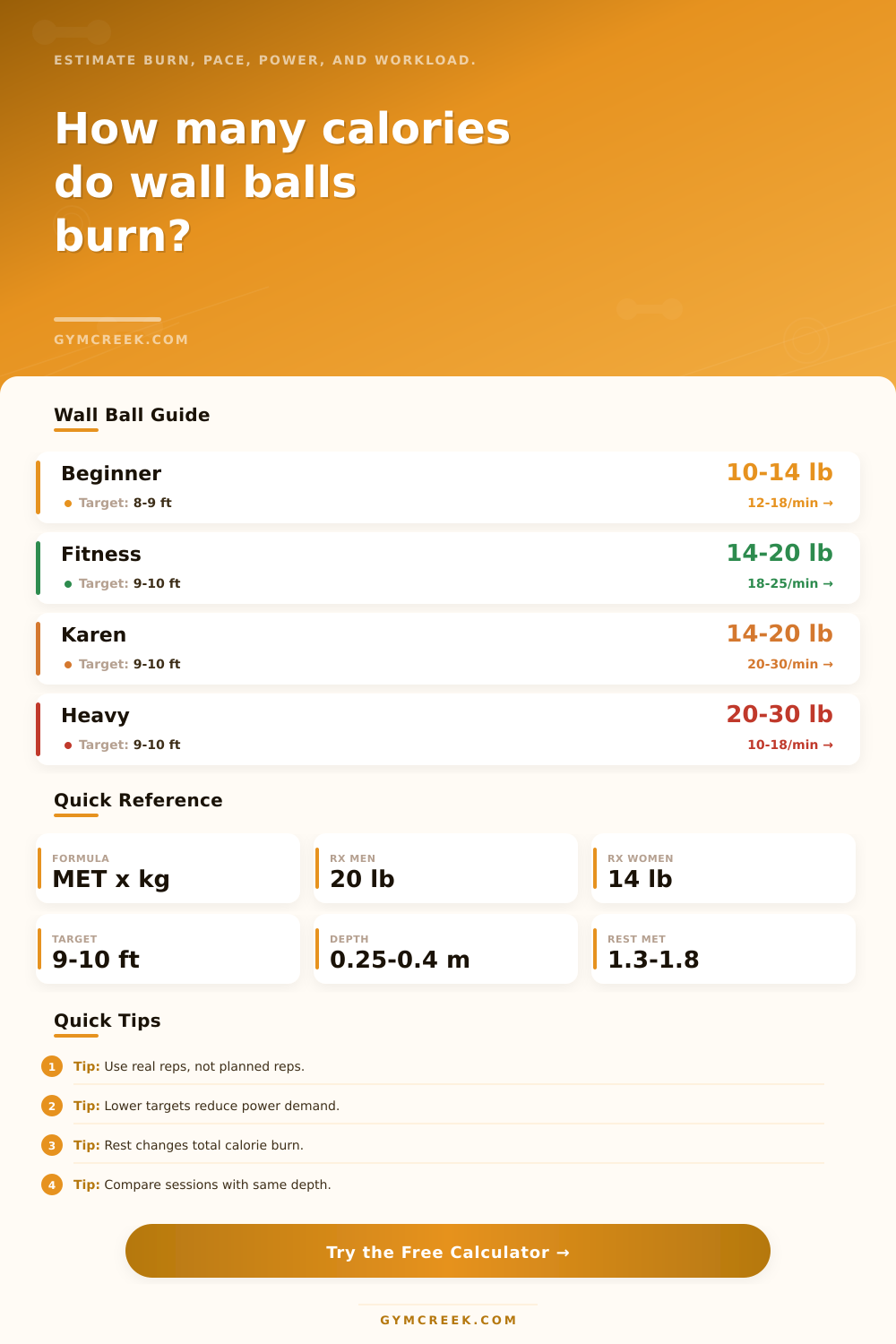
| Beginner technique | 10-14 lb | 8-9 ft | 12-18 reps/min |
| General fitness | 14-20 lb | 9-10 ft | 18-25 reps/min |
| Karen-style volume | 14-20 lb | 9-10 ft | 20-30 reps/min |
| Heavy wall balls | 20-30 lb | 9-10 ft | 10-18 reps/min |
| Squat Depth | Approx Travel | Demand | Use When |
|---|---|---|---|
| Quarter squat | 0.16 m | Low | Skill warmups |
| Half squat | 0.24 m | Moderate | Fast intervals |
| Parallel squat | 0.32 m | High | Standard reps |
| Deep squat | 0.40 m | Very high | Strict full range |
| Pace Zone | Reps/Min | MET Range | Training Signal |
|---|---|---|---|
| Technique | 10-16 | 5.5-7.0 | Skill quality |
| Steady | 17-24 | 7.0-9.0 | Conditioning |
| Hard | 25-32 | 9.0-11.5 | Metcon pace |
| Race | 33+ | 11.5-14.5 | Peak output |
| Formula | Variables | Output | Used For |
|---|---|---|---|
| MET calories | MET, kg, min | Calories | Session burn |
| Ball work | Ball, target | Joules | Throw demand |
| Squat work | Body, depth | Joules | Leg demand |
| Power | Joules, time | Watts | Pacing output |
💡Tips
A certain noise fills gym during a wall ball workout. There is a rhythmic thud as medicine ball strikes its target. And then there’s the grunt of someone rethinking their life choices.
Wall balls are an exercise that seems straightforward. Squat. Throw. Repeat. Their simplicity masks a complicated metabolic storm. When performing this move you’re doing more than simply squatting and pressing overhead; it’s a combination move incorporating both movements. This makes weight feel denser than it actualy is.
How to Calculate Calories Burned with Wall Balls
To understand how much energy it burns, you can’t just focus on what the ball weighs. Instead you must account for the throw height, squat depth and the pace at which you perform exercise, lest your heart explode. But then there’s the math, something that a human brain isn’t always great at calculating. So, rather than guessing (and potentially missing out on some coefficients), just plug in your own setup into calculator above. It will break the session down into actionables: Total calories burned + Average power output.
Why? Because most people think number of calories burned only depends upon length of time. But intensity alters all this. A high-effort conditioning set burns more then a slower paced set with a lighter ball. By using your pace as a means to adjust the metabolic equivalent, it differentiate between those two types of sets. And it accounts for resting periods. Many athlete skip this. Sure, it keeps you alive while doing the set. But it decreases your overall burn rate for the whole session. By weighing work time versus rest time, the calculator provide you with a realistic view of total energy used.
The most glaring factor is ball weight. But the silent multiplier are the target height. To throw to a ten foot line requires significantly more vertical power compared to throwing to an eight-foot mark. That’s why distance from your release point to the target line figures into calculator. Because when you’re tired, gravity is working against you. As reps start piling on, your throw height begins to decrease. It’s important that you keep the target height consistent in order to make valid comparisons over time. If you lower the target at the end of a set, then you’ve reduced mechanical work per rep. Thankfully, the tool accounts for this, so a lighter day where you lowered the target doesn’t falsely appear as productive as heavy day with full range of motion.
Another key input we often overlook when logging is squat depth. From a muscle use perspective, there’s a big difference between a deep squat and a quarter squat. The calculator uses your body mass x vertical displacement of body mass as an estimate of the amount of mechanical work. Therefore if you go deeper, your center of mass move farther, which means more work against gravity. That’s why after a deep squat wall ball workout, your glutes and quads will be sore for days. More energy required = more calories burned. It doesn’t seem like much, but it makes all the difference for accurate tracking.
Your heart rate: The calculator accounts for cardio load via pace. If you move quickly, what used to be a strength workout becomes a conditioning one. Your metabolism spikes; it demand more oxygen. To compensate, your body starts relying more on anaerobic pathways. So instead of pure calories burned, the workout now has a blend of an immediate draw down and a lasting post-exercise oxygen consumption. Push into those higher effort zones and that’s when the afterburn takes hold. You get a better picture of the total metabolic impact, including a small estimate of excess post-oxygen consumption added by the calculator.
None of this stuff requires you to become a physics professor. It’s just a way to get something out of the numbers, if you are willing to be honest: Feed the tool with an accurate account of the input. If the ball weighs 4 pounds, input 4 pounds. Don’t let hope drive your reps; input the number of real reps you actualy perform. Rest as long as you really rest. Input it honestly and you’ll get a good ballpark guess at how much work you performed.
You should of used more weight to see real gains. And then you have a benchmark against which you can measure your progress: Are you becoming more efficient? Burning more fuel? Simply getting stronger?
All you have to go on is the thud of the ball, but the story it tells you can make a huge difference. Knowing exactly what you’re buying when you break a sweat is the first step to spending it well.