Walking Calories by Weight Calculator
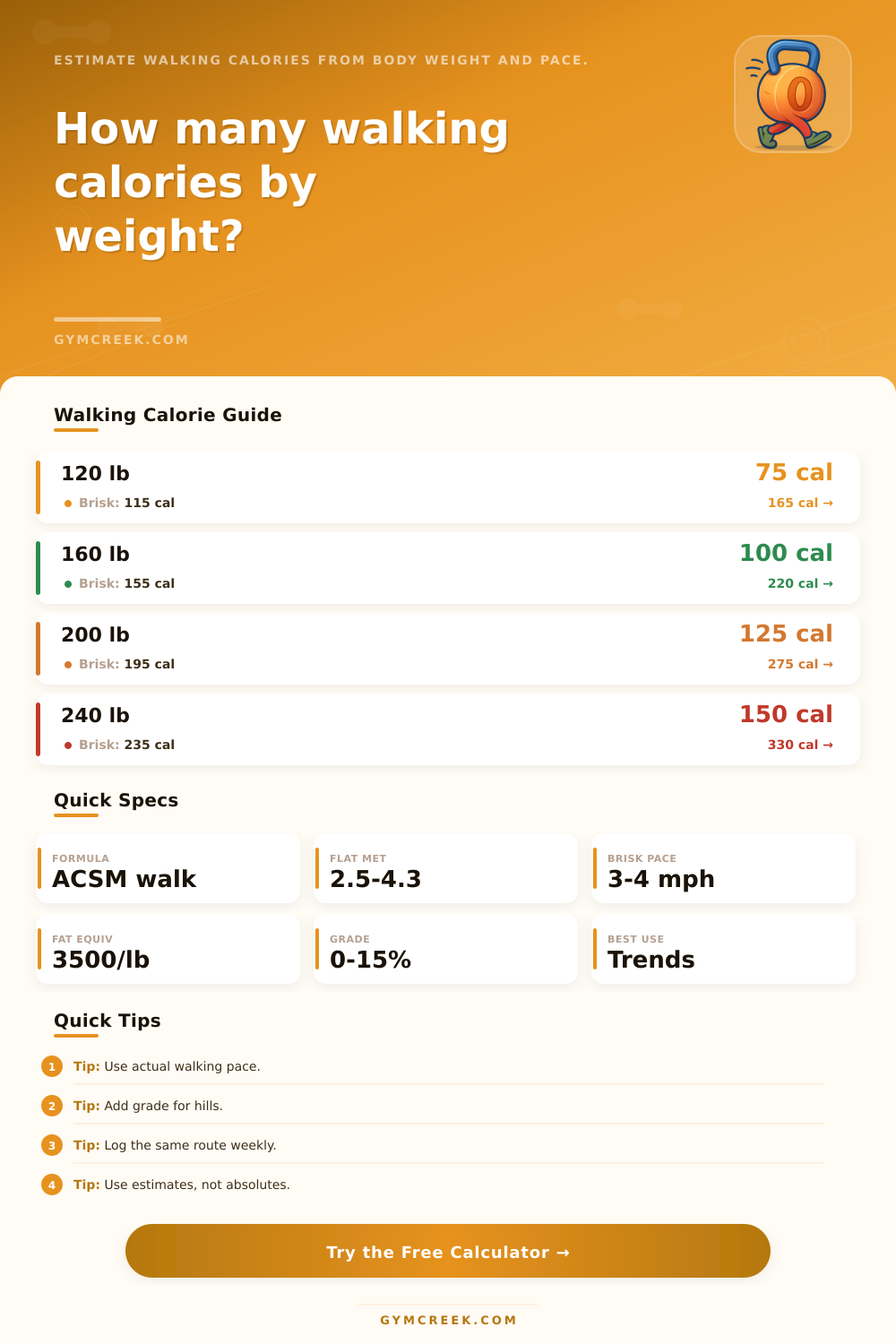
Estimate walking calories from body weight, pace, duration, grade, carried load, terrain, walking style, height, age, and weekly frequency using the ACSM walking equation.
📌Walking Presets
The core estimate uses the ACSM walking equation: VO2 = 0.1 x speed + 1.8 x speed x grade + 3.5, then converts oxygen cost to calories from body mass.
⚙Walking Inputs
Walking calories by weight snapshot
Enter weight, pace, duration, grade, surface, and weekly frequency to estimate walking energy cost.
📊Walking Metrics
📑Walking Reference Tables
| Component | Input | Factor | Effect |
|---|---|---|---|
| Body weight | --- | --- | --- |
| Body Weight | Walk Calories | Calories Per Mile | Weekly Total |
|---|---|---|---|
| --- | --- | --- | --- |
| Pace Type | Speed | Flat MET Range | Best Use |
|---|---|---|---|
| Easy stroll | 2.0-2.5 mph | 2.3-2.9 MET | Recovery, steps, beginners |
| Normal walk | 2.6-3.1 mph | 3.0-3.5 MET | Daily activity and commute |
| Brisk walk | 3.2-4.0 mph | 3.6-4.6 MET | Fitness walking and fat-loss support |
| Power walk | 4.1-5.0 mph | 4.7-6.0 MET | Conditioning, time-efficient sessions |
| Variable | Low Impact | Higher Cost | Calculator Treatment |
|---|---|---|---|
| Incline | 0-2% flat route | 6%+ sustained hill | ACSM grade term raises VO2 |
| Terrain | Treadmill, track, road | Trail, grass, sand, stairs | Surface multiplier adjusts economy |
| Carried load | 0-5% body weight | 10%+ body weight | Load adds effective moving mass |
| Walking style | Easy or normal cadence | Fitness or power walk | Style factor adjusts total calories |
💡Walking Calorie Tips
When it comes to burning calories, weight matters most Once you know how calories are calculated, the next part is walking them off directly. Because weight is the primary driver for that calculation, body-weight-based calculators provides a more accurate representation than other generic charts. While carrying things and terrain will change the overall number, weight remains at the heart of the formula.
Your body does all the work, but it doesn’t all count equally. Speed determines horizontal hardness, while vertical grade add another dimension. A slight uphill increase burn calories more then most realize. Then there’s terrain: The treadmill belt is efficient and stable. The grass or sand or undulating trail make your muscles do more work stabilizing each time you put your foot down. That eats up more energy for the same mileage. Load carried is similar. You might not feel like you’re carrying much extra, but your muscles is moving an effective weight that’s bigger.
How to Use the Walking Calculator
Frequency matters: Five walks of forty minutes will obviousy burn more then two walks of the same length. Duration matters too: four 40-minute walks burns more calories than two walks of the same length. Plug those numbers in and let calculator do the math, no more guessing at what effect a hill (or a slower pace) has on the needle.
We all get hung up on step count or distance, but frequently it’s “effort per minute” that matters most. For example, you might log 1 mile as a slow hike up-and-down some hills. Or perhaps you did a brisk walk on level ground for twice that long, burning even more. So that’s why the calculator want to know how fast and for how long you went (not just the distance), which is what affects calorie burn more. It also accounts for walking style: the more you use your upper body (like power walking with a good arm drive), the higher the energy cost compared to an easy stroll.
The larger picture is that week-to-week totals count. Whether you’re doing a fitness plan to lose fat, build an endurance base and recover from it, or whatever, the larger goal is served more by consistency within the week then by one really great workout here or there. For recovery or endurance work, we use a number that represents our “right range.” These same numbers lets us know if we’ve stayed in the right area or edged up (or down) a bit, helping us avoid pushing too hard or falling behind. To help illustrate that, the page includes some reference tables that show what happens to the same walk as your body weight creeps up or down, so you can get a sense of the impact of gradual changes without having to run a new set of numbers each week.
The calculator doesn’t take into account all of the things that real life throws at you. Your walk might cost more if you’re feeling sick to your stomach. The calculator doesn’t take into account all of the things that real life throws at you. Your walk might cost more if you’re feeling sick to your stomach. It might cost more in wind or when it’s hot out. It might cost more in wind, or heat could change how much energy it costs. All of those variables explain why we should of consider it a good estimate for our input but not an exact receipt. Walk the same route several times, when conditions is similar, and you’ll begin to notice what moves your number up/down and what barely registers.
The best habit of all is to use calculator once a week instead of every day. Plug in whatever mileage, speed, and route you actualy walked that day. See how much you burned, see how many pound of fat that equates to, then look at the running total for the week. Adjust any single variable, such as a faster pace. Maybe fewer hills? more days? You can see how it affects things over a few weeks. Little tweaks you can repeat again and again will add up quicker than big bursts of heroism now and again. That’s what makes a walking calculator a real planning tool, not just a novelty.