Waist Circumference Calculator
Screen waist size, waist-to-height ratio, waist-to-hip ratio, BMI context, and practical target waist ranges from one measurement set.
📌Presets
Each preset loads a realistic height, waist, hip, weight, and measurement setup so you can compare screening outcomes fast.
⚙Calculator
Waist screening snapshot
Enter your measurements and calculate central adiposity markers.
📊Fitness Metrics
📑Reference Tables
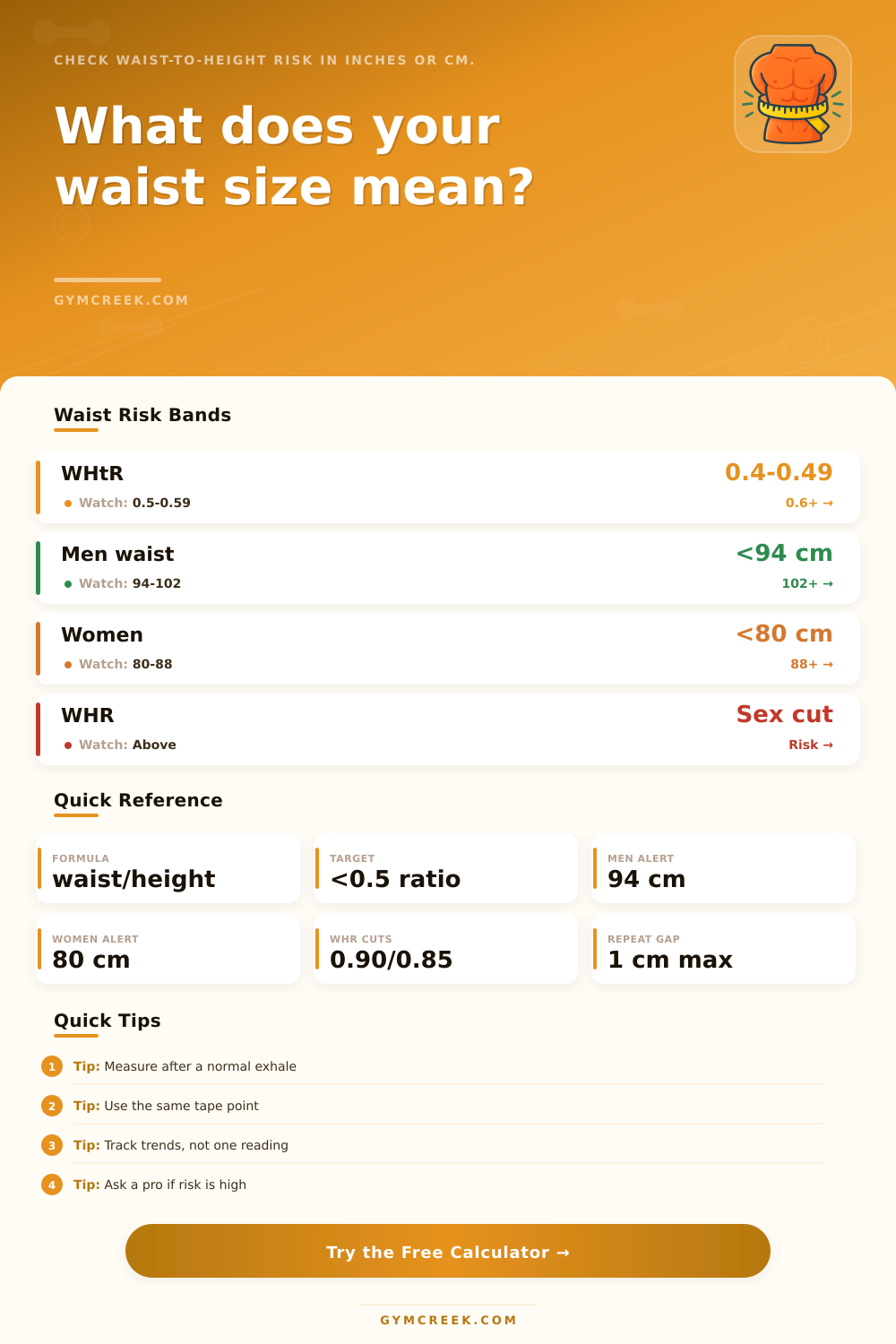
| Waist-to-height ratio | Central adiposity | Screening meaning | Action cue |
|---|---|---|---|
| Below 0.40 | Below usual range | May be low for some adults | Review context |
| 0.40 to 0.49 | Healthy range | No increased central risk flag | Track trend |
| 0.50 to 0.59 | Increased | Increased health-risk screen | Take care |
| 0.60 or more | High | Further increased risk screen | Seek advice |
| Sex | Lower risk waist | Increased risk | Substantially increased |
|---|---|---|---|
| Men | Below 94 cm / 37 in | 94 to 102 cm / 37 to 40 in | Above 102 cm / 40 in |
| Women | Below 80 cm / 31.5 in | 80 to 88 cm / 31.5 to 35 in | Above 88 cm / 35 in |
| Lower BMI risk groups | Use added caution | Men near 90 cm / women near 80 cm | Ask for individual advice |
| High muscle mass | BMI may overstate weight status | WHtR still helps screen waist size | Use body composition context |
| Waist-to-hip ratio | Men | Women | Interpretation |
|---|---|---|---|
| Lower flag | 0.90 or less | 0.85 or less | No WHR risk flag |
| Raised flag | Above 0.90 | Above 0.85 | More abdominal distribution |
| Use case | Shape context | Shape context | Adds to WHtR, not a diagnosis |
| Best practice | Repeat waist | Repeat hip | Use the same tape points |
| Measurement check | Best choice | Why it matters | Calculator flag |
|---|---|---|---|
| Waist site | Midpoint between ribs and hips | Matches common clinical protocol | Best confidence |
| Breathing | Normal exhale | Avoids bracing or sucking in | Use same state |
| Tape tension | Snug, not compressing | Loose or tight tape shifts result | Quality note |
| Repeat readings | Within 1 cm / 0.4 in | Improves trend reliability | Repeat flag |
💡Tips
People mostly obsess over numbers. They believe it’s a reflection of their value.
The flaw in this thinking: the number doesn’t differentiate between fat vs. Muscle. Your body can’t be judged by scale.
Why Waist Measurement Is Better Than Weight
One way to get a better idea of what you look like is by measuring your waist circumference. It gauges central fat (aka abdominal fat that correlates with metabolic issues). Abdominal fat lie close to internal organs. It’s visceral. Subcutaneous fat is located under the skin. Visceral fat has a greater influence on long term health results different than subcutaneous fat.
How? You can use a simple metric called waist-to-height ratio. There’s no math, and there are no charts to memorize. Enter your waist size (in inches) and height into tool above and let it calculate it for you.
Here’s how it works: Ideally your waist should be no greater than half your height. That’s true regardless of age or body type. It can help you track changes more accurately then many other metrics like BMI which lack detail.
Getting an accurate number takes proper technique. Many people trip up on this step. The measuring tape should be soft and pliable, not hard like a ruler. Position the end of the tape midway between top of your hip bone and bottom of your lowest rib. Ensure the tape is snug but not compressing any flesh. Take a normal breath out and note the number. Don’t hold your breath or suck in to get a lower number, that will throw off the measurement.
Consistency is also key. Use the same amount of tension, don’t measure at various points. Otherwise you has noise (measurement variance) instead of signal (actualy number).
For example, there’s a set of reference tables on the page with your risk band based off your gender. Those bands is based on well-established medical guidelines. Anything above eighty centimeters for women and ninety-four centimeters for men are an absolute cutoff flagging higher risk. That doesn’t mean it’s a diagnosis. Rather it’s an early warning system pointing out when to consider checking other marker such as cholesterol or blood pressure.
And then we have the waist-to-hip ratio too, another element of shape that add context beyond just height-based measures. That helps indicate whether someone has more of an apple-shape versus a pear-shape, each with its own unique metabolic meaning.
These numbers will also show trends if you track them over time. Half-an-inch doesn’t sound like much by itself. But when applied consistently week after week they’ll point to important changes within your body.
If you’re a strength athlete, you’ve likely seen the standard BMI charts categorize you as “overweight.” That can cause undue stress for people who is very muscular. In such cases, the waist-to-height ratio are more accurate. It removes the weight element from the equation and instead considers only size of your waist compared to your height.
Geometry is simple. Respecting what your body is telling you matters, and understanding your waist measurement give you the power to remove the guesswork from health tracking. Fear turns into clarity when you focus on this one, central metric; this practical handle on metabolic wellness.
Step off the scale and recall that it’s not only how much weight you have but also where it lives that tell the story. The tape measure offers answers that the number alone doesn’t. It turns vague health advice into real data. You should of used this sooner.