Volume Landmarks Calculator
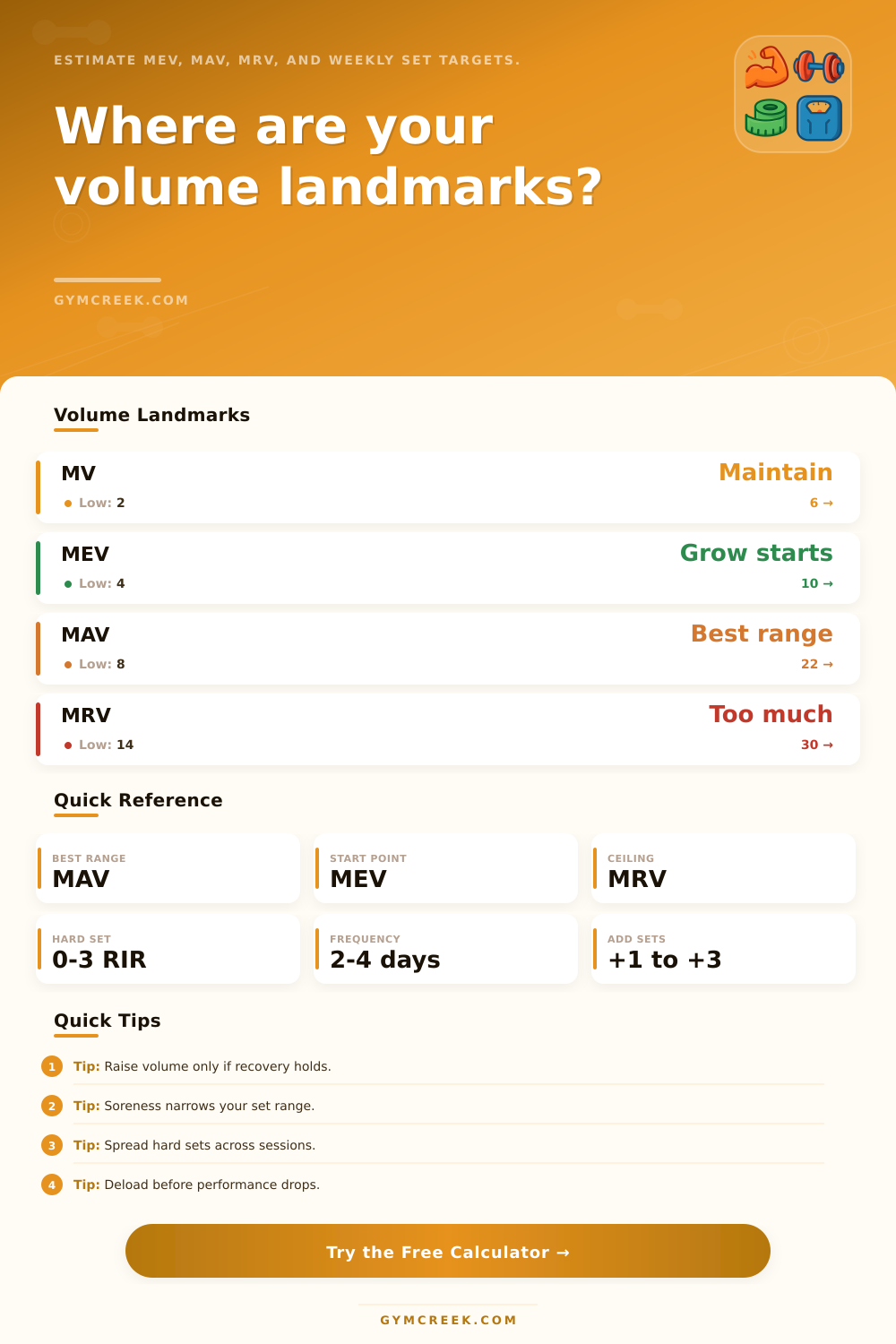
Estimate MEV, MAV, and MRV for a specific muscle using training age, recovery, sleep, stress, soreness, current sets, intensity, and frequency.
📌Presets
Each preset loads a muscle-specific volume scenario and recalculates the recovery-adjusted landmarks.
⚙Calculator
Volume landmark snapshot
Enter your current weekly sets and recovery markers to estimate a useful set range.
📊Fitness Metrics Comparison
📑Reference Tables
| Muscle | MEV | MAV | MRV |
|---|---|---|---|
| Chest | 6-8 | 10-20 | 20-24 |
| Back and lats | 8-10 | 12-22 | 24-28 |
| Quads | 6-8 | 10-18 | 18-22 |
| Hamstrings | 4-6 | 8-14 | 14-18 |
| Glutes | 4-8 | 8-18 | 18-24 |
| Side and rear delts | 6-10 | 12-24 | 24-30 |
| Biceps | 6-8 | 10-20 | 20-26 |
| Triceps | 4-8 | 8-18 | 18-24 |
| Calves | 6-10 | 12-24 | 24-30 |
| Abs | 4-8 | 8-18 | 18-24 |
| Landmark | Meaning | Training Signal | Action |
|---|---|---|---|
| MV | Maintenance volume | Holds size and skill | Use during low fatigue phases |
| MEV | Minimum effective volume | Growth can begin | Start mesocycles near here |
| MAV | Maximum adaptive volume | Best stimulus to fatigue ratio | Add sets while performance holds |
| MRV | Maximum recoverable volume | Recovery limit is near | Deload or reduce sets |
| Recovery Marker | Low Risk | Caution | MRV Effect |
|---|---|---|---|
| Sleep | 7.5-9 hours | Under 6.5 hours | Lower ceiling |
| Soreness | 0-2 of 5 | 4-5 of 5 | Trim volume |
| Stress | 1-2 of 5 | 4-5 of 5 | Reduce additions |
| RIR | 1-3 average | 0 on many sets | Fewer hard sets |
| Performance | Stable or rising | Falling | Deload soon |
| Frequency | Sets Each Day | Best Use | Watch For |
|---|---|---|---|
| 1 day | 6-12+ | Maintenance or simple splits | Late-session junk sets |
| 2 days | 4-10 | Most large muscles | Overlapping exercises |
| 3 days | 3-8 | Specialization blocks | Joint irritation |
| 4+ days | 2-6 | Delts, calves, arms, abs | Daily soreness buildup |
💡Tips
Training volume is the total amount of hard work that a muscle perform. The training volume for a muscle will determine how much that particular muscle can grow before the process of recovery becomes difficult for that muscle. If an individual perform too much training volume for they muscles, they may experience stalled lifts or soreness in there muscles.
However, if an individual can maintain the correct training volume for their muscles, they will experience muscle growth. Training volume is not just a number in the spreadsheet of training log that an individual may keep. Rather, training volume is a measurement of the amount of stimulus that a muscle can take before the body is unable to recover from that stimulus.
How to Find the Right Training Volume
The training age of an individual can play a major role in the amount of training volume that an individual can use with their muscles. For instance, a beginner can grow from a small amount of training volume because there body is not used to the stimulus of that training volume. An intermediate lifter will require more training volume than a beginner but will fatigue more easily if they go past a specific limit of training volume.
An advanced athlete can have there training volume very narrow because any increase in training volume will have the potential to overreach their muscle. Calculators can help an individual to determine their correct training volume by inputting their training age, the number of sets that they can currently perform, and their markers of recovery to determine how to adjust their training volume to improve their results. Recovery is a much more complex process than just the number of hour that an individual sleeps.
Beyond sleep, there are other factor that contribute to the recovery of an individuals muscles. For instance, recovery also includes the quality of the sleep that an individual gets, the amount of stress that they experience in their lives, and the level of soreness in their target muscle. If an individual sleeps less than seven hours for several nights, the training volume that once provided great result for that individual will become difficult to recover from.
High levels of life stress will also impact the ability of an individual to recover from the training that they perform. If an individual gets low levels of sleep or experiences high levels of stress in their life, their capacity for the training volume that they perform will decrease. Thus, these factor all need to be monitored because they will impact the training volume that an individual can handle.
The frequency that an individual trains is the number of training sessions that an individual uses to complete the training volume that they perform each week. The frequency with which an individual performs their training will impact the quality of the training volume that they perform. If an individual spreads their training volume into more training session, they are more likely to improve the quality of the training that they perform into each session.
For instance, if an individual can perform twelve sets of a certain exercise in one session, it is more likely that they can perform fifteen if those set are spread across three or four training sessions. An individual may also reduce the irritation of their joint if they spread their training volume into more training sessions. Additionally, spreading training volume into more sessions can improve the quality of the muscle contraction.
The calculator will adjust the target training volume if an individual change the number of training sessions that they perform. The training volume calculator will output a range of number for an individual. The first range will be the minimum training volume that an individual should have to experience muscle growth.
The second range will be the productive zone for that individual wherein their training volume will produce muscle growth without causing fatigue. The third range is the upper limit to the training volume that an individual can perform without their body being able to recover from the training. If an individuals training volume is currently at the top of the productive zone for their muscles, but their lift have stalled, they should of hold their training volume or decrease the training volume that they place into their muscles.
However, if an individuals training volume is below the productive zone, they can increase their training volume for their muscles to increase the size of those muscle. There are a few mistake that many individuals make when it comes to the recovery process. For instance, many individuals use the level of soreness that they feel in their muscles as the only way to monitor their recovery.
However, their muscles may not feel sore, but their body may still be struggling to recover due to poor sleep or high level of life stress. Additionally, many individuals will gradually increase their training volume each training week. However, their result may not be linear, and their body may need a week of lower training volume to allow their muscles to adapt to the increased training volume.
Thus, their performance trend will help to show whether their training volume is too high for their body. Incorporating each of these factor into an individuals training routine will allow that individual to truly understand the role that each factor play in muscle growth. To effectively use the training volume calculator, an individual must accept that training volume will be a range for that individual.
Their training volume should only be adjusted based on their recovery marker and performance trends. An individual should aim to train within the productive zone for their muscles because training within this range will allow for the best long-term growth in their muscles. However, an individual should never push their training volume to the limit of their recovery because this will prevent their body from being able to adapt to the training stimulus that they are placing into their muscles.