Volleyball Calorie Calculator
Estimate volleyball calories from indoor or beach play, position demands, match duration, rally count, rest ratio, jumps, approaches, and body weight using MET-based logic.
📌Presets
Presets load realistic volleyball scenarios and recalculate the estimate immediately.
⚙Calculator
Volleyball calorie snapshot
Enter court time, rallies, jumps, and rest ratio to estimate volleyball calories.
📊Fitness Metrics
🧮Formula Cards
Calories per minute = MET x 3.5 x body weight in kg / 200. The calculator applies this to active volleyball time and rest time separately.
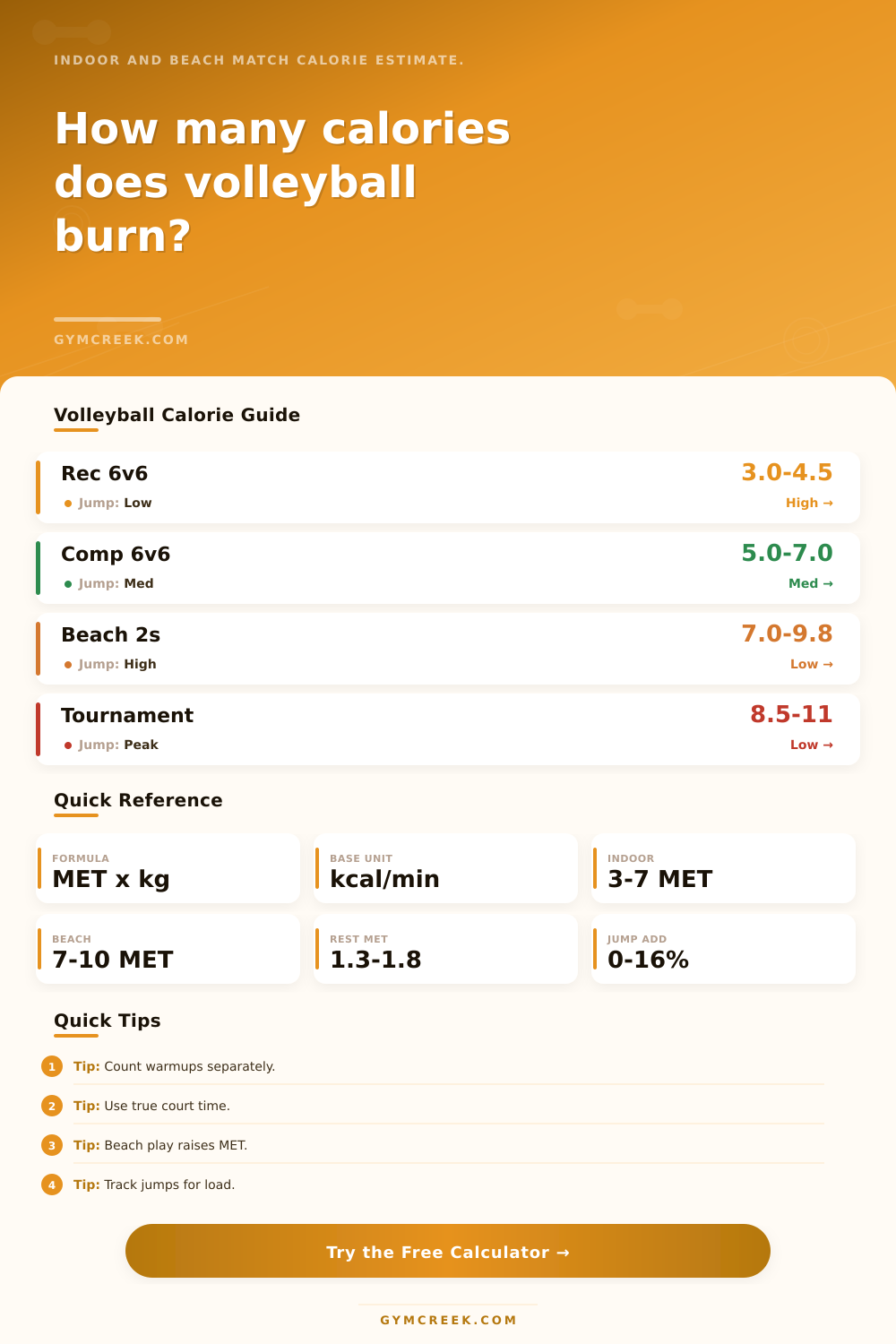
Indoor recreational, indoor competitive, drills, beach doubles, and tournament blocks start from different base MET values before modifiers are added.
Rally density, total jumps, attack approaches, defensive load, serve load, and position demand adjust the active MET estimate within a controlled range.
Mifflin-St Jeor estimates BMR from age, sex, weight, and height, then the selected activity multiplier gives a TDEE comparison.
📑Reference Tables
| Volleyball Type | Light | Moderate | Hard |
|---|---|---|---|
| Indoor recreational 6v6 | 3.0 MET | 4.0 MET | 4.8 MET |
| Indoor competitive 6v6 | 4.5 MET | 6.0 MET | 7.2 MET |
| Indoor drill session | 3.8 MET | 5.2 MET | 6.5 MET |
| Beach recreational doubles | 6.0 MET | 7.4 MET | 8.6 MET |
| Beach competitive doubles | 7.2 MET | 8.8 MET | 10.2 MET |
| Position | Load Pattern | Modifier | Best Input |
|---|---|---|---|
| Libero or DS | Digs and coverage | 0.96x | Defense high |
| Setter | Transitions and sets | 1.00x | Jumps moderate |
| Outside hitter | Pass and attack | 1.06x | Approaches high |
| Middle blocker | Repeated blocks | 1.09x | Jumps high |
| Beach all-around | Every-skill load | 1.12x | Rest ratio low |
| Scenario | Duration | Rest Ratio | Typical Load |
|---|---|---|---|
| Rec gym night | 60-90 min | 45-65% | Low-moderate |
| League match | 75-120 min | 35-50% | Moderate |
| Beach doubles | 45-80 min | 25-40% | High |
| Tournament block | 120-240 min | 30-55% | Mixed fatigue |
| Formula | Variables | Output | When Used |
|---|---|---|---|
| MET kcal | MET, kg, min | Calories | Main estimate |
| Active split | Duration, rest | Work min | Court rhythm |
| Rally density | Rallies, sec | Modifier | Pace check |
| Mifflin BMR | kg, cm, age | Baseline | Daily context |
💡Tips
Your body is running a complicated metabolic engine on the court, and each time you sprint, jump, and dive that engine shifts gears. You might think volleyball’s a simple game, standing around waiting for the serve makes it look like a casual sport from the sidelines. But as soon as the ball is in play, there’s a steep price paid internally. It’s easy to underestimate how much energy is used during those bursts of movement most people make.
Because of their intensity, a typical fitness tracker can’t accurately measure how hard you’re burning during a competitive match. That’s where the calculator comes into play (above). All you have to do is enter type of court you play on and its corresponding rally density to save yourself from guessing calorie cost of any given dig or block.
How Volleyball Burns Calories
At the center of this equation is something called METs, which stand for metabolic equivalents. It’s a way to quantify how hard you’re working compared to your restful state. There’s a huge range indoors, from recreational games where you shuffle feet around to tournaments where you explode off the floor. When playing recreationally, there will be long periods between points. During those times when ball is dead, your heart rate will slow down a lot.
Playing competitively, however, keep your heart rate elevated since the rallies last longer and transition time is shorter. Getting the pauses right matter. Even if your bursts are intense, they’ll get watered down by the pauses.
Intensity + Position = Metabolic Efficiency
Different positions requires different energy systems, which means that both has an impact on metabolic efficiency. For example, you’re burning calories with every dig on the floor and lateral movement throughout the entire match if you are a libero. That’s low-intensity, constant cardio.
If you play middle blocker, you makes lots of short, explosive jumps. Each jump spikes your heart rate momentarily before it drop back down on the reset. The tool recognizes this difference and applies modifiers to your base MET value. Jumping repeatedly uses energy different than running long distances. Choose the position that best aligns with your actual movement patterns (not simply what jersey title you wear).
The sand creates additional resistance with each jump and step that is part of the game. Jumping up and down on sand is also much more strenuous than jumping in a gym or anywhere else with a hard surface. Because there’s no footwear, you have to create all of your momentum based off unsteady footing. As your body moves, your muscles must work even harder to both push yourself forward and stay upright. If you’ve been playing indoors before hopping outside onto some sand, you’ll feel the soreness instanty.
That’s why we use higher base MET values for beach scenarios. This recognize how much more physical work your leg muscle do to move around.
The most misunderstood of all inputs is probably the rest ratio because it is a direct contributor to the overall total. For example, if you’re standing up or sitting on the bench with half your time on the clock, you’ll have a lower average burn rate (even though you might be kicking butt when you’re moving). Your true burn will be higher than what you input if you think that you’re always burning at full bore and then stand around during timeouts. That’s where accurately plugging in your real rest percentage makes all the difference.
You shouldn’t of overestimate your burn rate, and this table on the page makes clear how rest time lowers your effective METs for the duration of the workout. And lastly think about what you do when it comes to attacking and jump volume. These are high cost movements that layer on top of baseline movement. By tracking them we can further refine estimate. We go from a generic number to one that is specific to you.
It isn’t just about playing for a certain duration, but also how hard you play at those times that matter. By understanding these factors, we have a clearer picture of our physical output. We begin to view the sport less like a game and more as a series of physical demands we need to measure. This change in perspective allows us to recover better and train smarter. Next time you’re done with a match you’ll know exactly where you put your energy.