❤️ VO2 Max Calculator
Estimate your aerobic fitness using your resting heart rate — no lab test required
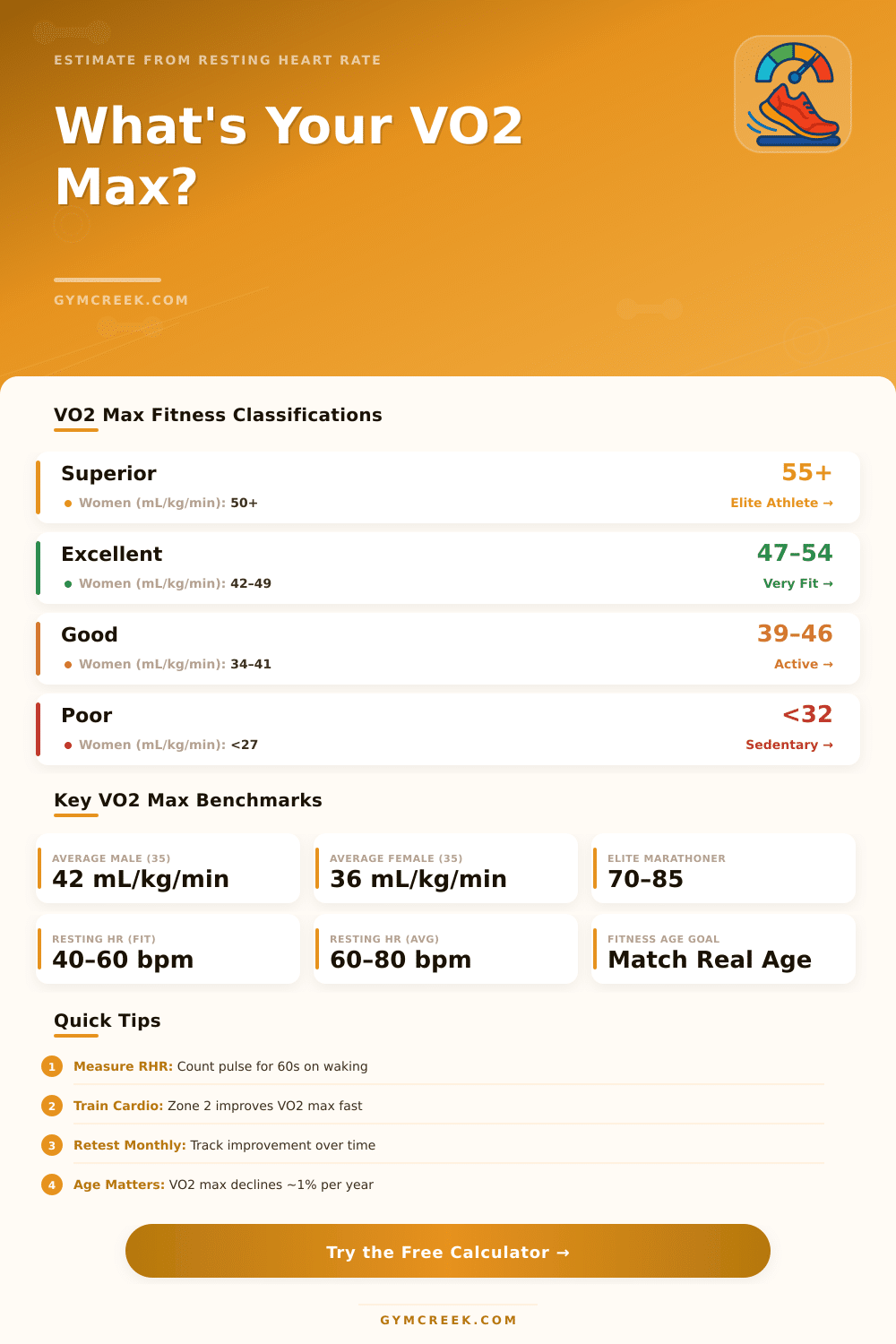
| Category | Age Group | Men (mL/kg/min) | Women (mL/kg/min) |
|---|---|---|---|
| Superior | 20–29 | ≥55.4 | ≥49.6 |
| Excellent | 20–29 | 51.1–55.3 | 45.2–49.5 |
| Good | 20–29 | 45.4–51.0 | 39.5–45.1 |
| Fair | 20–29 | 41.7–45.3 | 35.5–39.4 |
| Poor | 20–29 | ≤41.6 | ≤35.4 |
| Superior | 40–49 | ≥48.2 | ≥43.3 |
| Excellent | 40–49 | 44.1–48.1 | 39.5–43.2 |
| Good | 40–49 | 39.9–44.0 | 35.5–39.4 |
| Fair | 40–49 | 36.7–39.8 | 31.6–35.4 |
| Poor | 40–49 | ≤36.6 | ≤31.5 |
| Superior | 60–69 | ≥36.4 | ≥31.4 |
| Good | 60–69 | 30.9–36.3 | 26.6–31.3 |
| Poor | 60–69 | ≤26.0 | ≤22.7 |
| Fitness Level | RHR (Men) | RHR (Women) | Interpretation |
|---|---|---|---|
| Athlete | 40–50 bpm | 42–53 bpm | Exceptional cardio fitness |
| Excellent | 51–58 bpm | 54–60 bpm | Very good heart efficiency |
| Good | 59–65 bpm | 61–67 bpm | Above average fitness |
| Above Average | 66–69 bpm | 68–72 bpm | Moderate cardio health |
| Average | 70–73 bpm | 73–75 bpm | Normal population range |
| Below Average | 74–81 bpm | 76–83 bpm | Room for improvement |
| Poor | 82–89 bpm | 84–91 bpm | Low aerobic fitness |
| Very Poor | 90+ bpm | 92+ bpm | Consult a physician |
| Zone | % Max HR | Purpose | VO2 Max % Used |
|---|---|---|---|
| Zone 1 — Recovery | 50–60% | Active recovery, warm-up | ~45–55% |
| Zone 2 — Aerobic Base | 60–70% | Fat burning, endurance base | ~55–65% |
| Zone 3 — Tempo | 70–80% | Aerobic capacity, marathon pace | ~65–80% |
| Zone 4 — Threshold | 80–90% | Lactate threshold, race pace | ~80–95% |
| Zone 5 — VO2 Max | 90–100% | Max aerobic power, intervals | ~95–100% |
VO2 max is the biggest amount of oxygen that the body is able to take and use during hard exercise. The words in the name clear up quite easily. “V” means volume, “O2” means oxygen, and “max” means the highest.
DISCLOSURE: This post may contain affiliate links, meaning when you click the links and make a purchase, I receive a commission. As an Amazon Associate I earn from qualifying purchases.

Think of it like the power of a car. It measures the ability of the body to use oxygen when one exercises. With a higher value, the body takes more oxygen and works better in aerobic activities.
What is VO2 max?
One considers it widely the most reliable sign of heart fitness and aerobic endurance. With more oxygen that folk uses during exercise, they feel less tired and can last more long. High VO2 max shows that the body well takes oxygen from the air and moves it to the muscles.
VO2 max shows how well the heart pumps blood to the muscles and how well they pull oxygen from the flowing blood. When oxygen enters through breathing, it starts chemical processes in the muscle cells that deliver energy. Two main factors affect VO2 max: the heart output and the oxygen capture of working muscles.
The heart output depends on the stroke volume and the highest heart rate.
The most reliable way to measure VO2 max happens in a lab. The subject wears a mask or tube, connected to a device that measures oxygen, while one does exercises on a treadmill, fixed bike or rower. Outside of the lab, the Cooper-test offers easier access.
Here one runs or walks at the biggest speed during exactly 12 minutes, and the covered distance relates to VO2 max. Many trainers also try to measure it through heart rate and exercise data, although such calculations sometimes err.
VO2 max is measured in milliliters of oxygen per kilo of body weight per minute. A value around 57 ml/kg is considered good, but it only enters the range of top-level sports. Genetics play a big part in its setting, together with the build of the body.
It is possible too improve VO2 max. Training with high intensity in intervals is among the most effective ways for it to grow. Typical intervals last from one to six minutes with same times for work and rest, and one considers that training for VO2 max. Mixing intensities helps also. Training in zone 2 can help it grow.
Even so, too much work for VO2 max can leave folk overtrained and in ongoing acidosis. It is fitness that one gets quickly and loses just as quickly.
When VO2 max grows, the resting heart rate usually drops. At the same effort level, the normal heart reading is lower. The highest heart rate drops by 0.6 to 0.8 beats per minute per year during aging.
Older adults that trained at home during nine months to a year on average improved their VO2 max by 20 percent. Even so, VO2 max is only one part of the puzzle about endurance. The aerobic threshold and the lactate thresholdspeed stay better signs of real activity.