🏃 VO2 Max Calculator — 1.5 Mile Run Test
Estimate your aerobic fitness and VO2 max from your 1.5 mile run time
ml O₂/kg/min — Cooper Institute norms
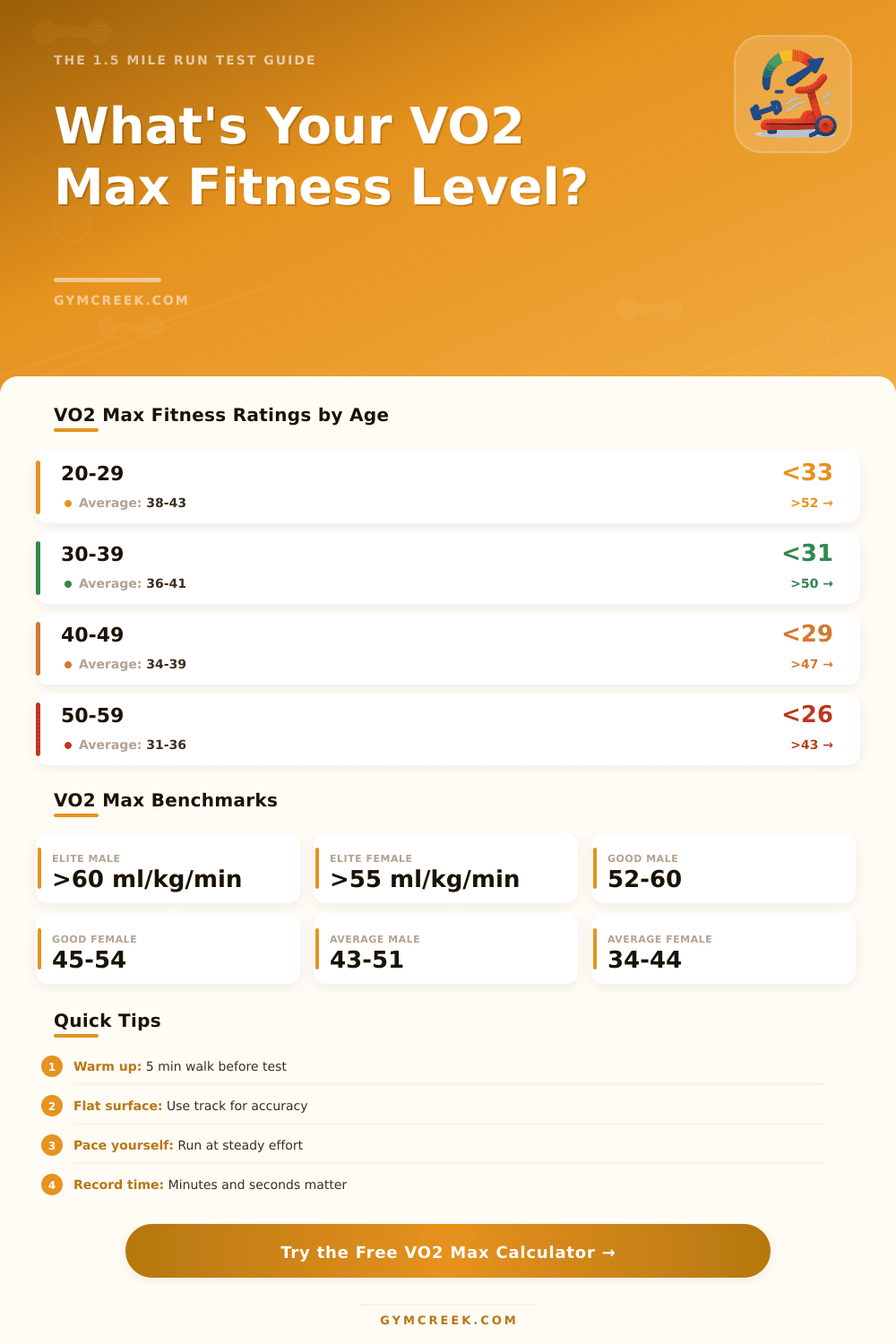
| Age Group | Very Poor | Poor | Fair | Good | Excellent | Superior |
|---|---|---|---|---|---|---|
| MALES | ||||||
| 13–19 | <35.0 | 35.0–38.3 | 38.4–45.1 | 45.2–50.9 | 51.0–55.9 | ≥56.0 |
| 20–29 | <33.0 | 33.0–36.4 | 36.5–42.4 | 42.5–46.4 | 46.5–52.4 | ≥52.5 |
| 30–39 | <31.5 | 31.5–35.4 | 35.5–40.9 | 41.0–44.9 | 45.0–49.4 | ≥49.5 |
| 40–49 | <30.2 | 30.2–33.5 | 33.6–38.9 | 39.0–43.7 | 43.8–48.0 | ≥48.1 |
| 50–59 | <26.1 | 26.1–30.9 | 31.0–35.7 | 35.8–40.9 | 41.0–45.3 | ≥45.4 |
| 60+ | <20.5 | 20.5–26.0 | 26.1–32.2 | 32.3–36.4 | 36.5–44.2 | ≥44.3 |
| FEMALES | ||||||
| 13–19 | <25.0 | 25.0–30.9 | 31.0–34.9 | 35.0–38.9 | 39.0–41.9 | ≥42.0 |
| 20–29 | <23.6 | 23.6–28.9 | 29.0–32.9 | 33.0–36.9 | 37.0–41.0 | ≥41.1 |
| 30–39 | <22.8 | 22.8–26.9 | 27.0–31.4 | 31.5–35.6 | 35.7–40.0 | ≥40.1 |
| 40–49 | <21.0 | 21.0–24.4 | 24.5–28.9 | 29.0–32.8 | 32.9–36.9 | ≥37.0 |
| 50–59 | <20.2 | 20.2–22.7 | 22.8–26.9 | 27.0–31.4 | 31.5–35.7 | ≥35.8 |
| 60+ | <17.5 | 17.5–20.1 | 20.2–24.4 | 24.5–30.2 | 30.3–31.4 | ≥31.5 |
Based on percentage of max heart rate (MHR = 220 – Age)
| Zone | Name | % Max HR | Training Effect | Perceived Effort |
|---|---|---|---|---|
| Zone 1 | Recovery | 50–60% | Active recovery, warm-up | Very easy, can sing |
| Zone 2 | Aerobic Base | 60–70% | Fat burning, base building | Easy, can hold conversation |
| Zone 3 | Aerobic | 70–80% | Improve aerobic capacity | Moderate, short sentences only |
| Zone 4 | Threshold | 80–90% | Raise lactate threshold | Hard, can barely speak |
| Zone 5 | VO2 Max | 90–100% | Max aerobic power | Max effort, cannot speak |
DISCLOSURE: This post may contain affiliate links, meaning when you click the links and make a purchase, I receive a commission. As an Amazon Associate I earn from qualifying purchases.

Reference chart for adult males (20–40 yrs). Female values are typically 10–15% lower.
| 1.5 Mile Time | Est. VO2 Max (ml/kg/min) | Fitness Category | Equivalent Pace/Mile |
|---|---|---|---|
| Under 8:00 | ≥60 | Superior / Elite | Under 5:20/mile |
| 8:00–9:30 | 52–59 | Excellent | 5:20–6:20/mile |
| 9:31–10:30 | 47–51 | Good | 6:21–7:00/mile |
| 10:31–11:30 | 43–46 | Above Average | 7:01–7:40/mile |
| 11:31–12:30 | 39–42 | Average | 7:41–8:20/mile |
| 12:31–14:00 | 34–38 | Fair | 8:21–9:20/mile |
| 14:01–16:00 | 28–33 | Poor | 9:21–10:40/mile |
| Over 16:00 | <28 | Very Poor | Over 10:40/mile |
VO2 max is the biggest amount of oxygen that the body can use during physical effort. Think of it like the horsepower in a car. It measures the ability of the body to use oxygen during exercise.
The words in the name come from “V” for amount, “O2” for oxygen and “max” for biggest.
What is VO2 max and how to improve it
It measures the main score for heart and lung function together with oxygen use. The more oxygen someone can process during movement, the easier workouts will feel and the longer one can keep the activity. Also VO2 max shows that the body grabs oxygen from the air and moves it to the muscles.
VO2 max shows how well the heart pumps blood to the muscles and how well those muscles pull oxygen from the blood. When one breathes oxygen, it starts chemical processes in the muscle cells. The value is shown in milliliters of oxygen for every kilo of weight for one minute.
Top athletes, like swimmers, cyclists, runners and cross-country skiers, commonly mention it.
The most reliable way to measure it is a lab test. Athletes do maximum effort on a treadmill, still bike or rowing machine, wearing a mask or tube bound to a device for reading breath. There are aslo easier ways.
In the Cooper test one runs or walks as quickly as possible during exactly 12 minutes, and the covered distance relates to VO2 max.
Watches and training apps can also guess it, though not always right. Their methods use data about weight, age, speed and pulse to do the calculation. When one reaches the same effort level with a lower pulse, that suggests a better rating of VO2 max.
Genetics plays a lead role in VO2 max. Still almost every person can improve it through quite a lot of hard exercise. One of the most useful ways to boost it is high-intensity interval training. Typical intervals last from one to six minutes with equal periods of work and pause, and they are seen as ideal four VO2 max. Also zone 2 training is useful.
For instance, one person improved his VO2 max from 43 to 49 during six months through zone 2 exercise. Changing the intensity at the start can also raise it.
When VO2 max grows, the resting pulse usually drops. During exercise at the same effort, the average pulse should be lower. Still VO2 max is easily gained through training, but also quickly lost.
Too much of it can leave the body overloaded. It does need high intensity.
Still VO2 max does not describe the whole picture. The speed at oxygen threshold and lactate threshold better predicts top performance, because they measure several factors, not only one. The maximum pulse drops by 0.6 to 0.8 beats per minute each year because of aging.
Previously untrained older adults, after nine months to a year of exercise, improved theirVO2 max on average by 20 percent, regardless of sex.