Vertical Leap Calculator
Estimate vertical jump height, peak power, flight time, takeoff speed, reach gap, and sport target progress from jump test measurements.
📌Presets
Presets load realistic jump test setups with reach, touch height, flight time, body weight, sport target, and strength context. Edit any field after loading.
⚙Calculator
Vertical leap snapshot
Enter jump test measurements to calculate vertical leap and power context.
📊Fitness Metrics
📑Reference Tables
| Jump height | General reading | Court sport context | Retest rhythm |
|---|---|---|---|
| <12 in / <30 cm | Developing base | Technique and strength floor | Every 2 weeks |
| 12-20 in / 30-51 cm | Recreational range | Useful for general sport | Every 2-4 weeks |
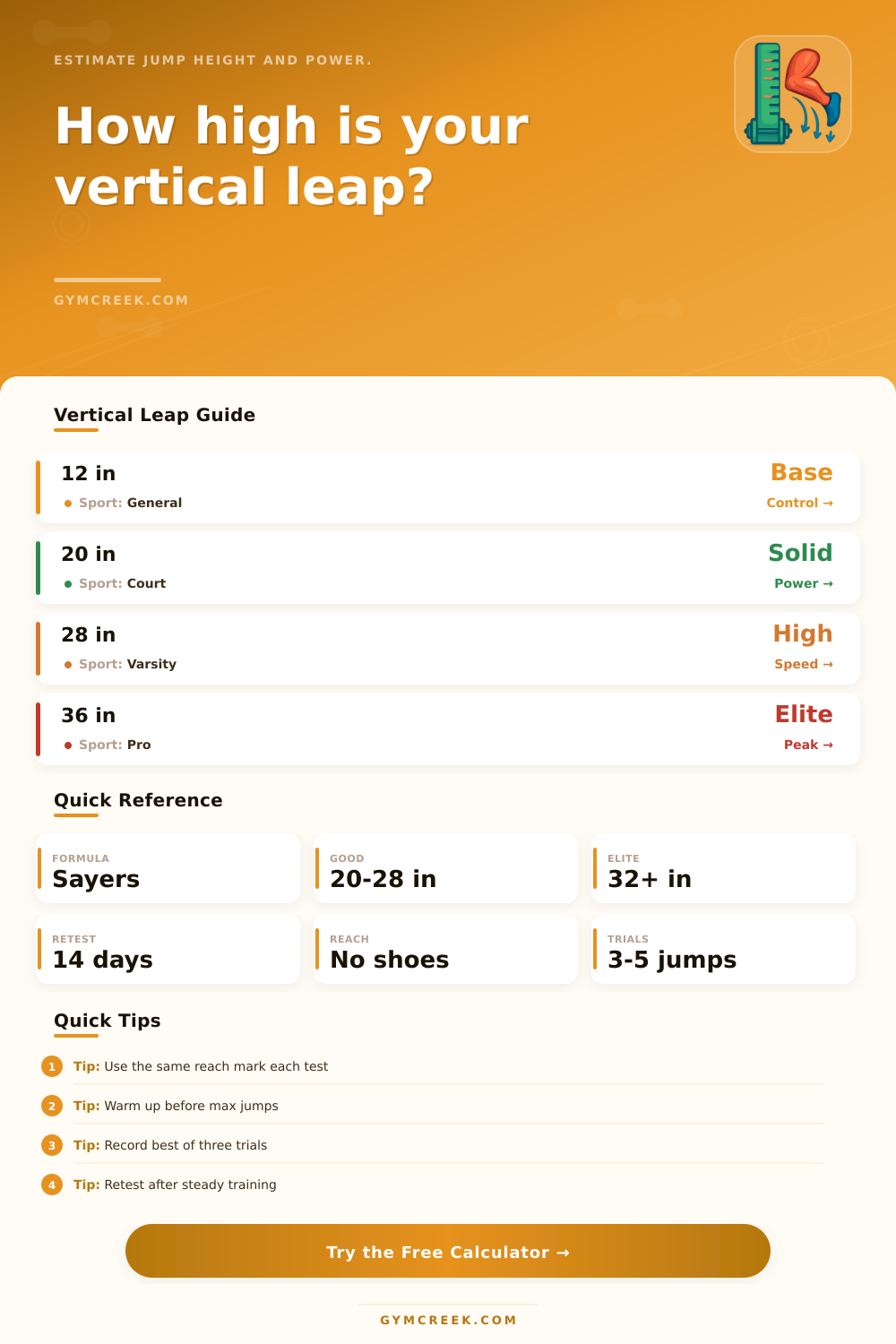
| 20-28 in / 51-71 cm | Solid athletic range | Competitive school and club | Every 3-4 weeks |
| 28-36 in / 71-91 cm | High performance | Advanced court and field sport | Monthly trend |
| 36+ in / 91+ cm | Elite expression | Exceptional explosive output | Monthly trend |
| Sport focus | Solid target | Advanced target | What the calculator checks |
|---|---|---|---|
| General fitness | 18 in / 46 cm | 26 in / 66 cm | Jump height and repeatable testing |
| Basketball | 24 in / 61 cm | 32 in / 81 cm | Reach gap for rim and touch goals |
| Volleyball | 22 in / 56 cm | 30 in / 76 cm | Standing and approach jump context |
| Football combine | 28 in / 71 cm | 36 in / 91 cm | Explosive power per body weight |
| Soccer | 20 in / 51 cm | 28 in / 71 cm | Takeoff speed and body control |
| Track and field | 26 in / 66 cm | 34 in / 86 cm | Elastic output and power ceiling |
| Formula | Purpose | Inputs | Best use |
|---|---|---|---|
| Touch minus reach | Jump height | Standing reach, highest touch | Wall, Vertec, rim, or board testing |
| g x t² / 8 | Flight-time height | Flight time in seconds | Jump mat or validated app timing |
| Sayers peak power | Peak watts | Jump cm, body mass kg | Comparing explosive output |
| sqrt(2gh) | Takeoff velocity | Jump height in meters | Speed at leaving the ground |
| Scenario | Signal | Likely limiter | Use this result |
|---|---|---|---|
| High strength, low jump | Strong squat ratio | Rate of force or technique | Watch takeoff speed |
| Low strength, fair jump | Good elasticity | Force ceiling | Watch power per kg |
| Approach above standing | Useful sport transfer | Coordination under speed | Compare styles separately |
| Flight and touch differ | Measurement spread | Timing or reach marking | Use the same method trend |
💡Tips
Measuring: Measurement provides a hint into one’s athletic potential. It sounds easy enough; however, this number tell you a lot about yourself. Think about how far you think you can jump. Chances are that our intuition fails us when it comes to explosive power.
Enter your reach and touch height into the calculator (above) and let it do all of the math for you. Skip the guesswork with conversions and physics coefficients and start paying attention to what these numbers says about your training routine.
How to Measure and Improve Your Jumping Height
Everyone thinks it’s all about having strong legs for jumping higher. But that’s only half the picture. The other half is about the rate at which your leg produce force during takeoff. When the action takes <1 second, speed trumps raw strength. An athlete who can squat twice their body weight might have a meager leap because they don't get off the ground fast enough. Meanwhile, another athlete with moderately low strength can beat them to the punch by producing force faster. The takeoff speed is one way we capture this contrast in our tool. It tells you what is limiting you: is it velocity or force?
Knowing this will point you in the right direction as you develop the proper kind of power instead of mindlessly increasing the load on the barbell. Most tests fail here, long before they start. First, take your standing reach while fully extending your arm and not wearing any shoes. Stand flat footed and make a mark at the highest point you can touch. Because little mistakes add up fast, consistency is important here. For example, if you are off by two inches on your reach mark, your ultimate jump height will be off by two inches as well. On the surface, it doesn’t sound so bad but then consider that could move you into a whole other performance band.
This is why we have the reference table on the page; it illustrates how the benchmarks change between recreational, competitive, and elite. It gives you an idea of what those bands mean. It shows how your score compare to others. It also shows how much it matters for the sport. In terms of athletic output, context matters. While jumping 28 inches is noteworthy for an average gym bunny, it may just be the norm for a competitive volleyball jumper.
To make up for these variables, the calculator takes into account the target jumps for different sports so it can tell you how much further you have to go from your current level. It also provides an estimate for peak power based off formulas developed by others, which allows you to get a measure of power relative to your own body weight. Such a measure shows your performance potential much better than absolute height. After all, generating enough force to reach the same vertical distance requires much greater effort if you weigh more versus less. Knowing this helps avoid making inaccurate judgments and setting realistic goals for your progress.
The training age also slightly affects how much you should of expect to gain early on. Because of this, beginners respond well to just being taught to move properly, which leads to rapid progress. This is referred to as an increase in stretch-shortening cycle efficiency. In other words, you’re coaching your nervous system to be able to use current strength better. As that hits a ceiling, then technical mastery starts to level off over time. Now it’s about hypertrophy and foundational strength development for continued progression. The focus shifts away from the gym floor to weight room for a while, which takes discipline and patience.
And here’s where the input of jump training age comes in; it adjusts expectations based on a timeline consistent with bodily reality versus hype. If you’re measuring progress, then you have to repeat this test under the same conditions. Make sure to take the same amount of attempts, on the same surface, with the same warmup routine every time. Fatigue will drasticly decrease performance. You’ll know how much you can do at your absolute max when you’re fresh.
Test yourself every 2-4 weeks to give yourself enough time to adapt but not lose motivation. A few data points form a trend line and smooth out the daily fluctuations of your sleep quality or energy levels. It’s far more valuable than fixating on one bad day at the gym, it’s the big picture.
At its core, however, the vertical leap is a reflection of your total athletic ability. It mirrors coordination, strength, speed and efficient nervous system function in a single, explosive display. To improve, you need to address all of those things individually, which is why improving it is a process as much as a number. It’s measured so we know our starting point and trained so that we can move away from it. Incremental improvements over time; that’s what separates standing reach from peak touch. That’s what moves us forward, one jump at a time, from potential to performance.