Velocity Based Training Load Calculator
Prescribe a bar load from exercise velocity, current 1RM, readiness, and fatigue cutoff logic.
📌Presets
Each preset fills a complete velocity profile, target goal, readiness modifier, and fatigue loss cap.
⚙Calculator
VBT prescription
Enter a 1RM and velocity reading to calculate the next working load.
📊Training Metrics
📑Reference Tables
| Goal | Velocity Range | Typical %1RM | Best Use |
|---|---|---|---|
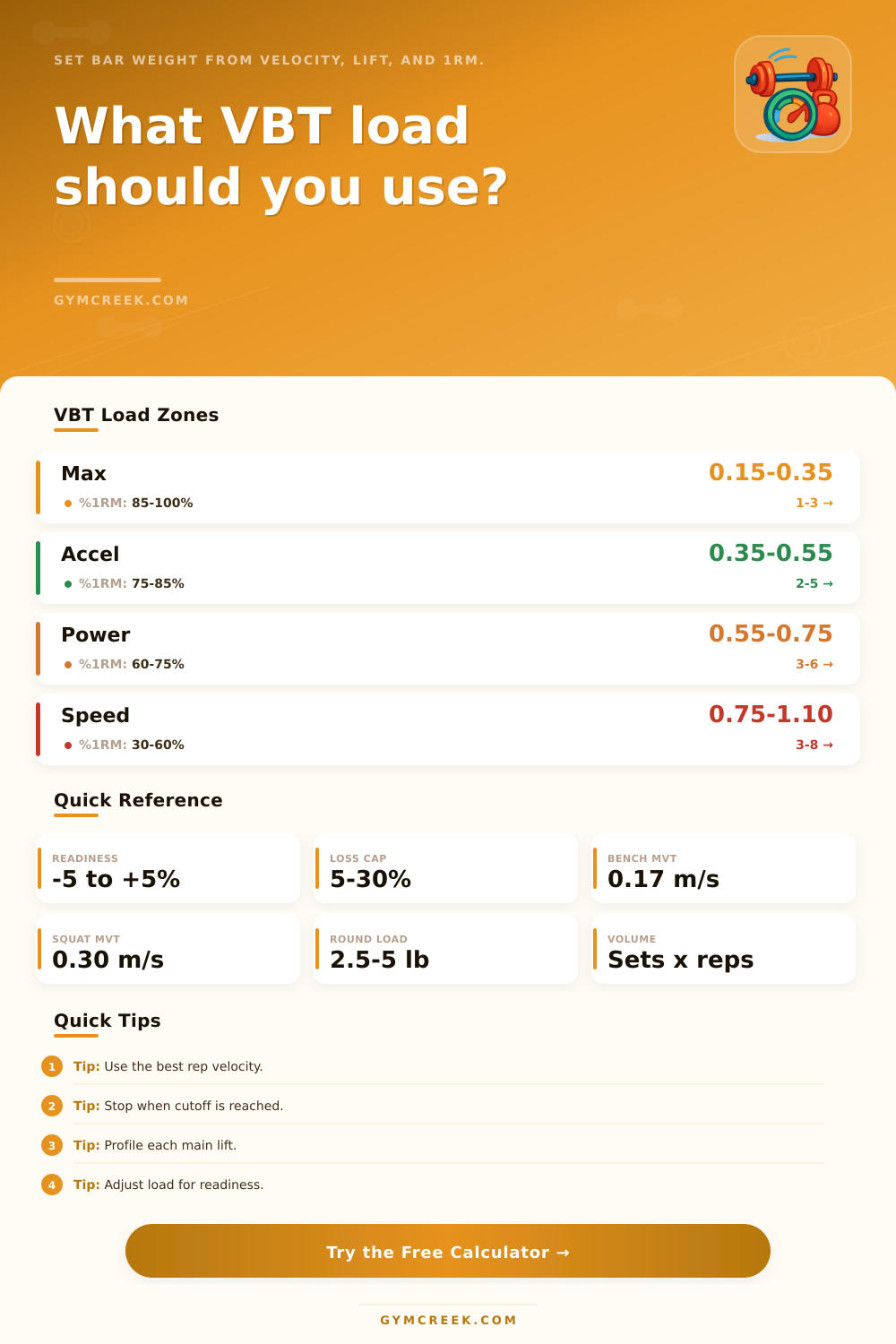
| Max strength | 0.15-0.35 m/s | 85-100% | Heavy singles and triples |
| Accelerative strength | 0.35-0.55 m/s | 75-85% | Heavy force with intent |
| Strength-speed power | 0.55-0.75 m/s | 60-75% | Power-focused strength work |
| Speed-strength | 0.75-1.10 m/s | 30-60% | Fast submaximal work |
| Technique speed | 1.00-1.30 m/s | 20-40% | Fast, crisp patterning |
| Exercise | MVT | Fast Anchor | Profile Note |
|---|---|---|---|
| Back squat | 0.30 m/s | 0.95 at 30% | Deep reps slow earlier |
| Bench press | 0.17 m/s | 0.85 at 30% | Often has lowest MVT |
| Deadlift | 0.25 m/s | 0.90 at 30% | Technique affects speed |
| Overhead press | 0.20 m/s | 0.80 at 30% | Small jumps matter |
| Olympic pull | 0.70 m/s | 1.45 at 30% | Designed for high speed |
| Velocity Loss | Set Character | Fatigue Level | Common Use |
|---|---|---|---|
| 5% | Very crisp | Low | Peaking and speed |
| 10% | High quality | Low-moderate | Strength practice |
| 20% | Moderate drop | Moderate | Hypertrophy quality |
| 30% | Large drop | High | Limited use blocks |
| Readiness Signal | Adjustment | Meaning | Action |
|---|---|---|---|
| Warmups fly | +3 to +5% | Better than normal | Add load carefully |
| Normal speed | 0% | Expected day | Use prescribed load |
| Slightly slow | -3 to -5% | Fatigue present | Trim intensity |
| Very slow | -6 to -10% | Poor readiness | Reduce or stop heavy work |
💡Tips
Lifting is all about using speed as a metric for performance and health. If your arms is slow, you’re creating fatigue rather than building strength even though you may be able to pick up two hundred pounds. Speed becomes the main measure of performance in velocity based training.
Plug in your current bar speed and your max effort and the calculator will do math for you. There’s no need to guess at conversions or coefficients. Tiredness turns into a number, a number that lets you know it’s time to stop. It’s a basic concept made difficult without numbers.
Why Speed Is Important in Lifting
There’s a clear relationship between speed and load on your body. That relationship is predictable based off your one rep max. Given what % you’re using of your 1RM, you should of have an idea how quickly you need to lift weight. The slower it moves different than what you expect, the more likely you are tired. This tool tells you what load to use given your desired velocity zone.
It determines a cutoff point. Below this point you risk compromising the work. You sacrifice quality for quantity, and that’s almost never a great way to become more athletic. The most difficult aspect of this is finding your base-line.
Each exercise have its own speed pattern. A bench press is not the same as a squat due to different range of motion and muscle groups involved. On the page is a reference table for minimal velocity values per lift type. Using squat numbers for bench press won’t cut it.
Profile your own exercises. Begin light. Do clean reps with maximal intent. Log the average upward speed from these reps. This establishes your anchor. It’s the only way to get it right, otherwise you’re shooting in the dark.
Then there’s readiness, which traditional percentage based training also fails to consider. Sometimes you walk into gym feeling ready to go. Sometimes your nerves is slow and your joints feel rusty. The calculator accounts for this daily fluctuation. Drop the intensity a little if your warmup sets are moving more slowly than normal. It’s a little tweak, but it ensures consistency over months of training while preventing injuries. You’re not bailing on your plan because you had a bad day. You’re changing the load to match what your body can handle right now.
That’s a pretty practical output; the velocity loss cap. It will tell you exactly where to quit a set. So if your target is a 10 percent loss, you’ll stop yourself just shy of technique breakdown and loss of speed. All rep are high quality. To build metabolic stress (for hypertrophy), you can pushes that limit upwards. To develop power, you’ll keep it tight. Always match the stimulus to the outcome.
It is never about doing as much work as possible. It is about doing the right amount of work to cause adaptation without breaking down. Expensive sensors aren’t required to get going. There are tons of free apps that can measure bar speed using your phone’s camera. But consistency is everything, use the exact same method each time.
The data beats your feelings. Your ego will always say, “add one more plate,” but the data shows whether your nervous system is actualy ready for it. With time, you begin to see patterns. How does your diet? Sleep? How do life stress factors affects your bar speed? It becomes a feedback loop which turns your training into something intelligent instead of just hard.
But again, lifting heavy isn’t the point. Lifting heavy fast while loaded is. This calculator allows you to find the sweet spot between intent and intensity. It eliminates the guessing component of prescription. You arrive, you test, you tweak, and you depart feeling confident. Sure, you may not lift as much as you would of on your best day, but the quality of effort will be better. This translates into strength development over time.