USA Swimming Power Point Calculator
Estimate a USA Swimming power-point style score from event, course, gender, age group, race time, base reference time, formula exponent, and standards band context.
📌Swim Score Presets
Presets are examples. Edit the event, course, time, base reference, exponent, and standard profile before using a score for planning.
⚙Calculator Inputs
Power-point estimate
Enter a race time to estimate a score.
📊Score Context
📋Reference Tables
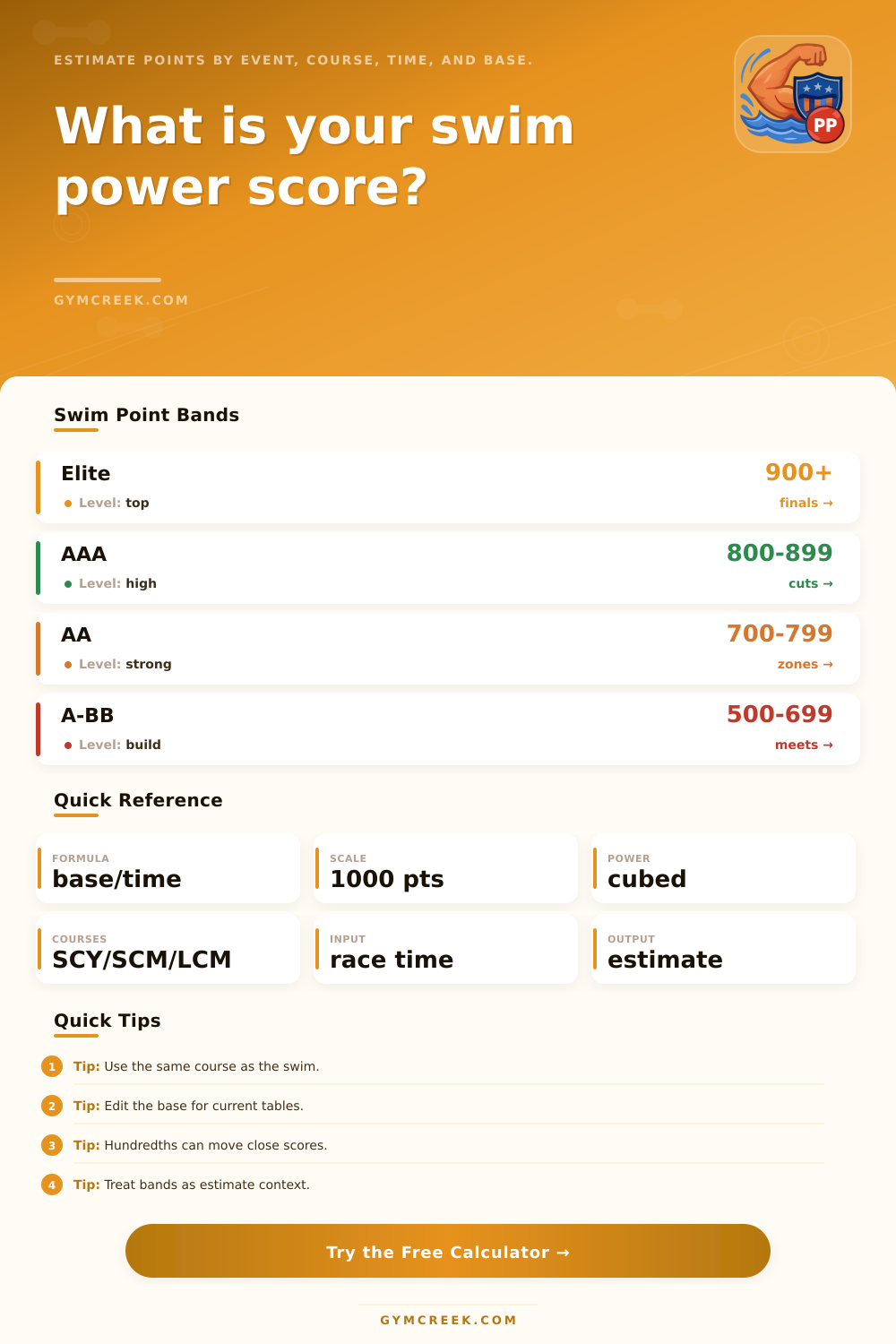
| Band | Points | Read | Use |
|---|---|---|---|
| Elite / N | 900+ | Very close to base reference | Top finals context |
| AAA | 800-899 | High-performance age-group swim | National-style planning |
| AA | 700-799 | Strong competitive swim | Zone or state context |
| A | 600-699 | Solid meet swim | State or club goals |
| BB | 500-599 | Developing competitive swim | Progress tracking |
| B / below | Under 500 | Early benchmark score | Technique and base work |
| Input | Meaning | Typical value | Effect |
|---|---|---|---|
| Swim time | Your official race mark | 0:51.75 | Faster raises points |
| Base time | Record or table reference | 0:41.64 | Faster base lowers points |
| Exponent | Curve steepness | 3.00 | Higher punishes gaps |
| Scale | Top score anchor | 1000 | Base swim equals 1000 |
| Course | SCY, SCM, or LCM | SCY | Must match the swim |
| Band | Planning category | AA | Not an official cut |
| Event | SCY male | SCY female | LCM note |
|---|---|---|---|
| 50 Free | 17.63 | 20.37 | about 20.9 / 23.6 |
| 100 Free | 41.64 | 45.56 | about 46.8 / 52.0 |
| 200 Free | 1:29.15 | 1:39.10 | about 1:42 / 1:53 |
| 100 Back | 43.35 | 49.18 | about 51 / 58 |
| 100 Breast | 49.69 | 56.88 | about 56 / 1:05 |
| 200 IM | 1:36.34 | 1:50.08 | about 1:54 / 2:06 |
| Age group | Model | Purpose | Reminder |
|---|---|---|---|
| 10U | 1.45 x open | Younger-event context | Use official age tables when available |
| 11-12 | 1.28 x open | Age-group scoring feel | Different strokes vary widely |
| 13-14 | 1.16 x open | Junior comparison | Puberty changes results fast |
| 15-16 | 1.07 x open | Senior approach | Still not an official standard |
| 17-18 | 1.03 x open | Late age-group context | Close to open reference |
| Masters | 1.10 x open | Adult comparison | Not age-graded masters scoring |
💡Use Notes
USA Swimming power points is a means of comparing a swim time to a reference marks. A reference mark indicates the base time for a swimmer of a specific skill level. A swim time that is exactly the same than the reference mark will earn one thousand power points.
Many coaches and parents uses power points because they permit for the individuals to discuss the performance of the swimmer without utilizing the swim time. A swim time is a raw number that represents the performance of a swimmer relative to all other swimmers, but the power point will indicate the performance of that swimmer in comparison to a specific reference mark. To calculate the power points for a swimmer’s time, several different input are required.
How USA Swimming Power Points Work
One such input is the course for the swim. Swim courses can be short course yards, short course meters, or long course meters. Each of these courses can be non-interchangeable for the calculation of power points.
As such, the coach must select the course for the swim time for the power points calculation, as well as the course for the reference mark. If the swim time and the reference mark are not from the same type of course, the power point score will be inaccurately. The next selection for the power points calculation is the event for the swimmer.
Each event will have different reference times for that specific swimmer. For instance, a 100 yard freestyle and a 100 yard backstroke will have different reference times. Furthermore, each swimmer will have a different reference time according to their age group.
Younger age groups will have a more lenient reference time for their age group then older age groups, as younger swimmers are expected to have relatively slower times than those who is age groups. The third selection for power points is the gender of the swimmer. Separate reference marks and historical data exist for male and female swimmers.
Thus, the gender of the swimmer will determine which data column is selected for that swimmer for the power point calculation. The fourth selection is the base reference mode. This mode determine the reference mark to be used for the power point score.
Reference marks can be based on the estimated age of the swimmer, the rough open water record for the swimmer’s event, or a custom base time can be selected. A custom base time allows for the insertion of a specific time to be compared to the swimmer’s time. For example, if the swimmer intends to compete in a specific championship meet, that meets time standard could be entered into the power point calculation as the custom base.
The other selections for the base time will work best in instances where specific time standards are not known or selected by the coach or swimmer. The fifth selection is the exponent for the calculation. An exponent that is relatively low will provide power point scores that are relatively even for different swimmers, yet a higher exponent will provide scores that drop more quickly for swimmers with slower times.
Most programs use an exponent of three for the power point calculation, as this is the standard for USA Swimming’s power points system. Other exponents may be utilized if a different standard is required for that swim team or coach. The sixth and final selection is the standards profile.
Standards profiles can be based upon national swim team standards, state swim team standards, or club development standards. Each standard is used to describe the same power point score. Thus, a power point score may indicate that a swimmer’s time is within a national style band, yet another may note that it is within a state style band.
The output of the power point calculation will be a score for the swimmer. That score will allow coaches to begin to discuss the performance of the swimmer. For instance, a score of 820 may indicate high performing swimmer, but a score of 620 may indicate that the swimmer is competitive yet has areas of improvement.
This score can help coaches to determine the time required to earn the next threshold for scoring, yet cannot account for all variables. For instance, a tired swimmer may score relatively low compared to another swimmer of similar skills and abilities who may have rested prior to the race. Additionally, other variables in relay races might impact a score for a swimmer.
Thus, USA Swimming power points are a helpful tool yet not a perfect tool for coaches to monitor the performance of their swimmers over time. In order for the power points to reflect the performance of the swimmer, the custom base time should of been kept up to date. The custom base time can be updated if there are changes to records or time standards for specific swim events.
Additionally, the course for the swimmer’s time should match that for the reference mark. By ensuring the coaches appropriately update these variables for each swimmer, the USA Swimming power points will reflect the performance of the swimmer over time.