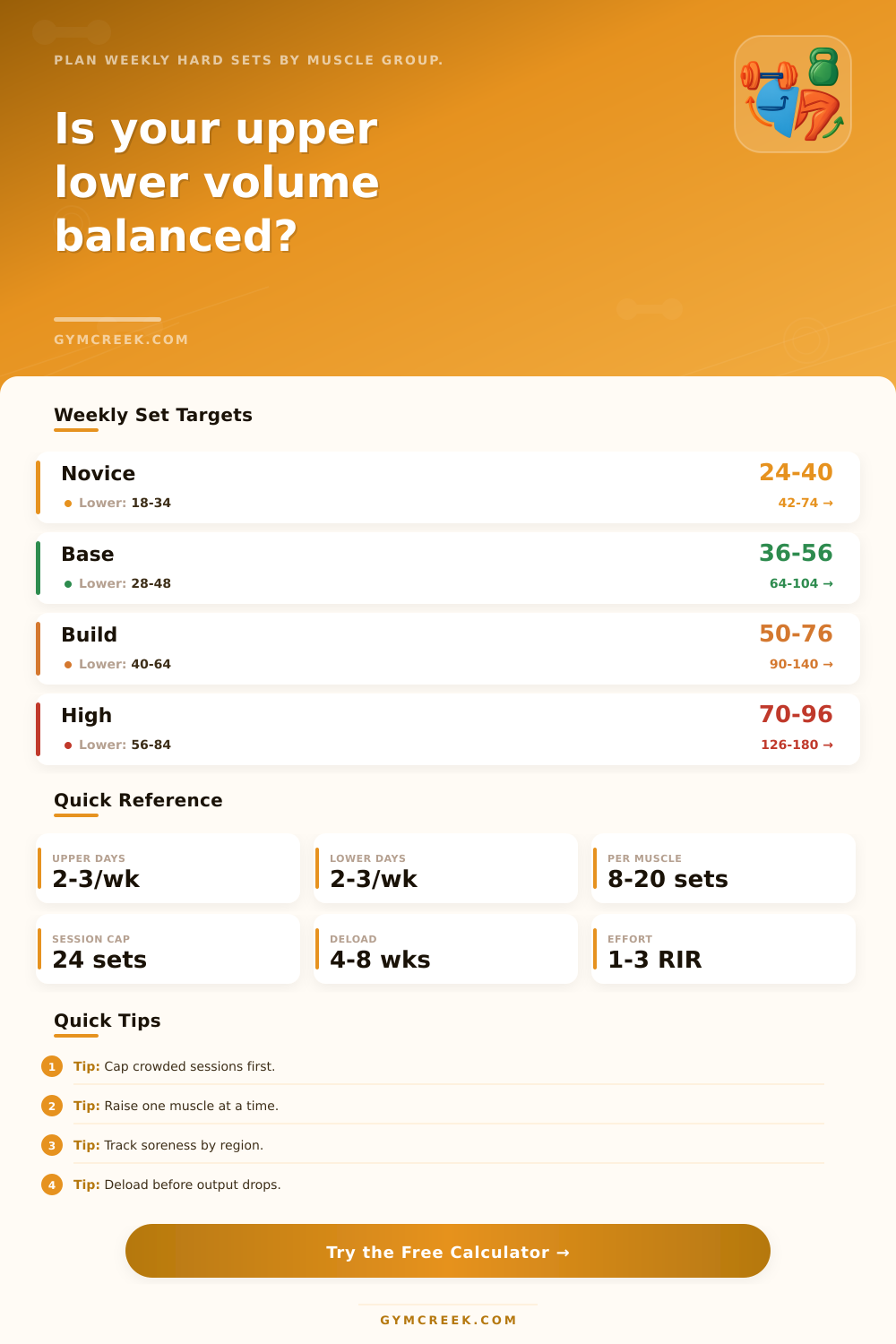
Upper Lower Split Volume Calculator
Plan weekly hard sets for an upper lower split using training age, recovery profile, session count, muscle targets, RIR, and session density.
📌Training Presets
Each preset fills a complete split profile, including body stats, weekly sessions, muscle set targets, effort, and recovery timing.
⚙Calculator Inputs
Upper lower split summary
Enter your split details to calculate weekly hard sets, balance, session density, and recovery fit.
📊Fitness Metrics Grid
📑Reference Tables
| Training Level | Typical Sets Per Muscle | Useful Weekly Total | Best Use |
|---|---|---|---|
| Novice | 6-12 sets | 42-74 sets | Technique practice with recoverable volume |
| Intermediate | 10-18 sets | 64-140 sets | Progressive hypertrophy or strength base |
| Advanced | 12-22 sets | 90-180 sets | Specialized blocks with planned deloads |
| Return week | 4-8 sets | 30-70 sets | Restart after break, illness, or high fatigue |
| Split Pattern | Weekly Layout | Volume Bias | Watch Point |
|---|---|---|---|
| Classic 4-day | Upper, lower, rest, upper, lower | Balanced | Keep lower days under 26 sets each |
| 3-day rotation | Upper, lower, upper then alternate | Alternating | Compare two-week averages |
| 5-day emphasis | 3 upper and 2 lower, or reverse | Specialization | Lagging side gets priority recovery |
| 6-day split | Upper lower repeated three times | High frequency | Use smaller per-session set doses |
| Muscle Group | Low Range | Productive Range | High Flag |
|---|---|---|---|
| Chest or back | 6-9 sets | 10-20 sets | Above 22 sets |
| Delts or arms | 4-8 sets | 8-18 sets | Above 20 sets |
| Quads or glutes | 6-10 sets | 10-20 sets | Above 22 sets |
| Hamstrings or calves | 4-8 sets | 8-16 sets | Above 18 sets |
| Formula | Calculator Use | Variable | Interpretation |
|---|---|---|---|
| Mifflin-St Jeor | BMR estimate | Age, weight, height, sex | Recovery context, not a diet target |
| TDEE multiplier | Activity stress | BMR x activity | Higher lifestyle load lowers reserve |
| Effective sets | Weekly volume | Sets x sessions | Weighted mode adds overlap credit |
| Density score | Session feasibility | Sets per hour | Very dense plans can reduce quality |
💡Volume Planning Tips
Balancing upper lower splits looks easy on paper. Two days upper, two days lower? Or maybe three of one, two of the other? But then it becomes…how much can I do for each muscle group before they starts needing recovery? Most guys know when something feels good that day, but it’s tough to get a read on the week unless you run some numbers to see how it all adds up.
Then you plug your per-muscle targets, session count, and training age into the calculator, and it does all of that math for you. And it will fold in outside activity, stress, and sleep, since these factors impact the amount of overall work your body can handle. You can’t expect someone with a desk job and eight hours of sleep to recover the same volume as someone with a stressful job and only six hours of sleep, even if they have exact same training split. It’ll spit out a recovery fit score so you know right away if your plan is realistic. Or already pushing the edge.
How to Balance Your Workout Split
The total isn’t really important; it’s understanding what each input actualy represents that counts. Advanced athletes requires higher volumes of input before they respond. Newer lifters are accustomed to lower workloads and can adapt quickly. This explains why training age determines the expected volume range. Session length is also significant. Twenty-eight hard sets taken over a period of seventy minutes feels different than the same number of sets dispersed over a period of ninety minutes.
Likewise, the reason we have an RIR field is that the sweet spot for maximizing most productive hypertrophy work are between one and three reps in reserve. Beyond this, both growth and fatigue change. Weekly totals is listed on the page in a reference table. This is good information, but it’s most helpful when viewed in relation to your self-imposed limits.
For example, perhaps upper days are peachy and your lower days gets ground into mush. Maybe it’s not that you need more volume, but that the split should of been adjusted. Add a few more sets to each muscle group and monitor your progress for a couple of weeks. This will show you if the change helped or if it was just extra effort.
There’s also a hidden variable called density. Too many sets in too few minutes leads to decreased performance on the latter exercises, which the calculator picks up by measuring sessions vs. It measures sets per hour to see if it should flag this for you. Do you need to squeeze more training into your schedule by adding another day, or will you drop some lower priority isolation work?
Typical errors occur because they view their volume as one single number instead of looking at how that volume is spread across different days and recovery periods. So they pile sets onto whatever muscle is lagging behind, unaware that total weekly volume has snuck up to a level that is too high given current levels of sleep and stress. Or they maintain the same split but fail to adjust when sleep declines or life stress increases. Either way lead to the same outcome: stalling out, where you think you’re having some kind of training issue when actualy you have a recovery issue.
Practically speaking: Run your first two weeks at whatever your plan calls for (use the calculator), and pay attention to how it feels during those two weeks. Did you get sore? Was your performance down? Did you lose motivation? If soreness lingers or performance dips, it’s likely that your recovery fit score was probably optimistic. On the other hand, if you felt all right between workouts and things were rolling along without hitches, you’re likely within a helpful range of volume.
From there, small tweaks seem to work better than big jumps from another person’s program.