Calories Burned Hiking Uphill Calculator
Estimate uphill hiking calories from body weight, pack load, moving time, uphill distance, elevation gain, grade, terrain, altitude, pace, and weekly repeats.
📌Uphill Hiking Presets
Presets focus on sustained uphill work, not whole-route difficulty, descent scoring, or incline-only angle conversion.
⚙Calculator Inputs
Uphill hiking calorie snapshot
Enter climb details to estimate calories, vertical rate, METs, flat equivalent distance, and weekly burn.
📊Uphill Metrics Grid
📑Reference Tables
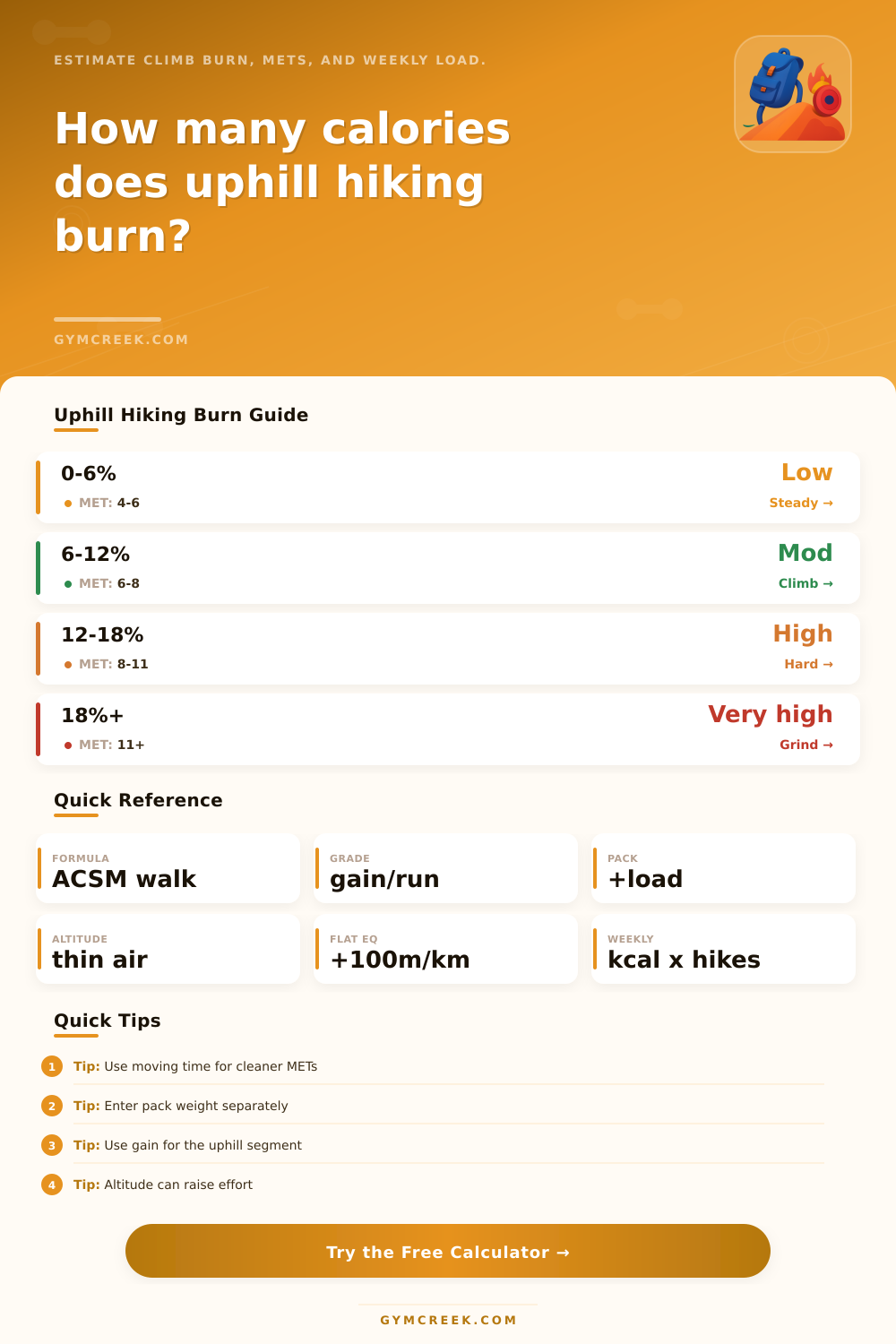
| Average grade | Typical MET | Vertical feel | Planning cue |
|---|---|---|---|
| 0-6% | 4.0-6.0 | Rolling or gentle climb | Pace and duration dominate burn. |
| 6-12% | 6.0-8.5 | Sustained uphill hiking | Breathing and pack load matter. |
| 12-18% | 8.5-11.0 | Hard climbing trail | Shorter stride and breaks are normal. |
| 18-25% | 11.0-14.0 | Very steep hiking | Footing and poles can change effort. |
| 25%+ | 14.0+ | Step-up or scramble-like | Use conservative calorie ranges. |
| Input | Factor | What it captures | When to use it |
|---|---|---|---|
| Smooth path | 1.00x | Predictable footing | Road climbs and wide paths. |
| Rocky rooty | 1.15x | Balance and foot placement | Uneven mountain trail. |
| Loose surface | 1.22x | Slip and push-off loss | Sand, scree, loose gravel. |
| Snow or talus | 1.35x | Slow unstable footing | Soft snow, mud, talus fields. |
| High altitude | 1.08-1.22x | Lower oxygen availability | Climbs above 1500 m. |
| Vertical rate | Metric rate | Uphill feel | Common profile |
|---|---|---|---|
| <700 ft/hr | <213 m/hr | Easy to steady | Beginner climb or social hike. |
| 700-1200 ft/hr | 213-366 m/hr | Steady work | Fit day hiker pace. |
| 1200-1800 ft/hr | 366-549 m/hr | Hard sustained | Conditioned mountain hiker. |
| 1800+ ft/hr | 549+ m/hr | Very hard | Fast ascent or training climb. |
| Metric | Formula | Inputs | Output |
|---|---|---|---|
| ACSM uphill VO2 | 0.1S + 1.8SG + 3.5 | Speed and grade | ml/kg/min |
| MET estimate | VO2 / 3.5 x factors | Terrain, altitude, pack | Adjusted MET |
| Calories | MET x 3.5 x kg / 200 x min | Body mass and time | Gross kcal |
| Equivalent flat | distance + gain / 100 m | Climb distance and gain | Flat effort distance |
| Weekly burn | hike kcal x repeats | Similar climbs per week | kcal/week |
💡Uphill Calculation Tips
Hiking uphill require more physical work than hiking downhill. Hiking uphill causes your heart rate to increase and your breathing to deepen. Many peoples dont appreciate the energy that hiking uphill requires.
To properly gauge your efforts on a hiking route, you should use a dedicated calculator to separate the effort of the uphill climb from the remainder of your hiking route. Such a calculator allows you to measure the energy cost of hiking uphill. The various inputs to the calculator help to determine the difficulty of your hiking route.
How to Use an Uphill Hiking Calculator
Factors like your body weight and the weight of your hiking pack contributes to the total energy that you need to hike your route. Factors like the duration and distance of your hike contribute to the total volume of work that you need to perform on your hiking route. Factors like the elevation gain and the grade of your hike contribute to the difficulty of your route.
Terrain type is one of the inputs to the calculator, as different type of terrain require more effort to hike than other types of terrain. Altitude is another of the inputs to the calculator, as different altitudes include different amount of oxygen for your body. Finally, one of the last inputs to the calculator is the pace that you hike at; this helps to determine your movement speed on the route.
The ACSM uphill formula uses each of these variables, with additional factors for footing, load, and elevation gain. Based on your inputs, the calculator output various measurements of your hike. The vertical gain rate helps you to compare one hike to another.
The MET estimate helps to indicate the intensity of your hike. The equivalent flat distance is useful if you wish to compare your uphill hiking to flat hiking. The weekly burn and the weekly vertical gain help you to determine your training load for the week.
Many people focus on the total distance of hiking that you will perform during the week, but that does not account for the energy that you will expend while hiking uphill. A three-mile stretch of hiking trail with a significant amount of vertical gain will burn more calories than another three-mile stretch of trail with little vertical gain. You can feel the difference in the effort that you expend on these two types of hiking trails, and your legs will adapt different to each trail.
In this case, using the calculator to separate the uphill segment will provide you with clearer numbers than if you averaged the entire hiking route. Terrain and altitude can impact the difficulty of the hikes that you undertake. For instance, a smooth road grade may be easy to hike when you are at sea level, but that same road grade may be difficult to hike at high altitude.
Hiking on a loose terrain will increase the difficulty of the hike, as each step require more effort than when hiking on even terrain. The calculator accounts for these two variables through the use of multipliers for these two variables. Pack weight can increase the difficulty of your hike.
The more you have to carry, the harder it will be to hike uphill. This effect is even more prominent on steeper hills than on hills with gentler inclines. The ratio of your pack weight to your body weight is another of the variable that impacts the difficulty of your hike.
For instance, a twenty-pound hiking pack will have a different impact on a one-hundred-fifty-pound hiker than on a two-hundred-pound hiker. Therefore, the calculator considers the ratio of your pack weight to your body weight as one of the factors in determining your total energy expenditure. The reference tables on the calculator help you to understand the various measurements that is provided to you.
The grade ranges and MET bands will help you to understand the level of effort that you will have to exert while on your hiking trip. The vertical rate benchmarks will help you to determine whether or not your hike is appropriate to your conditioning. These tables allow you to plan your hike and ensure that the numbers from the calculator match the difficulty of the hiking route that you plan to take.
One common mistake is to treat the total calories that are burned as a fixed number. However, if you adjust any of the variables within the calculator, such as your terrain or the weight of your hiking pack, the total number of calories will change. Additionally, another mistake that many individuals make is to include the calories that are burned on the descent into your hike.
However, you should not include the descent into your total calculations for your uphill hiking trip; the muscles used during a descent are not the same as the muscles used when hiking uphill, and the calories that are burned on a descent are typically lower per minute than on an ascent. Therefore, by leaving the descent out of your calculations, the uphill portion of your hike will be represented more accurately. Repeated uphill hiking will increase your fitness, while decreasing your fatigue over time.
As you hike uphill, your legs gain strength and aerobic capacity. Additionally, you will be able to build your fitness without hiking long distances. The various totals that is displayed in the calculator each have a role in tracking your fitness and preventing you from guessing at your total training load for the week.
This calculator allows you to compare similar hiking routes. For instance, you could use the calculator to determine the differences between two hiking routes of the same total distance but different altitudes. Additionally, you can use the calculator to determine the differences between hiking routes of similar vertical gains but with different terrain types.
By using these variables, you can determine the load that you can take on different days of the week for your hiking trip. Despite its seemingly narrow use, this calculator has a variety of potential applications. For one, you can use the calculator to determine the total number of calories that you will burn on a specific hiking trip that you plan to take.
The calculator can show you how to build endurance on various types of terrain. Finally, the calculator can allow you to compare hikes to assess your relative fitness on various trips.