Tricep Pushdown Load Calculator
Convert cable stack settings into real handle load, estimate pushdown strength, and choose a better target weight for your next triceps set.
📌Pushdown Presets
Presets load realistic cable ratios, attachment choices, RPE targets, and stack settings so machine-to-machine comparisons stay honest.
⚙Calculator Inputs
Pushdown load snapshot
Enter your stack setting, cable ratio, reps, and RPE to estimate useful triceps loading.
📊Fitness Metrics Grid
📑Reference Tables
| Cable Setup | Handle Multiplier | What To Log | Use Case |
|---|---|---|---|
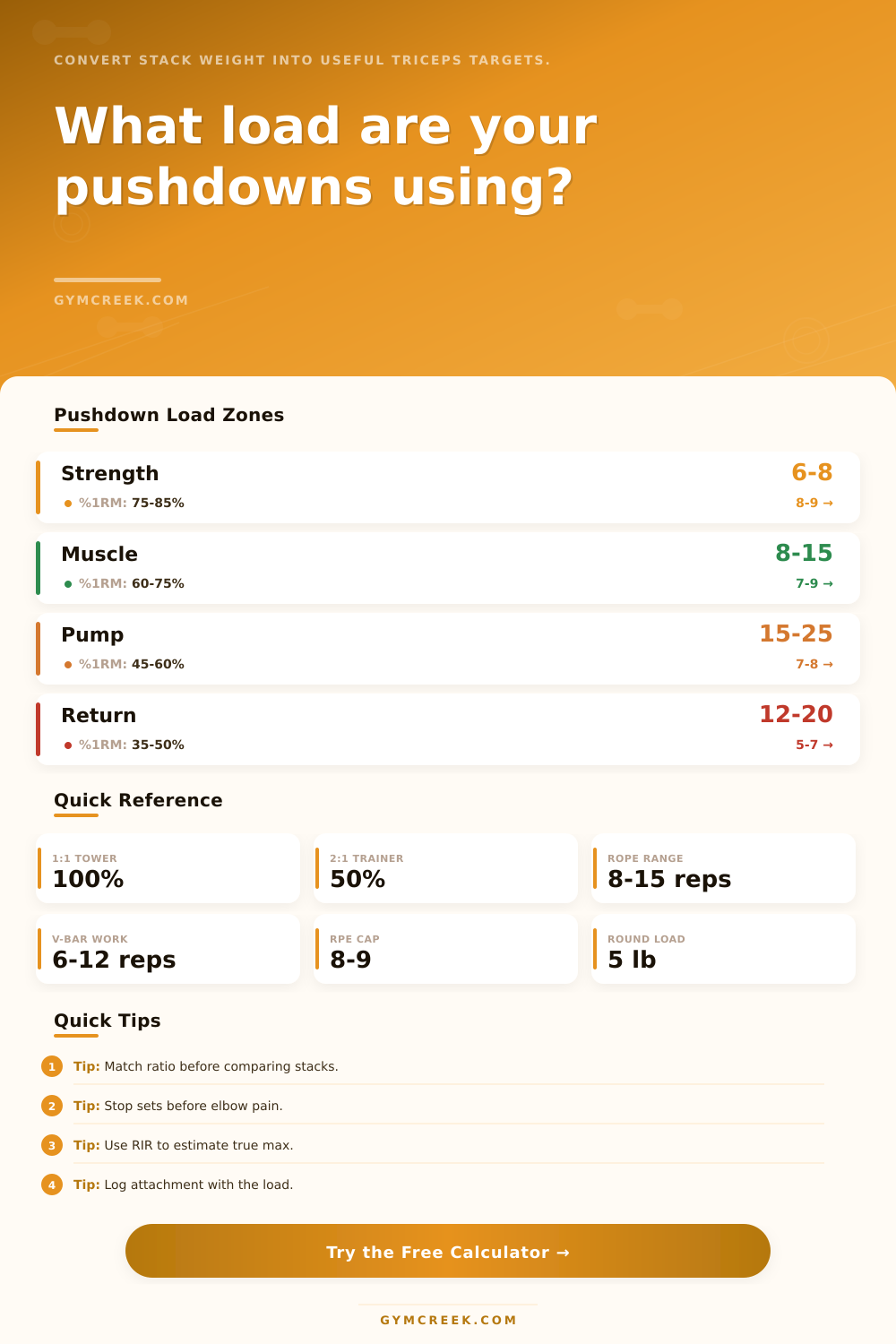
| 1:1 tower | 100% of stack | Pin plus add-on | Most pushdowns |
| 2:1 trainer | 50% of stack | Stack and side | Dual pulleys |
| 3:1 cable | 33% of stack | Ratio noted | Rehab stations |
| 4:1 cable | 25% of stack | Ratio noted | Light isolation |
| Pushdown Goal | Target Reps | Load Zone | Typical RPE |
|---|---|---|---|
| Heavy accessory | 6-8 | 75-85% 1RM | 8-9 |
| Hypertrophy | 8-15 | 60-75% 1RM | 7-9 |
| Pump work | 15-25 | 45-60% 1RM | 7-8 |
| Technique return | 12-20 | 35-50% 1RM | 5-7 |
| Attachment | Grip Bias | Load Note | Best Check |
|---|---|---|---|
| Rope | Neutral grip | Moderate load | Full flare |
| Straight bar | Pronated grip | Stable load | Wrists quiet |
| V-bar | Close neutral | Heavy friendly | Elbows pinned |
| Single handle | One arm | Lower stack | Side matched |
| Formula | Variables | Purpose | Output |
|---|---|---|---|
| Handle load | Stack x ratio | Convert machine | Real load |
| RPE to RIR | 10 - RPE | Rep reserve | RIR |
| Epley 1RM | Load x reps | Max estimate | 1RM |
| Target stack | Goal % 1RM | Next set | Pin weight |
💡Calculation Tips
At the gym you pin the weight stack up as high as it goes and then struggle to do more than a couple of reps with your arms giving out on you. Tricep pushdowns is an everyday thing. But what’s the actual resistance your muscles are fighting? It might be different than the weight on the stack. Cables hide the facts. And you know how handling a load differs from stack weight. Your arms grows, they don’t just get tired. That’s the variable that kills your gains: Most folks don’t pay attention to their cable ratio. Typically, the ratio for a standard tower is one-to-one, meaning the handle equals the stack. Dual-pulley functional trainers usually operate at a two-to-one ratio. On such a machine, pinning seventy pounds will feel like only thirty-five pounds of resistance, twice the weight as indicated on the stack.
After plugging in the ratio, the calculator does the math to correct for your relative weight. You will no longer be confused about your relative strength or guess based off ego-driven feelings. It’s about honesty. You can’t plug-in random numbers into a single log without correcting those numbers for different equipment. They’re meaningless then.
How to Do Tricep Pushdowns Correctly
Next there’s the bar you use. A V-bar will keep your elbows pinned to the sides and let you get away with higher tension while keeping strain off your joints. A straight bar requires strict wrist alignment. It can be more stable when using heavy loads, but it forces a pronated grip. Using a rope lets you grip neutrally and flare outwards at the bottom. However, it can also make things feel heavier on the elbows and increase amount of contraction. Pick the bar based on what you’re trying to do, not which looks best in the mirror. If you’re after hypertrophy, you want tension without pain. If you’re looking to build strength, then you want something stable. If you mix them up, you won’t know if you failed because of elbow pain or weakness.
Intensity is measured by how close you are to failure. Intensity doesn’t correspond with the size of the stack; it corresponds with distance from failure. A good gauge of intensity is rate of perceived exertion (RPE). If you’re in the middle of the set and feel like you’ve got two reps remaining in the tank, that’s an eight. That’s the sweet spot. Challenging enough to force change yet light enough to allow for ideal form. Pushing to failure on exercises such as pushdowns is difficult because the leverage changes rapidly and the stress dumps into the tendon. Because you lose posture when grinding out three reps with a heavy weight, a moderate load of eight to fifteen reps will be superior for muscle building.
A good workout isn’t necessarily about doing more. But if you do more, it had better be serious business. Twenty reps of something light doesn’t count as a workout; it’s a pump session. Sure, it’ll make your muscles feel full and help with bloodflow, but it won’t tap into those high-threshold motor units associated with muscle growth. Doing six heavy reps in a single set won’t stimulate much muscle growth either. There needs to be a happy medium. This is where the tool comes into play. It lets you gauge how much weight you should lift based on amount of work done, while also giving you the ability to scale workouts up or down to match your day. In other words, it takes the guesswork out of training. Program a recovery day, a volume day, and a heavy day without having to base them around how you feel that morning.
The long-term value of arm training is elbow health. Pushing against something heavy can be painful. Momentum cheating the weight into place can be painful. And many will do that just for short term gain while sacrificing their future. A tricep pushdown should be a slow, controlled motion. Let the weight stretch your muscle. Pause briefly. Then push with intent. If you can’t control the lowering portion, then the weight is too heavy and it doesn’t matter what the stack says. Joint stability and what the muscle feels like are key indicators of a successful set, alongside how your strength progresses over time. How strength progresses over time (months) is how you’ll know you’re progressing. It is not about doing something heroic in a single session. The stack weight fallacy gets back to consistency over intensity. Six weeks of a lighter but perfect-form workout will beat three weeks of a heavier and sloppy one.
The calculator turns your vague intentions into specific loads. This puts realistic targets within reach so you can nail them with good technique. When you understand the mechanics, you work with the machine rather than fighting it. You keep the loads honest, the mind focused, the elbows quiet, and the tension on the arms right… And those triceps grow. They grow not when the numbers are high, but when the tension is right.