Triathlon Training Calculator
Build a triathlon phase plan from race date, weeks remaining, current swim, bike, and run volume, race distance, sessions per week, long-workout progression, recovery load, and taper timing.
📌Triathlon Training Presets
Each preset fills race timing, current volume, sessions, long workouts, recovery load, and training emphasis so you can compare realistic planning cases.
⚙Athlete Profile And Calendar
📏Current Weekly Volume
📈Progression And Recovery
Triathlon training plan
Enter race timing, current volume, sessions, and progression settings to calculate the plan.
📊Training Metrics Grid
📑Phase And Long Workout Tables
| Phase | Weeks | Load target | Primary focus |
|---|---|---|---|
| Base | --- | --- | Aerobic durability |
| Build | --- | --- | Race-specific volume |
| Peak | --- | --- | Longest workouts |
| Taper | --- | --- | Freshness |
| Workout | Now | Target | Progression |
|---|---|---|---|
| Long swim | --- | --- | --- |
| Long ride | --- | --- | --- |
| Long run | --- | --- | --- |
| Brick | --- | --- | --- |
| Race | Common weeks | Peak hours | Taper |
|---|---|---|---|
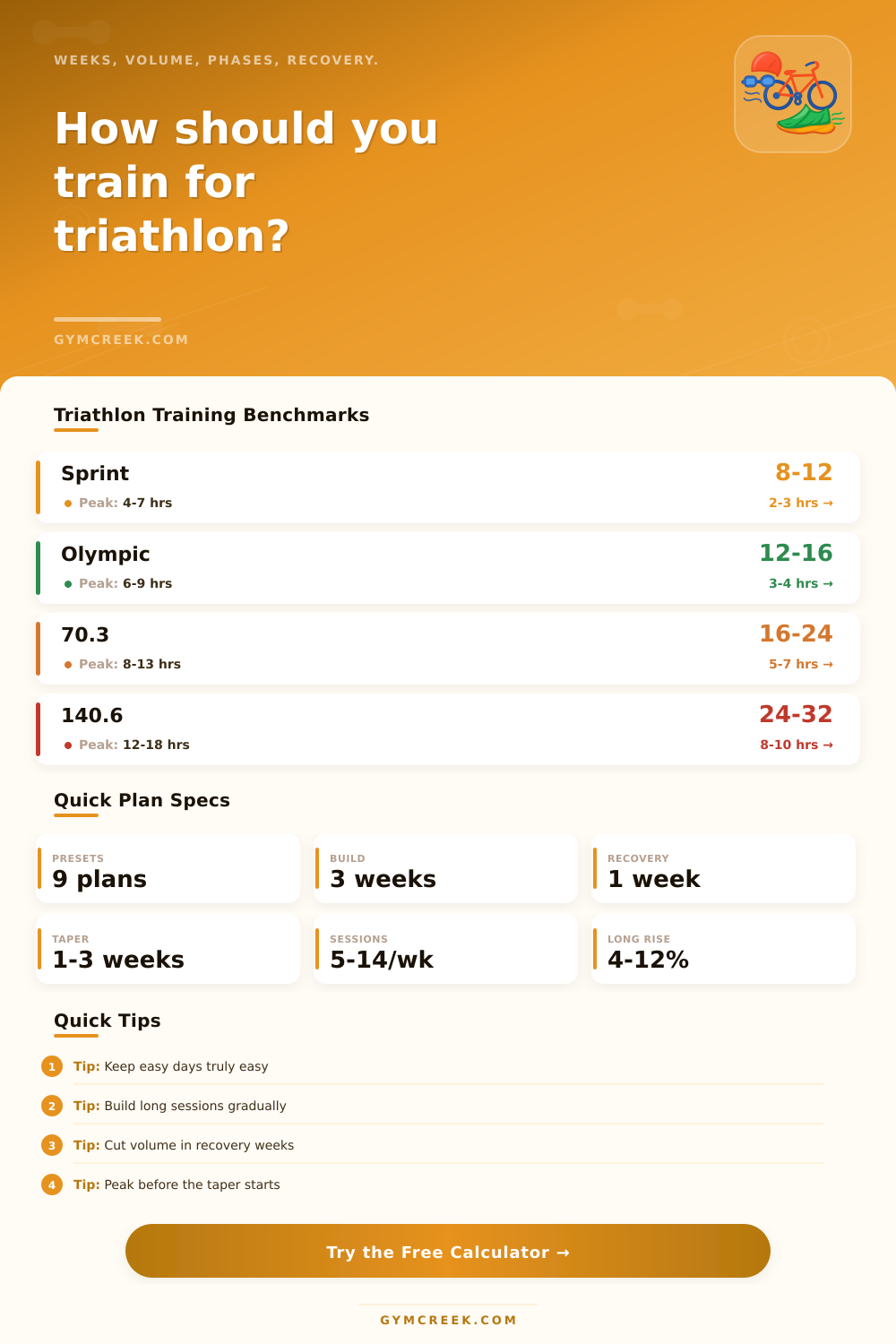
| Sprint | 8-12 | 4-7 | 1 week |
| Olympic | 12-16 | 6-9 | 1-2 weeks |
| 70.3 | 16-24 | 8-13 | 2 weeks |
| 140.6 | 24-32 | 12-18 | 2-3 weeks |
| Formula item | Calculation | Input | Output |
|---|---|---|---|
| Current load | Sport volume / pace | Swim, bike, run | Weekly hours |
| Build curve | Load x growth | Build rate | Peak estimate |
| Recovery load | Prior load x percent | Recovery % | Down week |
| Long workout | Current x progression | Long rise | Peak long day |
💡Training Calculation Tips
A training calculator is a tool to assist you with planning a training schedule for your upcoming triathlon. Specificly, a training calculator allow you to manage the different sport that will comprise your triathlon: swimming, cycling, and running. A triathlon involves three different sports to be competed in a single day.
Furthermore, your training schedule will have to account for the volume of each of these three sports. A training calculator will help you to make your training plans specific to your goal. By using a training calculator, you will be prevented from guessing at how you should train as the race day approach.
Plan Your Triathlon Training with a Calculator
The various input that you select for your training calculator will determine the accuracy of your training plan. You will have to enter your current volume for swimming, cycling, and running into the calculator. Furthermore, your current volume for each of these sports will indicate the starting point of your training.
You will also have to enter your experience level into the training calculator. This will allow the training calculator to determine how much additional volume you can train into your schedule without risking injury. You must also enter the distance of your race into the training calculator.
This will help to determine the total amount of training load that you should perform. Additionally, the training calculator will ask you for the number of training sessions that you are able to participate in each week. This will help to determine how you will distribute the total amount of training load that you will complete each week.
Recovery session are required for your training plan. The training calculator will allow you to select how many recovery weeks you would like to include into your training plan. Furthermore, the training calculator will also ask you for the percentage of the total training load that you would like to include during these recovery weeks.
Should you not include recovery weeks within your training plan, you may find that your motivation to continue to train decrease. Furthermore, your performance may also decrease. Recovery weeks will ensure that you are not too fatigued when you race in the triathlon.
You will have the energy to complete the race. The training calculator will ask of you long workout target. These targets will allow your training plan to prepare your body for race day.
The training calculator will ask of you the rate at which you wish for your longest training sessions to increase in length. If the rate that you provide is too slow, you may find that you are not prepared for the race. If the rate is too fast, you could potentially strain yourself during the race.
Your training calculator will show you the peak volume that your training will reach. This will help you to make your decision regarding your training plan. Phase planning allows for your training plan to be organized within your training.
Most training plans will include four different phase in which your training will occur: base, build, peak, and taper phases. Your training calculator will allow you to determine how many week to spend in each of these phases. The training calculator will calculate each of these phases based off the total amount of weeks that you have to train and the length of taper phase that you wish to include in your training.
The physiological demands of your training will change within each phase, thus making phase planning a necessity for your training season. Within the training calculator, there are reference benchmarks for training load. These benchmarks will help you to determine if your training target is too ambitious or too conservative.
Benchmarks will allow you to view the number of weeks that it typically takes to train for races of similar distance, as well as the amount of peak training hours that is required. For instance, a triathlon of Olympic distance will require twelve to sixteen weeks of training, and six to nine peak hour of training. While these benchmarks will not dictate your training plan, they will help to ensure that you do not train too much or too little for your race distance.
Within the training calculator are various tradeoffs for your training program. For example, if you have a limited number of training sessions that you can participate in each week, your training calculator will ask for the length of each of your training sessions. These long training sessions may take up a portion of your time each week.
Consequently, you may not have time to participate in other physical training activities besides your triathlon training. By identifying these tradeoffs in your training plan, you can adjust your training sessions and your expectation for your season in advance. The training calculator will ask of you the intensity that you will use within your training program.
The intensity that you choose will impact the amount of stress that is placed upon your body. High levels of intensity will place stress upon each hour of your training. Furthermore, high levels of intensity will require that you have a high amount of strength and recovery within your body.
These two training programs may have the same number of training hours each, but a high level of intensity will allow for a high level of stress upon your body. A training calculator cannot account for every variable in your life and training. For instance, it cannot account for unexpected event in your life such as illness or travel.
The training calculator is not meant to provide you with a schedule that cannot be changed. Rather, the calculator allows you to map out your training plan in advance, so that you can adhere to the program when your life interferes with your training. The goal that you train for will impact your training plan.
For example, you can choose to either create a conservative rebuild of your training program, or you could opt for an aggressive build of your training program. A conservative rebuild is best suited to individuals who are returning from injuries. An aggressive training plan is best suited to individuals whose life are stable and who have time to commit to their training program.
A training calculator will not provide a perfect training plan for yourself and your upcoming triathlon. However, it will allow you to have a clearer picture of the tradeoffs that your training program will involve. You will have an idea of the number of training hour that you will complete each week, the target load for your distance race, and how many weeks you have to train.
Furthermore, by using a training calculator, you have removed the guesswork from your training plan. This is a necessity to help you to avoid the mistakes of training too little or too much for your race distance.