Triathlon Split Calculator
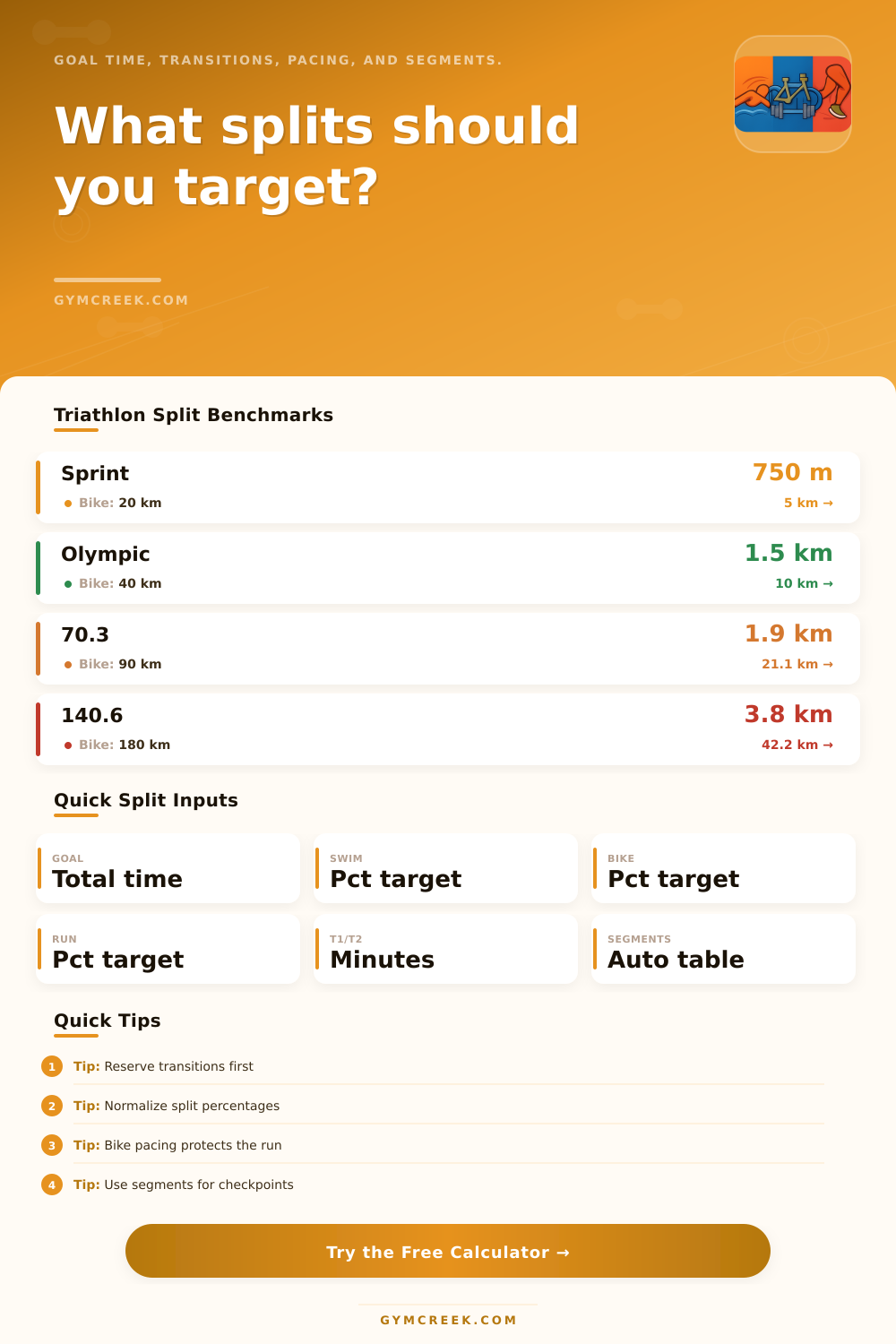
Turn a total race goal into swim, T1, bike, T2, and run split budgets with normalized discipline targets, course distance presets, pacing strategy, and segment checkpoint tables.
📌Split Presets
Presets set distance, goal time, split percentages, transitions, and pacing style. Percentages are normalized after transitions are reserved.
⚙Athlete And Race Setup
⏱Goal Time And Split Targets
📏Distances And Segment Breakdowns
Triathlon split plan
Enter a goal time, distance, transitions, and discipline percentages to calculate target splits.
📊Split Metrics
📋Segment Breakdown
| Segment | Distance | Split | Cumulative |
|---|---|---|---|
| Swim 1 | --- | --- | --- |
| Segment | Distance | Split | Cumulative |
|---|---|---|---|
| Bike 1 | --- | --- | --- |
| Segment | Distance | Split | Cumulative |
|---|---|---|---|
| Run 1 | --- | --- | --- |
| Leg | Target | Pace / speed | Cumulative |
|---|---|---|---|
| Swim | --- | --- | --- |
📘Reference Tables
| Race | Swim | Bike | Run |
|---|---|---|---|
| Sprint | 16-22% | 44-52% | 28-36% |
| Olympic | 16-21% | 45-53% | 28-36% |
| 70.3 | 9-14% | 48-55% | 31-39% |
| 140.6 | 7-11% | 48-55% | 34-43% |
| Style | T1 | T2 | Use |
|---|---|---|---|
| Fast | 1-3 min | 1-2 min | Simple setup |
| Normal | 2-5 min | 1-4 min | Age-group |
| Careful | 4-8 min | 3-6 min | Gear check |
| Long zone | 6-12 min | 4-10 min | Big venue |
| Strategy | Swim | Bike | Run |
|---|---|---|---|
| Even | Steady | Steady | Steady |
| Conservative | Controlled | Build | Build |
| Negative | Easy start | Even | Fast finish |
| Bike-save | Normal | Cap effort | Protected |
| Formula | Inputs | Output | Use |
|---|---|---|---|
| Usable time | Goal - T | Race budget | Split base |
| Normalize | Swim/Bike/Run | Shares | Fair split |
| Pace | Time / distance | Target pace | Checkpoints |
| Mifflin | Age, size, sex | BMR | Context |
💡Split Planning Tips
Planning a triathlon split require an understanding of the difference between total goal time and the time spent on each segment of the race. Total goal time for a triathlon include both the time spent moving and the time spent in transitions between events. Because the time spent in transitions includes variables like time spent at aid station and congestion in the course, those variables should be accounted for in the split plan for accuracy.
The calculator allow you to enter each of these variables to calculate your total goal time. The percentages assigned to each segment of the triathlon is important to understand both in regard to the specific course that is to be run, but also in regard to your racing style. For instance, for those who are competing in a 70.3 triathlon, a percentage of time for the bike may be increased relative to other distances because the distance include a long bike segment.
Plan Your Triathlon Split Times
For those who are more skilled at swimming, the runner may assign a higher percentage to the running segment. These percentages are subtracted for transition time first to ensure that the percentages dont incorrectly equate to equal segments of the total time. Following adjustment of the percentages for transition time, the calculator will provide the pace for each segment that is required to reach your total time goal.
Transitions for triathlons require careful planning to ensure that you are both saving time and remaining efficient during the race. Because the time spent in transitions cannot be recovered once you have begun each segment, it is important to plan for the fastest transition time possible. Time for T1 and T2 can be entered into the calculator, or an athlete can select a transition style.
The calculator pulls the time for each transition from the total goal time first, to ensure that only the time allocated to the events are accounted for in the split of swim, bike, and run time. Segment tables allows an athlete to see each of the split times for each segment. These times can be used to ensure that an athlete is maintaining the pace that is required to reach their goal.
An even split time will require athletes to maintain the same pace for each segment, whereas a negative split will increase the time for the later segments. A bike-save split will allow athletes to conserve energy by reducing the pace for the bike early in the segment. These splits can be seen in the tables create by the calculator.
Each variable for a triathlon can introduce additional variables outside of the parameters that is create by the calculator. For instance, open water races may be crowded, especially at transition points. A rolling bike course may allow athletes to produce less power than desire for that segment.
Additionally, the effects of heat can alter an athletes performance after the first hour of a race. Each of these variables are outside of the calculator, but still potentially impact an athletes performance in the same race. The reference ranges for each distance may help an athlete understand how long each segment should take, should they be uncertain about the time to dedicate to each segment.
Planning options for the race will alter the split plan that is provided to an athlete. For instance, if an athlete intends to comfortabley finish the race, an extra few minutes may be allotted for any unexpected events. If an athlete intends to run the race as close to their personal best as possible, there will be less time allotted for mistakes.
Each of these options will alter the split times that are calculated for each segment, though the split times will be the same if high risk course are selected. In these instances, the calculator may provide a note indicating that the athlete may need to exhibit patience during there race. The energy requirement for the race is represented in the results of the calculator.
This number represent the weight of the athlete, the distance to be covered, and the energy required for each segment of the race. This value can be compared with the amount of nutrition that an athlete consumes during training. If the energy represented is higher than training days, a brick workout can be performed with the same amount of nutrition.
If the energy represented is lower than training days, the athlete can compete with less nutrition to pass aid stations. The value of creating a split plan is that it forces an athlete to consider how their time is to be spent during the race. For instance, an athlete may recognize that shaving thirty seconds in transition may be easier than finding thirty seconds during their run segment.
Similarly, protecting energy during the bike segment may lead to an easier run segment. These variables are present in each race, though the split plan forces an athlete to recognize these variables prior to the start of the race. After creating a split plan, an athlete must execute the created plan to compete in the race.
The athlete should practice the transitions during the swim, bike, and run segments. Additionally, each athlete should ride the bike segments to the target speed or effort. Using the segment tables, the athlete can ensure that each segment is being executed at the proper pace.
While the calculator cant run the race, the split plan remove the guesswork for the athlete after their swim exit.