Triathlon Finish Time Calculator
Predict a triathlon finish time from swim pace, bike speed, run pace, transition minutes, race distance, bike and run elevation, temperature, humidity, wind exposure, and athlete profile.
📌Triathlon Presets
Load a realistic race scenario or enter your own split targets. The model keeps raw pace time separate from heat, hill, and exposure adjustments.
⚙Athlete Profile
📏Race Distance And Paces
🌡Transitions, Elevation, And Heat
Triathlon finish snapshot
Enter your paces and race conditions to estimate total finish time.
📊Race Metrics
📑Reference Tables
| Race | Swim | Bike | Run |
|---|---|---|---|
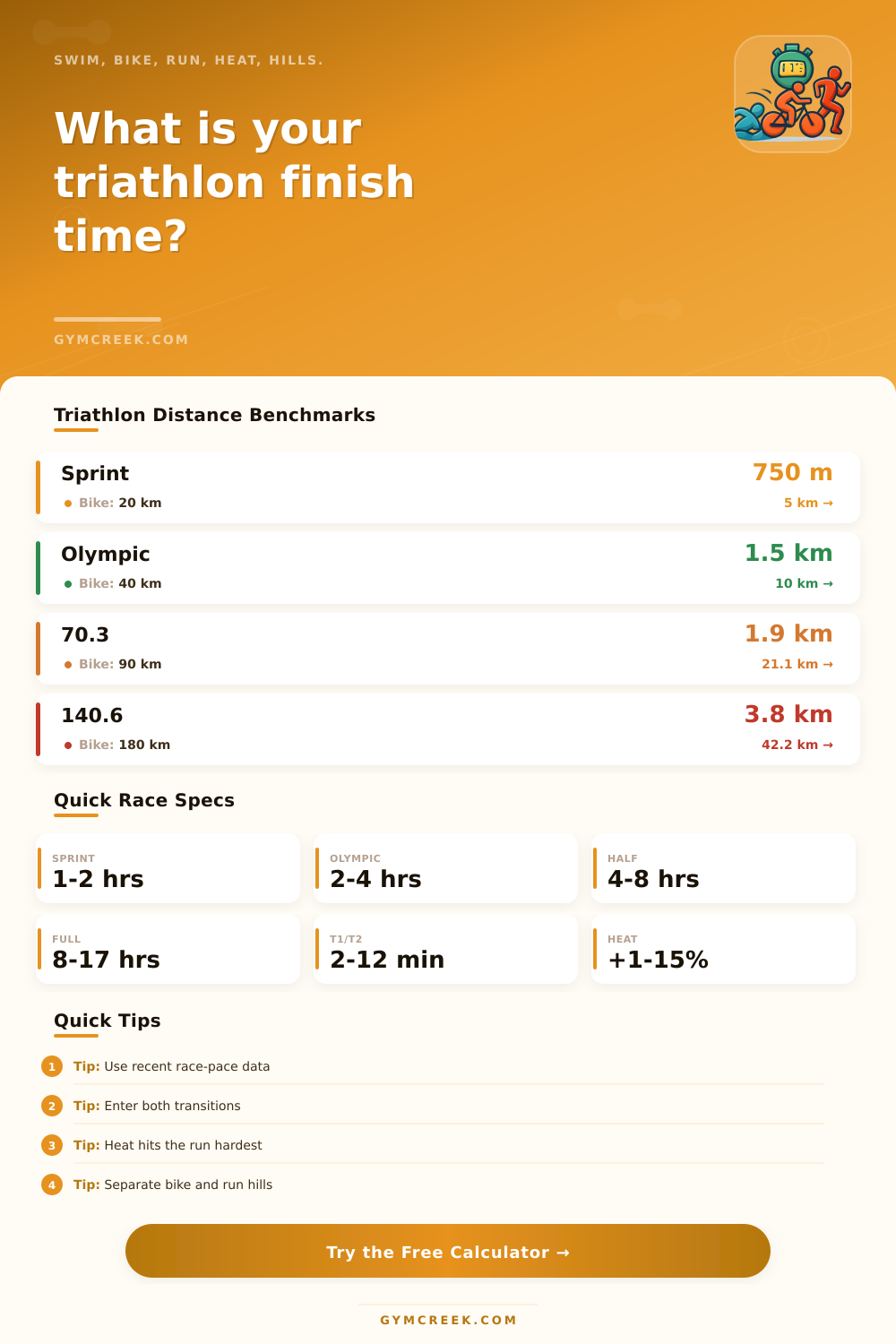
| Sprint | 750 m / 820 yd | 20 km / 12.4 mi | 5 km / 3.1 mi |
| Olympic | 1.5 km / 1640 yd | 40 km / 24.9 mi | 10 km / 6.2 mi |
| 70.3 | 1.9 km / 2112 yd | 90 km / 56 mi | 21.1 km / 13.1 mi |
| 140.6 | 3.8 km / 4224 yd | 180 km / 112 mi | 42.2 km / 26.2 mi |
| Race | Beginner | Trained | Fast |
|---|---|---|---|
| Sprint | 1:30-2:15 | 1:05-1:30 | Under 1:05 |
| Olympic | 3:00-4:00 | 2:15-3:00 | Under 2:15 |
| 70.3 | 6:30-8:30 | 5:00-6:30 | Under 5:00 |
| 140.6 | 13:00-17:00 | 10:30-13:00 | Under 10:30 |
| Factor | Small | Moderate | High |
|---|---|---|---|
| Run heat | 65-74 F | 75-84 F | 85 F+ |
| Bike climbing | Flat | Rolling | Hilly |
| Run climbing | Under 50 ft/mi | 50-100 ft/mi | 100+ ft/mi |
| Open-water swim | Calm | Crowded | Rough/current |
| Formula | Inputs | Output | Use |
|---|---|---|---|
| Split time | Distance and pace | Raw split | Swim, bike, run |
| Condition factor | Heat and elevation | Adjusted split | Course realism |
| Mifflin-St Jeor | Age, sex, size | BMR/TDEE | Energy context |
| Execution range | Risk and experience | Time window | Race planning |
📋Dynamic Split Table
| Segment | Raw split | Adjustment | Adjusted split |
|---|---|---|---|
| Swim | --- | --- | --- |
| T1 | --- | --- | --- |
| Bike | --- | --- | --- |
| T2 | --- | --- | --- |
| Run | --- | --- | --- |
💡Tips
A triathlon finish time calculator use mathematics to determine a triathletes finish time based on a variety of factors that impact the athlete. Each of the three portions of a triathlon have factors that may impact a triathletes time, and a triathlon finish time calculator account for these separate factors to arrive at a single predicted finish time for the race. While a triathlete can plan their training and their power output while training, various factors will impact the athletes actual finish time.
The swim portion of a triathlon will have a course factor that account for the difference between swimming in a race versus in a pool. For instance, triathletes typicaly calculate their swimming distance and pace while swimming in a pool; however, while swimming in a triathlon they must account for sighting distances, contact with other swimmers, and currents in the race. You can account for these factors in the calculator by entering the course factor for the swim portion of the triathlon; these factors will provide a more realistic calculation of a triathletes time for that portion of the race.
How a Triathlon Time Calculator Works
Calm waters will allow for faster times for triathletes compared to crowded swimming areas or areas with cross currents. The bike portion of a triathlon can include various factors that impact the time that each triathlete will take to ride from one portion of the course to the next. Factors such as elevation gain, wind exposure, and the heat can impact each triathletes time for the bike portion.
The calculator can account for each of these factors; for example, the calculator can account for the exposure to wind and heat as separate multipliers for the time that each triathlete will take to bike from one area to the next. You can enter these factors into the calculator as they will impact the athletes remaining energy for the run portion of the triathlon. In addition to each portion of the triathlon, there are transition periods that must be accounted for; periods between the swim and bike portions, and the periods between the bike and run portions.
Time for these transitions can be entered into the calculator for each portion as they will add to the total time that a triathlete will spend completing the triathlon. Often, individuals may underestimate the time required for removing a wetsuit or putting on shoes or socks; entering the correct amount of time for these transitions will allow for accuracy in the finish time that is calculated for the triathlon. Finally, heat and humidity can impact both the bike and run portions of a triathlon.
You can enter these factors in the calculator as percentages of heat and humidity in the environment. Furthermore, the calculator will apply a larger percentage to the run portion of the triathlon compared to the bike portion; this is due to the rising demand for the body to cool itself during the running portion of the triathlon compared to the biking portion. Thus, high levels of humidity and heat will slow the athletes rate for the run portion of the triathlon.
Another factor that impacts a triathlon is the elevation gain for the run portion compared to the bike portion. A triathlon finish time calculator may account for the elevation gain for each portion; however, it will impose a steeper slope for the running portion of the triathlon to account for the fact that running uphill is more strenuous than biking uphill. Thus, individuals should of consider the elevation gain for the run portion of the triathlon; it can have a similar impact on the athlete as elevation gain for the bike portion.
Each athlete has various factors in their athlete profile that may impact their performance in the triathlon; factors like age, weight, gender, and experience level can be entered into the calculator. These factors will create a prediction of the athletes performance; new athletes will have a higher range of possible times and a higher risk level in their profile than more experienced athletes. Athletes can also profile there goal for the triathlon; if an athlete aims to complete the race more aggressive, their risk level will increase.
A triathlon finish time calculator may also include reference tables within the calculator. These tables may allow for the athlete to compare their calculated finish time with typical finish times for various athlete. These tables do not, however, serve as targets for those finish times.
For example, the calculator may include a dynamic split table that allows for the athlete to compare their raw split times for each portion of the triathlon to the split times that the environment accounts for. A triathlon calculator cannot account for mental execution of the race; how an athlete will feel during the race, or how their stomach will handle the required nutrition during the race. Additionally, such a calculator cannot account for how an athlete may react to other athletes during the race.
The value of such a calculator can be realized by utilizing it multiple times. After an athlete completes a triathlon, their athlete can enter the variables for the actual race into the calculator; the comparison of the calculated finish time to the actual time that the athlete spent completing the triathlon will allow for that individual to better understand their pacing and nutritional needs during the triathlon.