Triathlon Distance Calculator
Total swim, bike, run, transition distance, custom units, course elevation, and race-type presets into one clear triathlon distance breakdown without turning it into a race-duration tool.
📌Race Presets
Presets load standard and practical course profiles. You can override race type, every discipline distance, transition walking distance, and elevation gain after loading.
⚙Calculator Inputs
Triathlon distance snapshot
Enter course details to calculate the race distance breakdown.
📊Distance Metrics
📘Reference Tables
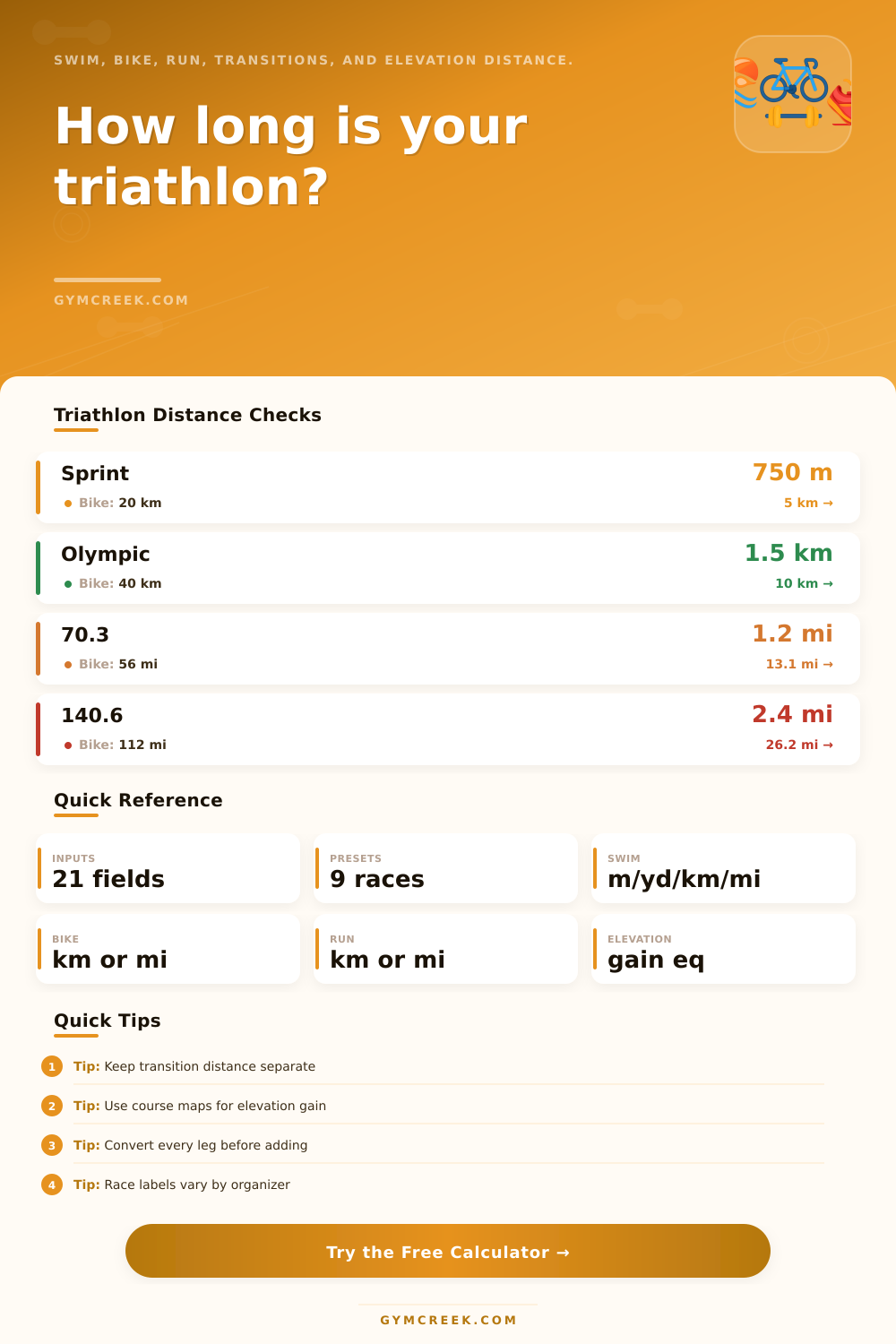
| Race label | Swim | Bike | Run |
|---|---|---|---|
| Super sprint | 400 m | 10 km | 2.5 km |
| Sprint | 750 m | 20 km | 5 km |
| Olympic | 1500 m | 40 km | 10 km |
| 70.3 half | 1.2 mi | 56 mi | 13.1 mi |
| 140.6 full | 2.4 mi | 112 mi | 26.2 mi |
| Unit | Meters | Kilometers | Miles |
|---|---|---|---|
| 100 yd | 91.44 m | 0.091 km | 0.057 mi |
| 750 m | 750 m | 0.75 km | 0.466 mi |
| 5 km | 5000 m | 5 km | 3.107 mi |
| 13.1 mi | 21082 m | 21.08 km | 13.1 mi |
| 26.2 mi | 42165 m | 42.16 km | 26.2 mi |
| Segment | Default | Example | Equivalent |
|---|---|---|---|
| Flat course | 0 x | 0 m gain | No add |
| Bike gain | 4 x | 100 m | 0.4 km |
| Run gain | 7 x | 100 m | 0.7 km |
| Hilly bike | 6 x | 300 m | 1.8 km |
| Trail run | 10 x | 250 m | 2.5 km |
| Formula | Inputs | Output | Purpose |
|---|---|---|---|
| Segment total | Swim, bike, run | Course km | Race distance |
| Transition total | T1 plus T2 | Walk distance | Venue load |
| Buffer | Course x % | Adjusted km | Map variance |
| Climb equivalent | Gain x factor | Flat add | Course load |
| Discipline share | Leg / total | Percent | Breakdown |
💡Calculation Tips
The distance of a triathlon can be difficult to calculate due to the different unit of measurement that are used for each of the three leg of the race. For instance, one race may have distances in meter for the swim leg, kilometers for the bike leg, and miles for the run leg. Each of these units must be converted into the same unit before they can be added to calculate the total distance of the triathlon.
Additionally, other factors that impact the total difficulty of a triathlon, such as transition distance and elevation, may be measured in different unit than these leg distances. One way to assist with these vary units is through the use of a calculator. Such a calculator allow for each of the distances to be entered for the swim, bike, and run legs.
How to Calculate Total Triathlon Distance
Additionally, the distance of the transitions may also be entered into the calculator to calculate a total distance that include walking distances during the race. The calculator can display the total distance of the triathlon that includes only the race distances (excluding transitions), as well as the total distance that also includes the transition distance. In addition to distance, elevation is another factor that can impact the difficulty of a triathlon.
Elevation is typically measured in units of feet or meter. However, the difficulty of climbing a hill on a bike is different than the difficulty of climbing that same distance on foot. To account for this, a person can multiply certain factors by each of the elevations for each of the race leg distance to obtain an equivalent flat distance for each leg of the race.
This equivalent flat distance will not necessarily be the same as the official distance of the race, but it can provide a view of how much energy the course will require to complete the race. Different label can be applied to triathlons to indicate the distances of each of the legs of the race. For instance, a 70.3 triathlon have certain distances for each leg of the race.
The total distance that is measured for each of the legs, however, might not be the same as the distance that is labeled for that race. The actual distance of each leg of the race might be different due to different reason, such as smoothing of the GPS data for that race course, or the tangents that the race director may lay out for the runners. A buffer can be used within the calculator to adjust each of the distances of each leg of the race by a percentage (such as 1% or 2%), which might be of use in comparing the distances for two different triathlons with the same label but with different actual distance.
Additionally, another table that is provided within the calculator display the standard distances for each of the labels of triathlons. Additionally, examples can be provided of the conversion of each of those distances. These examples dont need to be memorized, but may be of use in reviewing the way that the distances increase with each category of triathlon; longer race will include more distance from the swim leg to the run leg.
Another potential aspect of a triathlon that many athlete may not consider is the distance of the transitions. These distances may add hundreds of meter to the total distance that must be traveled during the triathlon. Each of these distances, including the length of any chute for runners or the distance from the course to the area where athletes may park their vehicle, may impact the total distance.
If that distance is to be included in the total distance calculation of the triathlon, those distances can be entered into the calculator. Such inclusion will change the total distance of the triathlon, and that change can be of use in planning the distance that an athlete will travel during the race. Another factor in the calculation of the difficulty of a triathlon is the equivalent flat distance.
For instance, the user can enter the elevation data for a triathlon into the calculator. Each of the elevations can be assigned a multipler; for instance, a higher multiplier can be assigned to the elevation of the running leg than that of the cycling leg; gaining a meter of elevation on foot is more energy-intensive than climbing a meter on a bike. These different multipliers can be adjusted according to an athlete’s power-to-weight ratio.
By adjusting each of these elevations according to an athlete’s multipler, the calculator will provide a total distance for an athlete to use for training. If that equivalent flat distance is used to train an athlete, the athlete will find that their training session more closely match the distance that must be traveled during race day. The calculator is also of use in creating training route for athletes that wish to compete in the specific triathlons.
Each of the distances for each of the legs of the race can be entered into the calculator, as well as the elevation that is published for each of those legs. Based on these distances and elevations, the calculator can indicate a certain equivalent flat distance for that training route. Then, an athlete can search for roads or routes that may equal that same equivalent flat distance.
Additionally, the use of the calculator in creating training routes is useful in that it forces the athlete to convert each distance to the same unit prior to adding the distances together, which ensures that the training route and the triathlon that an athlete is to run will be accurate to one another. Some of the most common mistake of athletes with respect to the calculation of the distance of a triathlon are those that ignore the differences in units for each leg of the race, or the mistakes of not including the distances for the transitions. For instance, should the distances for the various legs of a triathlon be added together without converting the distances to the same unit, the total distance will be incorrect.
Additionally, if the distances for the transitions are not included in the distance calculation, that total distance will also be incorrect. In each of these instances, the unit selector must be checked prior to calculating the total distance of the triathlon; checking the unit selectors will prevent such mistakes. Another mistake that many athlete commit is the assumption that the distance of each leg of the triathlon that is labeled for the race is the actual distance of that leg.
The actual distance of each leg may be altered due to various reason; the course for the triathlon may be altered for the safety of the athletes. Additionally, the actual distance that is calculated for each of the legs may differ from the distance that is published for that race. For instance, in the athlete guide for the triathlon, the distances for each leg can be entered into the calculator to determine the actual distance of the race.
Any adjustments to those distances will be reflected within the total distance that is calculated by the calculator. In most instances, the effort that is required of an athlete to compete in a triathlon is more closely correlated with the equivalent flat distance than with the official distance of the triathlon. For instance, a flat distance for a 70.3 triathlon may be considered to be of less difficulty than a hilly distance for an Olympic triathlon.
Both of these distances, however, should be considered for the determination of the athlete’s total effort for that race. When considering both the official distance and the equivalent flat distance for each of the legs of a triathlon, an athlete can set expectations for the effort that they may have to undertake for race day. Finally, the calculator is of use in comparing the distances of two different triathlons.
For instance, one triathlon might include hills for its cycling leg, while another race may have long distance for its running leg. By calculating the total distance of each race, including the elevation for each leg and the distances for the transitions, an athlete can determine which race may be of more effort than the other. This information may be of use in determining which race to enter in instances in which the athlete has limited time for recovery.
Thus, the use of the calculator to determine the distance of each leg, the transitions, and the elevation is of value to the athlete in that it forces the athlete to consider each of these element separately as they relate to the total effort of the race.