Triathlon Crank Length Calculator
Estimate a triathlon crank length from cycling inseam, aero-bar drop, hip angle priority, race distance, cadence style, knee comfort, and current bike setup.
📌Tri Fit Presets
Presets load common triathlon fit scenarios and calculate crank size, nearest standard length, aero clearance, and setup changes.
⚙Rider, Bike, And Race Inputs
Triathlon crank length recommendation
Enter rider measurements and aero fit goals to calculate a starting crank length.
📊Fit Metrics Grid
📑Reference Tables
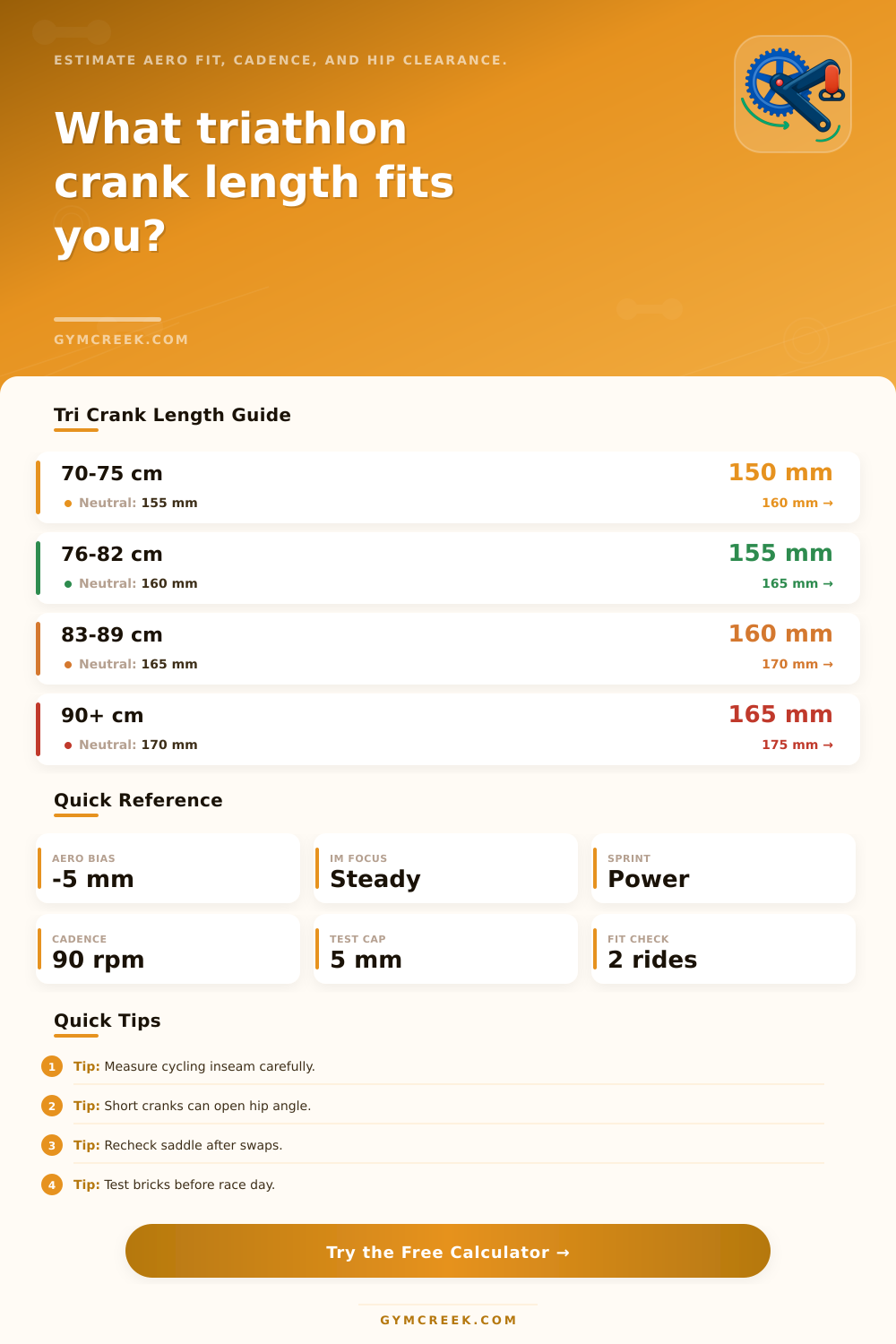
| Inseam | Aero bias | Neutral tri | Power bias |
|---|---|---|---|
| 70-75 cm | 150-155 mm | 155-160 mm | 160-165 mm |
| 76-82 cm | 155-160 mm | 160-165 mm | 165-170 mm |
| 83-89 cm | 160-165 mm | 165-170 mm | 170-172.5 mm |
| 90-96 cm | 165-170 mm | 170-172.5 mm | 172.5-175 mm |
| Signal | Likely move | Why | Retest |
|---|---|---|---|
| Closed hip | -5 to -10 | Opens top | Power |
| Long course | -2.5 to -7.5 | Run legs | Brick |
| High cadence | -2.5 to -5 | Less arc | Cadence |
| Front knee | -2.5 to -5 | Less bend | Comfort |
| Distance | Bias | Goal | Common test |
|---|---|---|---|
| Sprint | Neutral | Power | Hard bike |
| Olympic | Slight short | Aero rpm | 10 km run |
| 70.3 | Shorter | Steady run | Brick |
| Ironman | Shorter | Durability | Long ride |
| Layer | Input | Adjustment | Purpose |
|---|---|---|---|
| Inseam | Leg length | 2.04x cm | Main size |
| Height | Stature | 9.3% | Proportion |
| Aero | Drop, hip | Shift | Clearance |
| Run | Priority, IF | Shift | Freshness |
💡Tri Fit Tips
A person may experience a pinching sensation within there hip while performing cycling in an aerodynamic position. This sensation is typicaly cause by the crank arms that is too long for the angle of the body of the cyclist. For cycling triathlete, the crank length exert a leverage that determines the amount of power that the cyclist can produce on the road, as well as the amount of room that the cyclist’s knees has while in this aerodynamic position.
People typicaly accept the crank lengths that come with their bicycles. However, this could be a mistake for those who compete in cycling triathlons with different requirement to road cycling. Cyclists who use an aerodynamic position will fold their body to bring the thigh and chest into close proximity to each other.
Choose the Right Crank Length for Triathlon Bikes
In these instances, with longer crank arms, their knees will rise too highly above the body, forcing the tilting of their hips or rounding of their back. A cyclist must find the perfect balance for their cycling position with enough room for their knees not to come in contact with their chin. To find this perfect position, many people must consider their inseam length and femur length.
Additionally, the ratio of the length of the thigh in comparison with the length of the shin will play a crucial role in determining their cycling position. For individuals who have a long femur, they will feel the pedal stroke higher on the bicycle compared than individuals who have a short femur and a longer shin. The use of a calculator that take into account an individual’s height and body proportions will provide a better understanding of the perfect length for the cyclist to have their crank arms rather than guess at the length that will work best for them.
Additionally, the distance of the race will also play a role in the length of the crank that they will use. For sprint races in triathlon, the length of the crank should be more longer to produce more power. For races like the Ironman triathlon, the cyclist will want to opt for a shorter crank arm to last the distance with their legs still having the energy to complete the required run competition.
Shorter cranks will reduce the distance of the foot of the cyclist traveling in comparison to longer cranks. These shorter cranks will also open the angle of the cyclist’s hips which will preserve their flexors for the marathon portion of the triathlon. The level of aggressiveness of the cyclist’s aerodynamic position will play a role in the length of the crank arms that they have on their bicycles.
For cyclists whose bicycles have a significant drop in height from the bicycle’s saddle to the aero bars, they have their body in a more compressed state. Shorter cranks will lower the height of the highest point of the pedal stroke of the bicycle. Additionally, they will have more room for their hips to rotate while cycling at their desired rate.
For individuals who feel the tightness in their body at the top of their pedal stroke, reducing the length of the cranks of their bicycles by five or ten millimeter may be of benefit to them. For individuals with high cycling cadences, shorter cranks will benefit them due to the reduced arc of the movement of the cyclist’s foot. For individuals with sensitivity of the knees, shorter cranks will allow their knees to avoid extreme flexion when cycling.
For each alteration of the length of the crank arms that a cyclist utilizes on their bicycles, they will experience change to the angle of the saddle on their bicycles. With shorter cranks, the cyclist will feel as if the saddle is higher to accommodate for the shorter crank length. For these cyclists, the cyclist will have to lower the saddle to accommodate for the same extension of the cyclist’s leg.
Additionally, the cyclist will have to re-verify the angle of the cyclist’s knee and the distance of their body to the aero bars after changing the length of the crank. These specifications will have to be validated through brick workouts to ensure that the new length of the crank arm will allow the cyclist to reach their target power with their pedals while also preserving their legs for the required running portion of the triathlon. A shorter crank length may be the more better option for those racing in the long-distance triathlons, even if the cyclist is losing a bit of power.