Triathlon Calorie Calculator
Estimate race or training calories from swim, bike, run, transition minutes, body stats, segment intensity, terrain, wind, temperature, humidity, and planned fueling intake.
📌Triathlon Presets
Choose a scenario or enter your own race file. The calculator separates gross calorie burn, net exercise burn, segment share, and fueling gap.
⚙Athlete Profile
🏊Swim Segment
🚴Bike Segment
🏃Run, Transitions, Heat, Fueling
Segment burn summary
Enter your segment times, intensity, course context, and fueling plan.
📊Current Split Metrics
📋Segment Details
| Segment | Duration | Adjusted MET | Gross Cal | Net Cal |
|---|---|---|---|---|
| Run the calculator to fill segment details. | ||||
📘Reference Tables
| Leg | Easy | Steady | Hard |
|---|---|---|---|
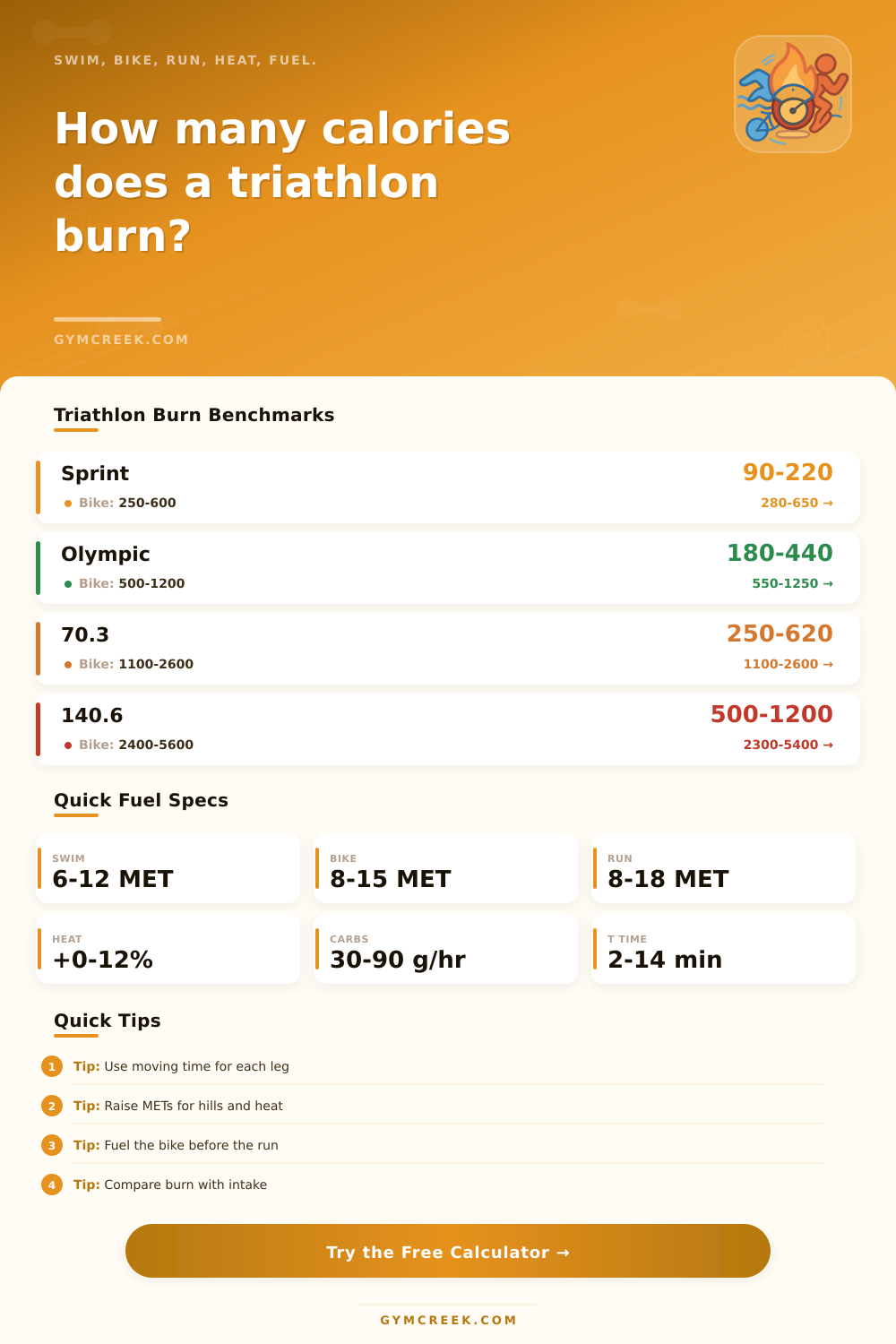
| Swim | 6-7 MET | 8-10 MET | 10-12 MET |
| Bike | 7-9 MET | 9-12 MET | 12-15 MET |
| Run | 8-10 MET | 10-13 MET | 13-18 MET |
| Transition | 2 MET | 3 MET | 4 MET |
| Duration | Carb target | Calories/hr | Context |
|---|---|---|---|
| Under 90 min | 0-30 g/hr | 0-120 | Optional |
| 1.5-3 hr | 30-60 g/hr | 120-240 | Useful |
| 3-6 hr | 60-90 g/hr | 240-360 | Important |
| 6+ hr | 70-100 g/hr | 280-400 | Critical |
| Modifier | Low | Medium | High |
|---|---|---|---|
| Swim chop | 0% | 4% | 9% |
| Bike terrain | -3% | 4% | 10% |
| Run terrain | 0% | 4% | 10% |
| Heat load | 0% | 4-7% | 8-12% |
| Formula | Inputs | Use | Output |
|---|---|---|---|
| MET calories | MET, kg, min | Exercise | Gross burn |
| Net calories | Gross minus rest | Training load | Net burn |
| Mifflin-St Jeor | Age, sex, size | Baseline | BMR/TDEE |
| Fuel gap | Burn and intake | Race context | Calorie gap |
💡Calculation Tips
Triathlon racing require careful planning. When it comes to planning for a triathlon, many athlete dont plan their nutrition adequately on the morning of the race. While athletes will burn some calories during a triathlon, the number of calories that their body will demand must be equal to the number of calories that the athletes are planned to be replace by.
Factors that will cause an athlete to burn more calories include higher temperature, tired legs, and hills in the course. If athletes do not plan for these factors when calculating the number of calories that they will burn during the triathlon, the athlete will likely find themselves losing the race. The gap between the number of calories that are consumed and the number of calories that athletes burn during a race is much larger than athletes may expect.
How to Plan Fuel for a Triathlon
The distance that must be covered during a triathlon is only one part of the equation that determines how many calorie an athlete will burn. Other factors that will play into the number of calories burned by an athlete include the terrain that the athlete is to be covered by during the triathlon as well as the weather during those races. For instance, an athlete who is racing on a flat sprint course will likely burn fewer calories than an athlete whose triathlon include hills.
The calculator that is made available to triathlon athletes will take into account each of these factor when performing the calculations of the number of calories that athletes will burn during these races. The calculator will not provide athletes with a single number. Instead, it will provide athletes with a clear picture of the fuel that the athlete must contain within their body and the fuel that they will be able to ingest during their race.
An athlete’s intensity during the swim portion of the triathlon will impact the number of calories that the athlete burns. Additionally, many athlete who are just beginning to compete in triathlons underappreciate the impact of swim intensity on triathletes. If an athlete is racing against conditions where they must contact other athletes or if the swim portion of the triathlon requires that athletes continuously sight targets, those athletes will burn more calories during the swim portion of the race.
Factors like these can be added into the calculator in addition to an athlete’s body size, swim times, heat, and experience. Athletes who wish to accurately calculate the number of calories that will be burned during their triathlon must account for these factors. If athletes do not account for these factor, they may find themselves underestimating the number of calories that will be burned during the swim portion of the triathlon.
As a result, those athletes will lack the energy to adequately compete in the bike portion of the triathlon prior to having a chance to consume food. The terrain for the bike portion of the triathlon as well as the wind conditions during those rides will play an impact on the number of calories that are burned by athletes during races. Terrain that includes rolling roads will require athletes to burn more calories than flat roads.
Additionally, headwinds will require athletes to burn more calories during these portions of the triathlon than when riding on flat roads without any opposing wind. The calculator uses the MET value to account for these factors for each minute that an athlete is riding bikes. These factors will impact the total number of calories that are burned by athletes during their triathlon as well as the percentage of the athlete’s total calories that come from the bike portion of the race.
The bike portion of a triathlon will typically burn the most calories during longer races. Therefore, calculating these variables allow for athletes to determine whether the amount of calories that are planned to be ingested hourly during the race are realistic according to the energy that will be needed to complete each segment of the race. The run portion of a triathlon can also create some complications for athletes in relation to the number of calories that are burned by those athletes during races.
For instance, athletes typically begin to experience fatigue after the bike portion of the triathlon. The calculator allows for athletes to select the level of fatigue that they may experience during the race. Additionally, those who are fatigued will be burning more calories during the run portion of the triathlon.
Each minute that athletes run while fatigued will burn more calories than athletes who is fresh and strong. Furthermore, if the run portion of the triathlon is to be conducted in hot, humid climate, athletes will burn additional calories due to the challenges of running in such conditions. The calculator will determine the percentage of the total number of calories that athletes burn during their triathlon that will be represented by the run portion of the race.
Many athletes are surprised at the percentage of calories that is burned during the run portion of triathlons. In addition to the segments that athletes race during triathlons, athletes also burn calories during the transitions between the different portion of the race. Athletes burn calories when standing, when jogging between different zones of the course during transitions, as well as when moving their race gear.
This calculator calculates each of these calories separately to determine the total number of calories that will be burned by athletes during their triathlons. The number of calories that are burned during the transitions between portions of the triathlon will have the least impact on short race distances. In long races, however, the number of calories that are burned during these transitions can add up to a significant amount of calories that are burned by athletes during their triathlon events.
By understanding the gap between the number of calories that are to be consumed during a triathlon and the number of calories that an athlete will burn during such a race, athletes will have a better understanding of how to fuel their bodies for the event. For instance, there may be a small gap between the number of calories that are targeted for athletes to ingest during each portion of the triathlon and the number of calories that those athletes burn. For sprint distances, this small gap may be acceptable.
For half or full-distance triathlons, though, a small gap in the number of calories may cause problem for athletes. While athletes do not need to consume the same number of calories as their bodies burn during a triathlon, athletes need to understand the size of that gap in order to make adjustments to the distance that they race or to the fuel that they will need to carry during their events. The body size and the activity level of an athlete during a typical day will be used to create the calculation of the number of calories that will be burned during a triathlon.
Athletes who are of a larger weight will burn more calories during each portion of a triathlon than athletes of a lower body weight. Additionally, athletes who have higher metabolic rate will burn more calories during a triathlon than those who have lower metabolic rates. The age and gender of an athlete will also be calculated in the estimation of the number of calories that are burned by an athlete during a triathlon.
These factors will help to create a calculation of the number of calories that are burned by an athlete based on their physiology. If athlete inputs are accurate, the gap between the number of calories that are to be ingested and the number of calories that will be burned will be a helpful planning tool for athletes. The variables that the tool calculates are not likely to be the same as the conditions during the actual races.
For example, weather and temperature will change during races. The terrain that the athletes are to be covered by during races may change during those competitions. While the calculator cannot provide an accurate estimation of these variables, athletes can use the calculator to create a few different scenarios for the triathlon based on different variable.
By creating these scenarios, athletes can gain an understanding of which scenario they should expect during the race, and which scenario they may experience during their actual triathlon competitions. One of the most common errors of athletes is to treat the planning of calories as a math problem that is to be solve upon arriving at the start line of the triathlon. After the start of the triathlon, though, athletes must use the information obtained from the calculator to adjust the fueling of athletes during the race.
If athletes feel that they are burning more calories than they are consuming, they should adjust the fueling of athletes during the race. Athletes should listen to their body. Athletes should slow down if the weather during the triathlon becomes hotter.
Athletes should also adjust their food intake according to how well their bodies are cooperating with the consumption of food during the triathlon. By utilizing the calculator, athletes will be able to reduce the number of surprises that may happen to athletes during their triathlon competitions. The biggest value of this calculator for athletes is that athletes will have a clear idea of what each triathlon will require of athletes.
By utilizing the calculator, athletes will understand if the amount of fuel that they are putting into their bodies is enough to last the entire triathlon competition. While there may be other surprises for athletes during the actual races, athletes will be prepared for some of those surprises if they utilize this tool to calculate their fueling needs for each portion of their triathlon competitions.