Treadmill Steps Calculator
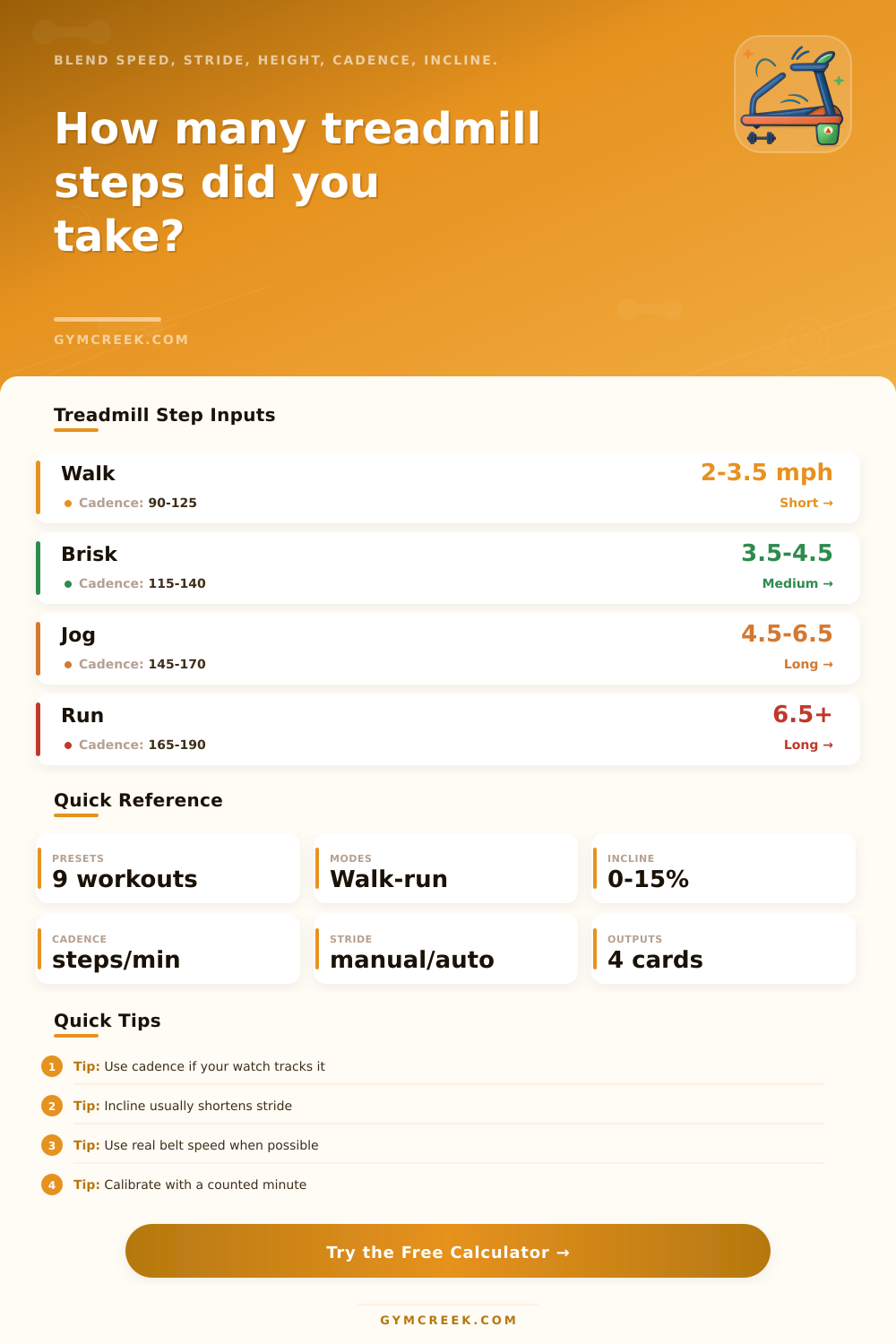
Estimate treadmill steps from belt speed, workout time, height-based or manual stride length, cadence, incline, and walking or running mode.
📌Presets
Each preset loads a different treadmill situation, including speed, duration, stride source, cadence, incline, mode, body size, and calibration factor.
⚙Calculator
Treadmill step estimate
Enter speed, duration, stride length, height, cadence, incline, and mode to estimate steps from multiple signals.
📊Session Metrics
📑Reference Tables
| Mode | Typical speed | Cadence range | Step pattern |
|---|---|---|---|
| Easy walk | 2.0-3.0 mph | 85-115 steps/min | Short, relaxed stride |
| Brisk walk | 3.0-4.5 mph | 110-140 steps/min | Quicker foot turnover |
| Jog | 4.5-6.5 mph | 145-170 steps/min | Longer aerial stride |
| Run | 6.5+ mph | 165-190 steps/min | Cadence usually steadier |
| Mode | Base factor | Incline change | Best use |
|---|---|---|---|
| Walking | 0.413 x height | Shortens faster | Normal walking and desk treadmill sessions |
| Brisk walking | 0.430 x height | Moderate shortening | Fast walks near the walk-run transition |
| Jogging | 0.580 x height | Moderate shortening | Easy running where stride opens up |
| Running | 0.650 x height | Smaller shortening | Runs with stable cadence and longer stride |
| Output | Formula | Signal | Why it matters |
|---|---|---|---|
| Stride steps | Distance / stride | Speed, time, stride | Uses the actual belt distance instead of guessing from time alone. |
| Cadence steps | Cadence x minutes | Steps per minute | Captures short steps, watch cadence, and treadmill cadence checks. |
| Final estimate | Weighted blend | Stride plus cadence | Reduces error when one signal is weak or uncalibrated. |
| Calories | ACSM walk/run | Speed, grade, weight | Gives training context without driving the step estimate. |
| Check | Expected result | Adjust if | Input to change |
|---|---|---|---|
| Count one minute | Matches cadence | Watch differs by 10%+ | Cadence or calibration |
| Known 30-minute walk | Steps feel plausible | Estimate is too low | Stride length shorter |
| High incline hike | More steps per mile | Stride stays too long | Mode or incline |
| Fast run | Cadence stable | Stride estimate jumps | Use cadence priority |
💡Tips
A treadmill allows a person to exercise while remaining in one place. Although many people uses treadmills at the gym or at home, it is often difficult for a person to determine how many steps they have taken while running on the treadmill. Speed is one measurement of how many steps a person may have taken on the treadmill.
The speed at which a person is running on a treadmill, however, is not a complete measurement of the number of steps the person took because the length of each stride may change. The length of a persons stride may change based on the incline of the treadmill, the state of fatigue of the person running on the treadmill, and whether the person is walking or running on the treadmill. Another method of estimating the number of steps taken on a treadmill is by using a watch to record the cadence of the persons legs.
How to Count Steps on a Treadmill
The cadence readings from a watch, however, may not be accurate in comparison to the distance traveled on the treadmill. A calculator can help a person to determine the number of steps they have taken on the treadmill by taking into account several different variable. The treadmill step calculator use the speed of the person on the treadmill, the number of minutes the person spent on the treadmill, and the person’s height, the incline of the treadmill, and whether the person utilized the handrails of the treadmill to determine the steps taken by the person on the treadmill.
Using the handrails of the treadmill may cause a person to take shorter strides, thus reducing the number of steps taken by that individual on the treadmill. Instead of only using the stride length of the person as calculated by the calculator, the person can also manually enter the number of steps taken by the person in a minute. By manually entering the stride length and the cadence of the persons legs, the calculator calculates a weighted average of the two measurements to determine the total number of steps taken on the treadmill.
The incline of the treadmill may impact the number of steps taken by a person on the treadmill. If a person sets the incline of the treadmill to a small incline, the person may have to take shorter strides as their feet will be on an incline. The calculator accounts for this by allowing the person to select the mode in which they are walking or running, as well as the percent of the grade of the incline that they set on the treadmill.
Even a small change in the length of a persons stride can impact the number of steps they take on the treadmill during a thirty-minute session. Using the handrails on the treadmill can impact the stride of the person. If a person leans on the handrails, their stride will shorten, which can reduce the number of steps they take on the treadmill.
The calculator accounts for this by allowing the person to input the amount of support they use on the handrails. Cadence is another factor that can be used to calculate the number of steps a person takes on a treadmill. Cadence can be measured with a persons watch while they are on the treadmill.
The cadence reading from a persons watch does not rely upon the distance covered by the person on the treadmill. Cadence is another measurement that can be accounted for in the calculator. If a person manually inputs their stride length and the cadence of their legs into the calculator, the calculator will place more weight on the cadence reading if the person chooses the cadence-priority setting for the calculator.
Additionally, if the stride length and cadence readings are similar to each other, the calculator will place more weight on each of those measurements. The calibration factor for the calculator may be used in cases where the number of steps taken is manually calculated and found to be different than the number of steps taken according to the watch that is used to calculate cadence. Tables on the calculator provide information about the number of steps per minute that are taken by individuals when walking or running on a treadmill.
These tables are not rules that individuals must follow when they use the treadmill. The tables, however, indicate the typical number of steps per minute that are taken while performing each of these activities on the treadmill. For instance, individuals take fewer steps per minute when they are walking as compared to when they are running on the treadmill.
These tables can help a person to understand if the number of steps calculated by the calculator is an accurate reflection of the number of steps that they took while on the treadmill. After a person calculates the number of steps they took on the treadmill, the calculator displays a variety of different metric for that individual during that session on the treadmill. In addition to the distance traveled on the treadmill by the individual, the calculator calculates the number of vertical steps taken and the number of calories that were burned by the individual during their session on the treadmill.
By reviewing the number of steps that are indicated on the calculator, the person may be able to make a determination of whether they would like to adjust the incline of the treadmill for future sessions. The number of steps that are calculated on the calculator can be made more accurate by utilizing the actual measurements of the individual. The best measurement for speed for the treadmill is the speed that is indicated on the treadmill console.
Additionally, if a person manually counts the number of steps that they take in one minute, they can use that measurement to manually adjust the calculators determination of the number of steps that they took on the treadmill. The calibration factor on the calculator can be used to adjust for these errors in the measurement of the number of steps. There are some complications to utilizing the calculator that may differ from the actual number of steps that an individual may have taken on the treadmill.
For instance, a person may take longer strides on some days than they do on other days. The person may take longer strides when they are rested as compared to when they are feeling distracted from their treadmill. Additionally, if a person incorporates intervals of walking and running on the treadmill, these different speeds may impact the cadence of the individual, which can be difficult for the calculator to account for within a single measurement.
While these errors may impact the accuracy of the calculator, they do not impact the validity of the estimate of the number of steps that were taken on the treadmill. The use of the calculator may become more valuable to an individual if they track the number of steps that they take on the treadmill over a period of several week. By tracking the number of steps, distance traveled, and incline of the treadmill, an individual can determine whether their stride is increasing or decreasing over time.
Additionally, with such a calculator, an individual can determine if certain modes on the treadmill result in the taking of more steps than others. Such information could be used by an individual to help achieve their goals for distance running or walking, or to track their steps throughout the day to ensure that they are meeting their movement goals. The calculator provides an estimate for the number of steps that an individual takes on the treadmill.
That number provides an individual with a means of comparing their movement on different days.