Treadmill Incline Calculator
Convert treadmill grade into hill angle, vertical gain, equivalent flat effort, METs, VO2, calories, and training notes using speed, time, body size, and handrail use.
📌Presets
Presets fill realistic treadmill sessions. Change any field and recalculate for your treadmill, unit system, and training goal.
⚙Incline Inputs
Incline estimate
Enter your treadmill settings to calculate hill angle, climb, and metabolic cost.
📊Fitness Metrics
📘Reference Tables
| Incline | Angle | Typical use | Training feel |
|---|---|---|---|
| 0% | 0.0 degrees | Flat treadmill baseline | Lowest belt-only workload |
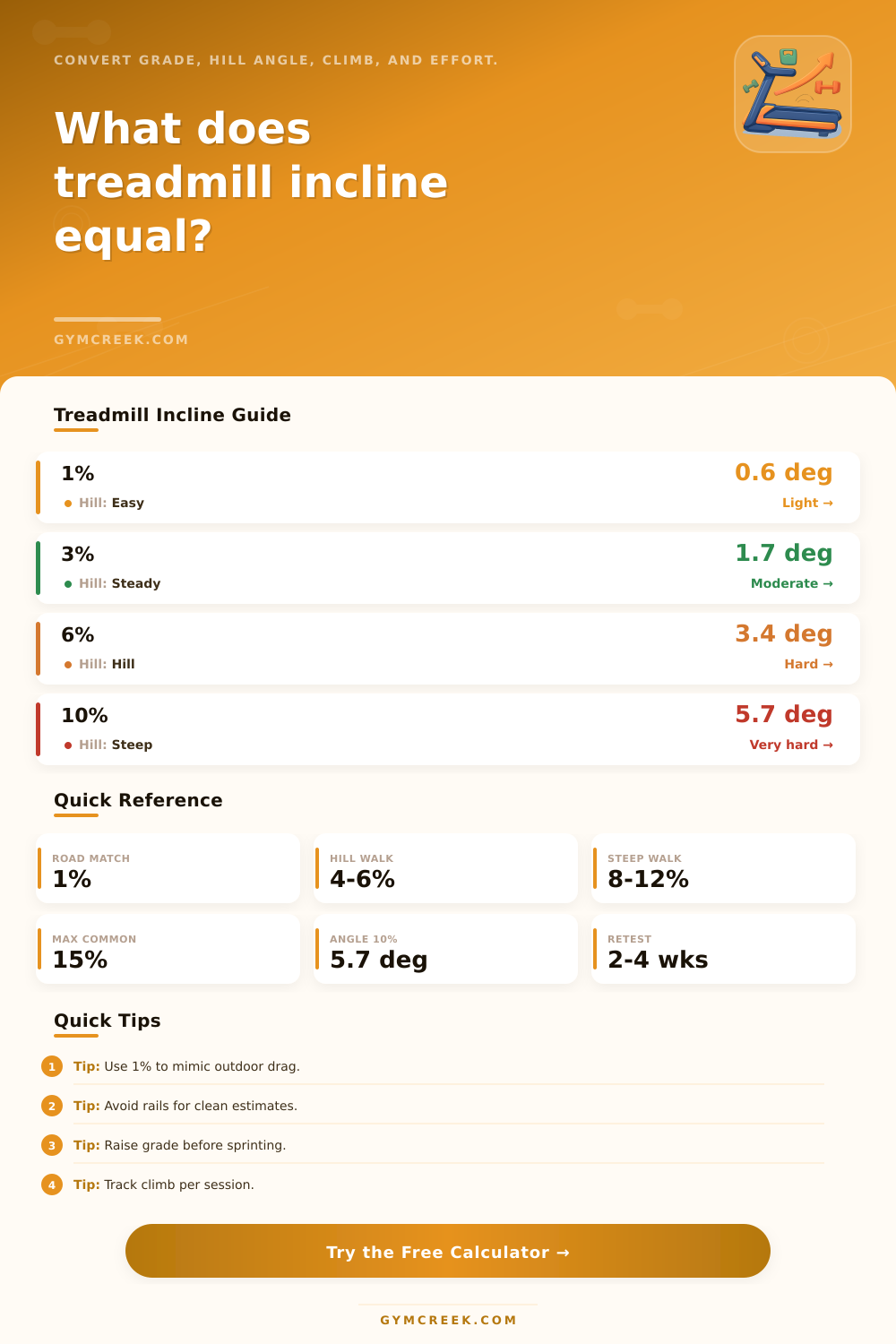
| 1% | 0.6 degrees | Outdoor road effort match | Slightly firmer than flat |
| 3% | 1.7 degrees | Easy hill walk or aerobic jog | Noticeable but sustainable |
| 6% | 3.4 degrees | Hill walking and base climbing | Strong posterior-chain demand |
| 10% | 5.7 degrees | Steep walking or power hiking | High calf and glute demand |
| 15% | 8.5 degrees | Maximum grade on many treadmills | Very high walking workload |
| Scenario | Speed | Incline | Expected result |
|---|---|---|---|
| Outdoor race tune-up | 5.5-7.5 mph | 1% | Small grade, closer road effort |
| Incline walking base | 3.0-4.0 mph | 4-8% | High METs without running speed |
| Power hiking prep | 2.5-3.5 mph | 8-15% | Large vertical gain per hour |
| Recovery incline | 2.0-3.2 mph | 1-4% | Low impact, modest workload |
| Hill repeat set | 5.0-8.0 mph | 3-8% | Brief hard VO2 demand |
| Formula | Variables | Used for | Note |
|---|---|---|---|
| Grade to angle | atan(incline / 100) | Degrees of treadmill slope | Percent grade is rise over run |
| Vertical gain | Distance x grade | Climb per session | Uses adjusted belt distance |
| ACSM walking | 3.5 + 0.1S + 1.8SG | VO2 at walking speeds | S is meters per minute |
| ACSM running | 3.5 + 0.2S + 0.9SG | VO2 at running speeds | Used above about 5 mph |
| Calories | VO2 x kg x 5 / 1000 | Energy estimate | Adjusted for rails and carried load |
| Mifflin-St Jeor | Weight, height, age, sex | BMR and TDEE context | Not a diagnosis |
💡Practical Tips
Treadmill incline is an setting that changes the physical demands placed upon the body, and the incline setting for treadmills can change the bodys response to exercise. Increasing the treadmill incline change the amount of work the body must perform in vertical movements. A small increase in the incline setting can make a walking routine feel like it has increased in grade, heart rate, and breathing rate.
Because the treadmill belt move horizontally but does not move forward in space, the incline is the setting that simulates running up a hill. Many people uses the incline setting to control the physical demands of their workout routine. However, treadmill incline is a measurement of the rise over the run of the incline setting.
How Treadmill Incline Changes Your Workout
The percent grade of the treadmill incline represent the rise of the treadmill belt over the distance that the treadmill travels forward. Because the physical demands of a treadmill incline depend upon a runners speed and the length of time they run on the treadmill, a calculator can help to indicate the specific math that relate to the incline of a treadmill. Such a calculator allows an individual to enter their settings into the calculator to determine how they feel compared to other incline settings for the treadmills.
Several factor determine how much energy the body use while exercising on the treadmill at a specific incline. One of these factors is the body weight that must be lifted over the incline; the higher the body weight, the more energy is required. Another of these factors is the rate at which the individual is traveling on the treadmill; the higher the speed, the more times that the body must lift its weight over the incline.
The third of these factors is the length of time that the individual spend on the treadmill; the longer time that an individual runs on the treadmill, the more vertical gain that individual achieves. Thus, an individual can burn more energy during a long session at a low incline than during a short session at a high incline. Many runners use a one percent incline to simulate the feel of outdoor running.
Outdoor running includes the resistance that the air presents to an individual as they run outdoors, as well as the natural variations of terrain outdoors. By using a one percent incline on a treadmill, runners can even out the energy expenditure of outdoor and indoor running. Additionally, increasing the incline of the treadmill shift the physical demands upon the body to the posterior chain (the calves and glutes).
Thus, individuals that wish to increase the strength of these muscles can use a higher incline on the treadmill. One of the measurable variable of using the treadmill incline is the vertical gain that is created. Vertical gain is the total distance that an individual gains in vertical movement while running on the treadmill.
If an individual’s goal is to gain as much vertical movement as possible, then they should track their vertical gain rather than their treadmill incline. The calculator create a variable for vertical gain by inputting an individual’s incline and the length of time that they run; this provides individuals with a means of comparing vertical gains between different sessions on the treadmill. For instance, an individual can use the calculator to determine if a forty-minute session at an eight percent incline will lead to greater vertical gain than a twenty-minute session at a twelve percent incline.
The body use different amounts of energy walking on a treadmill incline compared to when running on that same incline. The equations for walking use the incline of the treadmill more heavily than those for running, as the body remain in contact with the treadmill for longer periods during walking compared to running. Thus, the calculator must determine the speed at which an individual plan to exercise to ensure the proper formula is used to calculate the energy use for that treadmill incline.
The extra weight that an individual carry can impact the physical demands of the treadmill incline. The additional weight increase the mass that must be lifted over the incline; thus, the body will expend more energy and fatigue more quickly using the treadmill incline. If an individual is training for backpacking or other type of trail travel with added weight, that weight must be accounted for in the calculations.
Using the handrails can alter the physical demands of the treadmill incline. If an individual uses the handrails to assist in movement forward, their legs must produce less force to achieve the same movement. Because treadmills are set up to assume that an individual will support their body weight, using the handrails alters the incline setting to one that is easier to achieve.
Thus, individuals should avoid the use of handrails if their goal is to experience the incline setting of their treadmill. There are different types of training that can be performed with the use of a treadmill incline. Sessions at a modest incline and speed can be used to recover from physical exertion.
Sessions at a steep incline and controlled speed can be used to increase the bodys power. Aside from incline, there are many other variables associated with treadmills. Thus, incline should be one of many variables that an individual adjust, rather than the only variable.
For instance, each variable can be adjusted one at a time while monitoring the effects of that variable on vertical gain and energy use. Though the calculator may provide the numbers for treadmill incline, it is up to the individual to use those numbers in making decisions regarding there training.