Treadmill Grade To Outdoor Pace Calculator
Convert treadmill grade, belt speed, athlete size, calibration, handrail support, surface, wind, and route profile into an equal-effort outdoor pace estimate.
📌Grade Conversion Presets
Presets fill every field with realistic running or walk-jog scenarios. Change any value to recalculate the outdoor pace estimate.
⚙Treadmill And Outdoor Inputs
Treadmill grade conversion
Enter belt speed, grade, outdoor conditions, and athlete context to estimate the outdoor pace that matches the treadmill effort.
📊Outdoor Pace Metrics
📘Grade And Pace Reference
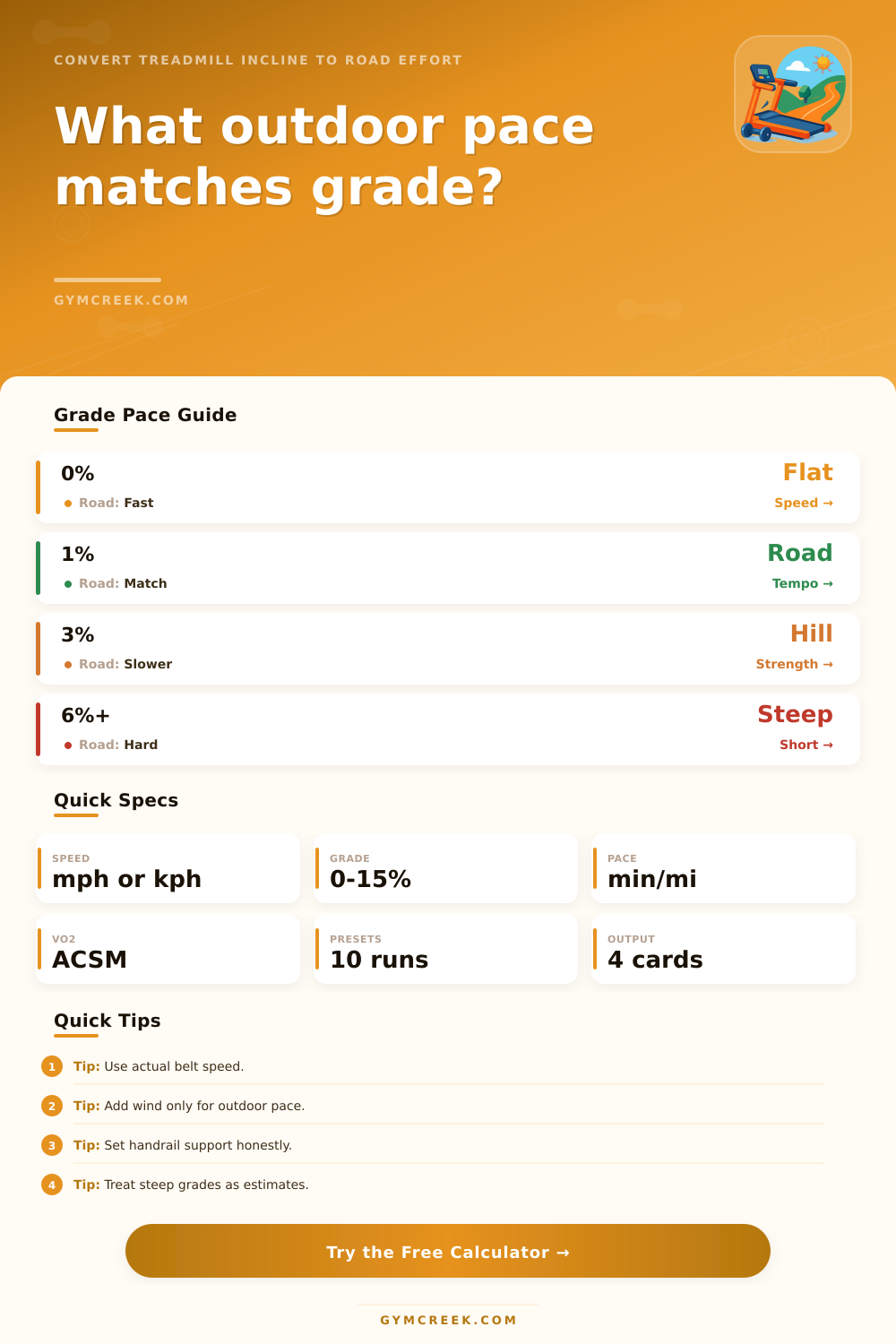
| Grade | Typical Use | Effort Shift | Outdoor Read |
|---|---|---|---|
| 0% | Turnover work | Lowest belt load | Often faster than flat road |
| 1% | Flat road practice | Small added cost | Common road-air proxy |
| 2% to 3% | Tempo strength | Noticeable climbing load | Outdoor pace slows meaningfully |
| 4% to 6% | Hill repeats | High aerobic and muscular load | Use effort more than pace |
| 8%+ | Power hiking or steep runs | Very high slope term | Estimate only; form dominates |
| Factor | Low | Moderate | High |
|---|---|---|---|
| Surface | Track or road | Gravel or grass | Trail, snow, or sand |
| Wind | Calm | Light breeze | Headwind, heat, or cold |
| Route | Flat or closed race | Rolling roads | Hilly or technical route |
| Handrails | None | Light touch | Steady or heavy support |
| Grade | VO2 | Flat Pace | Use Case |
|---|---|---|---|
| 0% | -- | -- | Speed reference |
| 1% | -- | -- | Road proxy |
| 3% | -- | -- | Hill strength |
| 6% | -- | -- | Steep repeat |
| Step | Formula | Inputs | Result |
|---|---|---|---|
| Speed | pace or belt speed to m/min | unit system | running velocity |
| Grade VO2 | ACSM walk/run equation | speed and slope | oxygen demand |
| Outdoor pace | flat speed divided by modifier | surface, wind, route | equal-effort pace |
| Session load | VO2 x kg x minutes | weight and time | calories and METs |
💡Conversion Tips
Though the belt move at the same speed, you’ll find that adding incline will change your experience. It’s harder on your legs and lungs. This means if you want to know whether treadmill training will translate to your pace outside, you’ve got to know what your treadmill’s asking of you.
Every additional percentage grade add to the vertical part of your step, which require more oxygen sooner then you’d think. This is why a 1 percent grade is considered similar to road running, as it provide roughly the same amount of air drag and rolling resistance you encounter outdoors. The calculator figure out how hard it will be for you to travel at any speed across a given grade.
How Treadmill Changes Help Your Outdoor Running
If you push to something like 4 or 6 percent, the work is no longer general and becomes specific to hills. This is because it begins to rely more on muscles then breathing. Those are variables, too, treadmill running is never quite like running on pavement, but the variables matter when handrail support reduce load in ways it’s easy to underestimate.
A light touch drops your effective effort noticeably and steady gripping changes your movement pattern; the surface you plan to run on outdoors adds another layer of difficulty. Grass or gravel will slow you down compared to smooth asphalt. A technical trail or a headwind make that difference even bigger.
The tool allow you to adjust to match those changes, rather than guessing how many seconds slower your road pace should of been after a steep session. The picture gets changed by weather and route profile as well: A calm day on flat roads yields one set of results while the same treadmill workout done on a moderately breezy, rolling course is different. The calculator takes those factor into account.
This allows you to determine whether this indoor session really equaled intended outdoor workout. This is key if you’re targeting specific adaptations, such as low-fatigue turnover or muscular resilience from sustained climbing. You should also monitor vertical gain.
For example, the same duration and speed on a 3 percent grade vs. A 6 percent grade result in very different climbing totals. Though it will appear as if you are going slower, a higher grade might provide more targeted training for hill strength in preparation for an upcoming race. Meanwhile, a modest grade for longer duration can still build up usable work without as much muscular cost if you’re guarding against overtaxing recovery between hard days.
The reference tables that come with the tool quickly put this into context, showing how efforts vary across different grades and providing guidance about how handrail, wind and surface selection will shift your ultimate outdoor pace. Don’t worry about memorizing the numbers but knowing that tiny changes in set-up result in meaningful shifts in what the treadmill workout is actualy training.
But that’s the great thing about the practical habit. You do the math beforehand so you know the cost in terms of outdoor pace. You do it during the run if the conditions are not what you expected. You do it after to make sure you’re running the right number. It gets intuitive over time, and that’s where the calculator realy shines. It takes away the guesswork and makes training decisions intentional versus hopeful.