Trampoline Calorie Calculator
Estimate calories burned from rebounder workouts, backyard jumping, fitness intervals, skill attempts, jump cadence, rest intervals, session length, body weight, and adjusted MET logic.
📌Presets
Each preset loads a realistic trampoline session and recalculates calories from bounce style, cadence, rest structure, impact, and skill density.
⚙Calculator
Trampoline calorie snapshot
Enter bounce cadence, session length, rest intervals, skill attempts, and body weight to estimate calories.
📊Trampoline Metrics
🧮Formula Cards
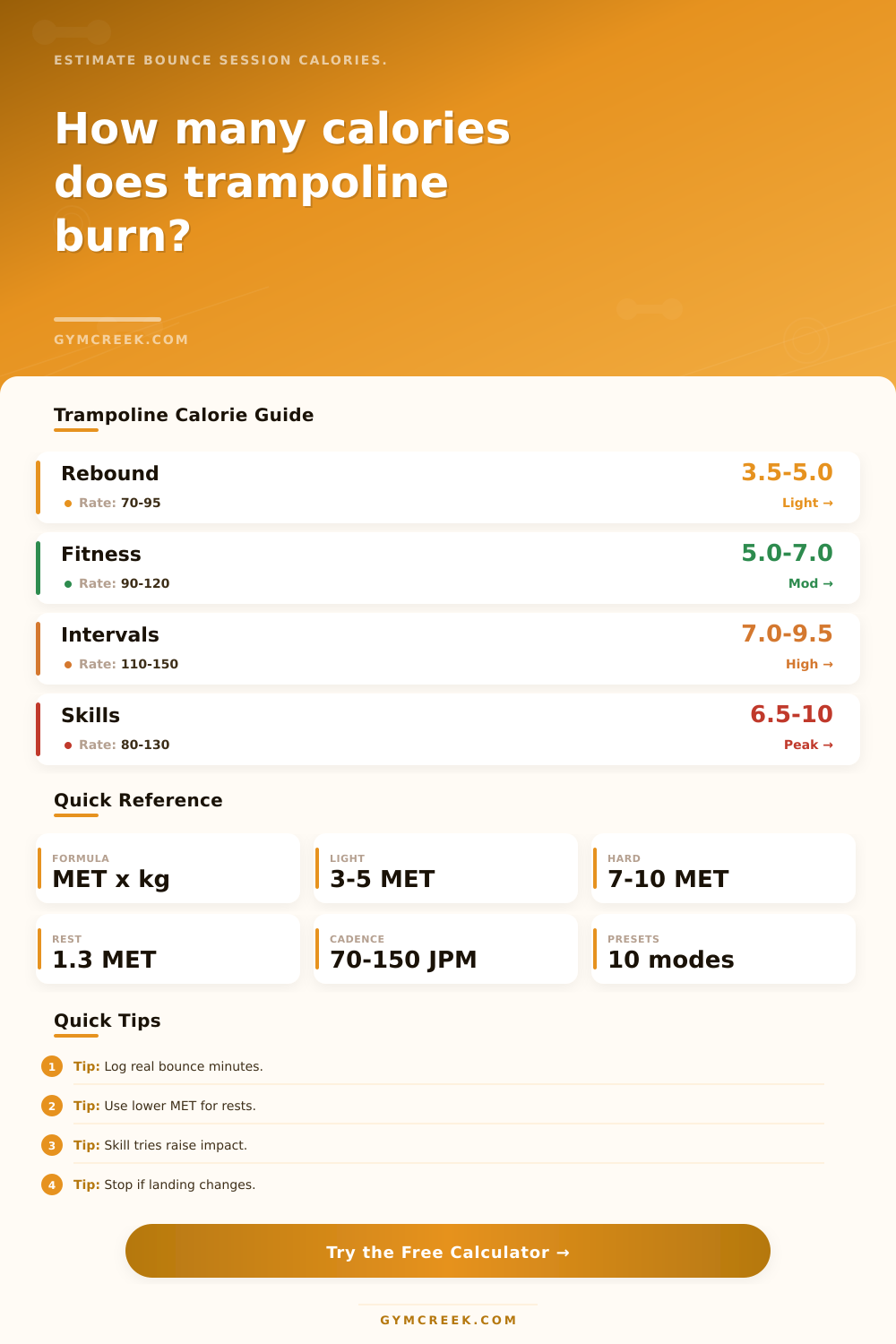
Calories per minute = adjusted MET x 3.5 x body weight in kg / 200. The calculator applies that formula to active bounce minutes.
Health bouncing starts near light MET values, while sprint bounces, HIIT rounds, plyometrics, and gymnastics drills start from higher anchors.
Jump rate, skill attempts, trampoline type, landing impact, and arm drive adjust the base MET before calorie math is applied.
Rest intervals use low MET burn, then Mifflin-St Jeor BMR and activity level estimate how the session compares with daily energy needs.
📑Reference Tables
| Bounce Style | Easy | Moderate | Hard |
|---|---|---|---|
| Health bounce | 3.2 MET | 4.0 MET | 4.8 MET |
| Steady fitness bounce | 4.6 MET | 5.8 MET | 6.8 MET |
| Jogging bounce | 5.4 MET | 6.6 MET | 7.8 MET |
| High knees or sprint | 6.4 MET | 7.8 MET | 9.2 MET |
| Skill attempts | 6.0 MET | 7.4 MET | 9.4 MET |
| Jump Rate | Cadence | Modifier | Session Clue |
|---|---|---|---|
| Gentle | 20-60 JPM | 0.92x | Warm-up |
| Steady | 61-95 JPM | 1.00x | Fitness |
| Quick | 96-125 JPM | 1.07x | Cardio |
| Fast | 126-160 JPM | 1.14x | Intervals |
| Sprint | 161+ JPM | 1.22x | Peak work |
| Skill Density | Attempts | Modifier | Examples |
|---|---|---|---|
| Low | 0-20 | 0.98x | Basic bounce |
| Moderate | 21-60 | 1.03x | Tuck jumps |
| Busy | 61-120 | 1.08x | Seat drops |
| Heavy | 121-220 | 1.14x | Combos |
| Peak | 221+ | 1.20x | Drill sets |
| Formula | Variables | Output | When Used |
|---|---|---|---|
| MET kcal | MET, kg, min | Calories | Active time |
| Rest kcal | Rest MET, kg | Break burn | Pauses |
| Mifflin BMR | kg, cm, age | Baseline | Daily context |
| Impact logic | Rate, skills | Adj MET | Skill load |
🛡Safety Tip Box
💡Tips
The trampoline’s a playground device where calorie burn isn’t just a constant value from a fitness table, but changes based off how you bounce. Hop up. Bounce a couple times. Done! Well, no. The mistake is that rebounding isn’t a one-size-fits-all exercise.
Every time you do it, your body weight, the stiffness of bed, the mechanics of your leap. These all interact in changing ways. A gentle bounce differs as much in physics than in effort. Sink further into the mat? Your muscles has to engage more vigorously to slow descent and set up for next rise. This additional tension cause the true metabolic expense.
How to Count Your Calories on a Trampoline
All you have to do is input what you did during your training session and the calculator does all the complicated math for you, no conversion factors or coefficients required. First, it anchors your burn down to an energy level (MET), aka the amount of energy it takes to power whatever type of bounce you were doing. Moderate pace bounces would fall somewhere towards the middle. Skill attempts and fast-paced sprints will skew toward higher end.
But that’s just the baseline. From there, it takes into account how quickly you’re jumping (or “cadence”). You might be banging out a hundred jumps each minute, meaning you’re going through recovery quicker and creating greater force output. That require more fuel and more oxygen. It’s a tiny detail, but it makes all the difference when it comes to accuracy.
But the largest problem for estimation come from forgetting about rest periods. A real workout isn’t 45 consecutive minutes bouncing around like mad. There’s time between move to reset, take a breather, and double-check form on a complicated move. With this calculator, you can set the percentage of your bounce that is active, and then set how long your rests are. So instead of applying a higher metabolic rate while doing nothing but waiting, it will apply a lower one to rest periods. It paints a truer picture of what you’re burning as a whole.
And it takes into account the density of skills. One bounce up and down vertically isn’t nearly as taxing on your body as seat drop or a tuck jump, which both require you to engage core and tense your entire body against gravity. Every time you try one, your body fights gravity with intention, not just in time to music. That multiply the effort you expend per attempt.
Safety isn’t just a disclaimer here. This is something that limits what you’ll be able to do. When the effort level gets intense enough, your ability to control your landing will slip. And there’s a safety reminder on the tool: if your landings get erratic, or if you start to lose balance, it reminds you to dial back the intensity. It looks cool in pictures, but it can mess up your ankles if your footing isn’t steady. You should of wanted to be icing your shins for the next week; you want to be burning calories.
The style breakdown on this page (metabolic load) breaks out into easy, moderate, hard efforts so you know going in what to expect even before stepping on the mat. At its core, though, it’s all about energy and movement. What does that mean? How do you know?
The numbers provided by the calculator are a snapshot. It is a rough estimate of what your body just did. But more than anything else, it’s about awareness. You begin to feel the difference when a few extra inches make your heart beat a bit faster. You see how brief rests aren’t idle time, they’re fuel for the upcoming burst. You no longer guess; instead, you measure your improvement in terms of consistency and quality.
The trampoline no longer feels like a bouncy toy, it’s now a finely tuned tool used to condition your body. Each jump now has a cost, and it has a payoff: you know exactly what it’ll give you back and what it’ll take from you. That understanding makes this once casual hobby into a disciplined practice.
One bounce at a time.