Taper Calculator
Build a peak-week taper from event date, days out, baseline training volume, intensity retention, sport or lift, fatigue, fitness priority, and taper length.
📌Named Taper Presets
Each preset changes sport demands, baseline load, fatigue, priority, and final-session timing.
⚙Taper Inputs
Peak week taper snapshot
Enter your event timing, training load, fatigue, and priority to calculate a taper.
📊Taper Metrics Grid
📑Taper Tables
| Phase | Window | Volume Target | Training Focus |
|---|---|---|---|
| Start | --- | --- | --- |
| Sport Type | Usual Length | Final Volume | Intensity Note |
|---|---|---|---|
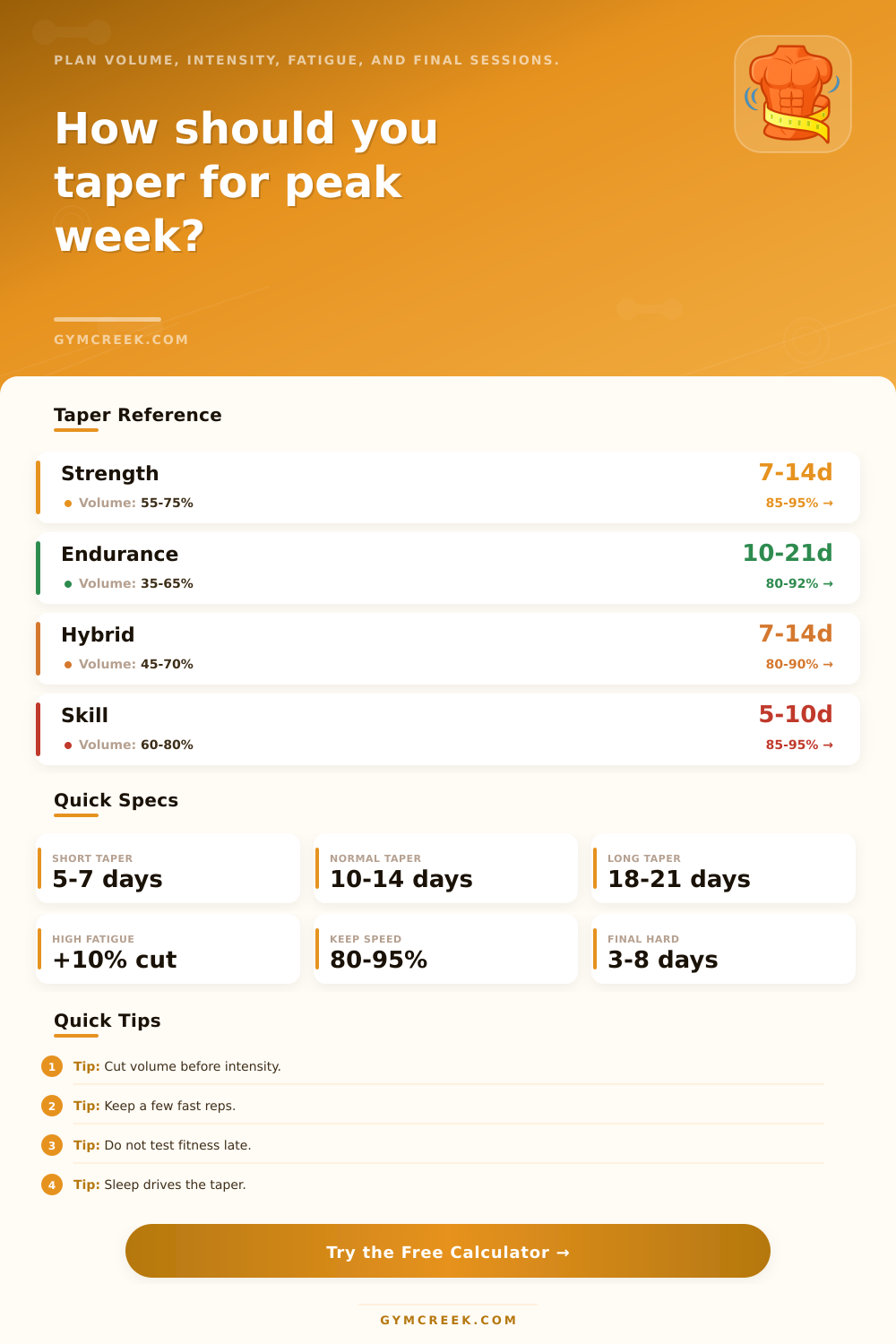
| Powerlifting or max strength | 7-14 days | 55-75% of baseline | Keep heavy singles, reduce backoff work |
| Endurance running | 10-21 days | 35-65% of baseline | Keep race pace, remove long fatigue |
| Cycling endurance | 7-18 days | 40-70% of baseline | Short openers preserve power |
| Hybrid competition | 7-14 days | 45-70% of baseline | Keep skills crisp, avoid soreness |
| Signal | Low | Medium | High |
|---|---|---|---|
| Fatigue score | 0-3: small cut | 4-6: normal cut | 7-10: extra cut |
| Readiness | 80-100: hold rhythm | 55-79: normal taper | 0-54: recover first |
| Freshness priority | Keep intensity | Drop volume | Move hard work early |
| Fitness priority | Keep frequency | Reduce duration | Avoid new work |
| Session Type | Best Window | Volume | Purpose |
|---|---|---|---|
| Sharpness | --- | --- | --- |
💡Taper Tips
But how do you clear all this fatigue off of your nervous system and muscles without erasing the specific skills you worked on? That’s what a taper is. Whether you’re going in sharp or flat depend on this balance, and many athletes end up cutting too much too soon, cutting the wrong thing at the wrong time. But the calculator help you make it concrete.
You enter your baseline volume so the tool knows how big your last stable load was. Everything we do is always relative to that number. Then you set days out from your event, which sets calendar. And then you select your lift type/sport to adjust the default, as a marathon runner clears fatigue and loses fitness at different rates than a powerlifter. Next, you’ll input a readiness score and a fatigue score since even two athletes with the exact same log will recover differently. Finally, sleep data and trends in your pre-taper further adjust the plan. Poor sleep mean you need to drop volume more aggressively.
How to Use the Taper Calculator
Those inputs is translated into actionable decisions rather than abstract percentages. For example, timing of last hard session and the number of sharpness sessions provide time guidance: Don’t push it when you need recovery! The freshen-up estimate sits side-by-side with fitness estimate: Both matter. Your intensity retention figure indicate how much load or speed to maintain while still feeling like “it’s a workout.” That final-week volume target become what you should of schedule. A risk label flags if the plan is veering towards unnecessary loss of sharpness or under-recovery.
Yes, you probably realize you need to cut back more than you do. Now how much more? And when does it make sense to change what is considered normal? The general rule is: cut deeper if your readiness is low and fatigue level are high. Injury, travel stress require even greater conservatism; so does a short taper.
That’s the hard stuff. Figuring out what to trust on each training block come down to self-honesty about the signals you see. Once you plug those into the calculator, it will do the math for you.
The problem here is you treat final week as a mini training camp. The other issue is you pull the final hard effort too far forward, as it never seems good enough when you’re nervous. Both stem from the fear of stopping training and not having your fitness go away. But what goes away fast isn’t fitness. Instead, it is low-grade systemic fatigue that masks your fitness. Residual soreness also hide fitness, but it doesn’t impact performance different than real fatigue does.
To help in second guessing, there’s a reference table at the bottom of the page to demonstrate how other sports has approached reducing volume while retaining intensity (a nice resource if your current situation falls between two preset). For those who are more interested in freshness than fitness, these tables can be used as a starting point for what to expect and then changed from there by calculator using your real-world readiness, fatigue, and sleep data.
In those last few days, the most effective taper feel boring. Your training is short, targeted, and wraps up early enough to allow your body to recover fully. That’s where the calculator comes into play: It helps you reach that sweet spot through less guesswork. If you’re putting in what your body realy shows you versus what you wish it looked like, chances are, the output will land in the same place. You do little enough work so you show up rested and just enough work to keep you sharp.