Training Monotony Calculator
Enter seven daily training loads to calculate mean load, standard deviation, monotony, strain, variation quality, and a readiness-adjusted coaching signal for your sport and load type.
📌Presets
Presets fill realistic seven-day load shapes. Use one load method across the full week: session RPE load, minutes, distance, TSS, tonnage, or another consistent internal or external load score.
⚙Calculator Inputs
Training monotony snapshot
Enter seven daily loads to calculate monotony, strain, variation, and readiness-adjusted next steps.
📊Metrics Grid
📑Reference Tables
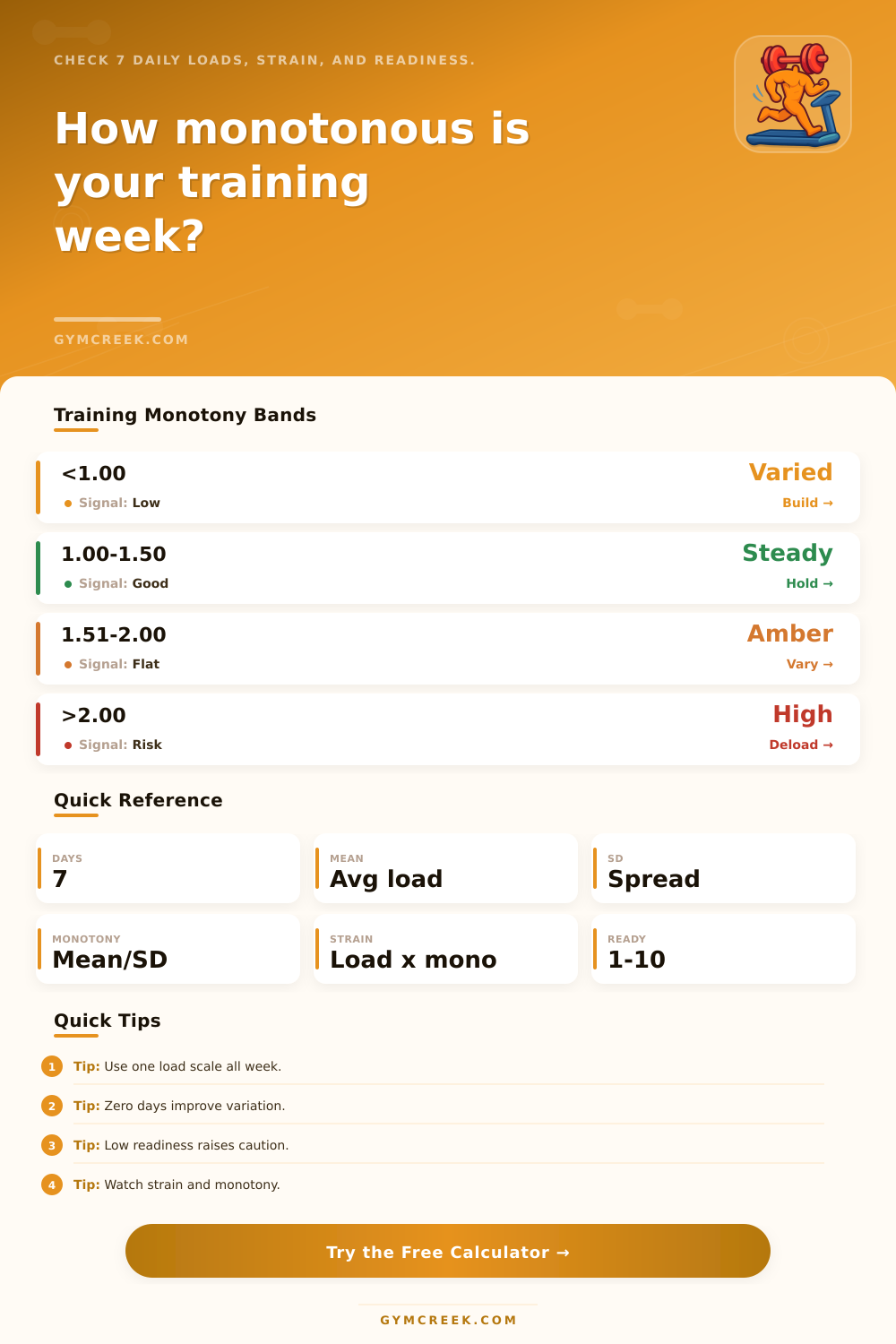
| Monotony | Band | Signal | Training Call |
|---|---|---|---|
| <1.00 | Varied | Large load spread | Build if recovered |
| 1.00-1.50 | Steady | Useful rhythm | Hold structure |
| 1.51-2.00 | Amber | Similar daily load | Add contrast |
| >2.00 | High | Flat high stress | Deload or vary |
| Measure | Formula | Reads | Use |
|---|---|---|---|
| Weekly load | Sum 7 days | Total stress | Volume review |
| Mean | Load / 7 | Daily average | Baseline |
| SD | Daily spread | Variation | Shape check |
| Strain | Load x mono | Stress density | Risk screen |
| Sport | Typical Load | Variation Need | Watch First |
|---|---|---|---|
| Field sport | sRPE / GPS | High-low rhythm | Sprints |
| Running | Miles / TRIMP | Easy-hard split | Long run |
| Gym | Tonnage / RPE | Heavy-light days | Joint stress |
| Cycling | TSS | Intensity blocks | Back-to-back |
| Readiness | Meaning | Bias | Decision |
|---|---|---|---|
| 8-10 | Fresh | Normal | Proceed |
| 6-7 | Okay | Watch | Keep flexible |
| 4-5 | Flat | Caution | Reduce sameness |
| 1-3 | Poor | High caution | Deload |
💡Tips
When you get into training monotony, your days is all the same. Same effort. Same load. Same recovery window. While it initially feels like you’re doing work, over time your body stop adapting because it has no reason to change. This is where measuring monotony come into play. It allow you to take a vague sense of staleness and turn it into something real, something you can measure and alter.
The formula calculate how similar (or dissimilar) all of those days are in a single week. The more spread out they are from each other, the more different signals the body get to respond to. You’ll see a lower number if your easy day and hard day has a big difference. Neither number is automaticly good or bad. If your loads is close together, you’re seeing a higher number. In that case, the system will treats all session with equal demands. Neither is inherently good or bad. It simply depends on whether this pattern align with your goals for the week.
Why You Should Measure Training Monotony
Different sports tolerate monotony at different levels. For example, for field athletes, there are typicaly days of light technique and days where things really speed up. Runners should has truly easy days so they feel like that is what an easy day should be, along with a longer run that feels like something else. Gym athlete tend to split up volume days and heavier neural days so that the joints has some relief.
Regardless of sport, the calculator doesn’t alter the numbers, but will shift the words in describing risk after you choose your sport. This allows you to interpret the number relative to the needs of your real training.
It’s also different depending on whether or not you’re ready. You might have a relatively high monotony score. This is risky when you’re feeling flat and you’ve got limited recovery capacity. On the other hand, you might have a relatively high score that’s okay if it’s just for a short block and you’re fresh. So the readiness input adjust the recommended action while leaving the calculation intact. It just makes the recommendation more truthful to where you are at the moment.
People add in some random easy days and lower their score but they might of just lowered the overall trigger required for adaptation as well. I think the best thing is to leave at least one clear contrast day (full rest or very light), so you aren’t watering down each day with something else. That one choice tends to move your score further then you’d guess.
Another common mistake is mashing up load scales during the week. If I use Session RPE Monday, then minutes Wednesday and finally distance Friday, it’s a useless number because now the units aren’t talking the same language. It expects that you’ve picked a single unit (i.e., minutes) as your weekly measure. Follow that rule and now you’ve got something useful, something you can rely on to make little tweaks versus wholesale overhauls.
But I think that’s where the true value comes out, if you treat the output as something to check weekly instead of just something interesting to look at once. Within a week or two, you’ll begin to see the kinds of training that cause your monotony score to creep into the “amber” zone while others helps you maintain a more stable score. And that’s when you can make adjustments before you become bored with the workout or fatigued by it.
That’s what happens over time; looking at variation becomes an automatic habit. It becomes part of planning the week. Log the loads without second guessing yourself about the scale. Let the number guide whether or not it’s getting out of shape. The calculator just makes this a bit quicker and more accuratley than going off feel alone.