Training Load Calculator
Compare acute load, chronic load, acute-to-chronic ratio, monotony, strain, and weekly ramp rate from session RPE or TRIMP.
📌Presets
Each preset fills the last 7 days plus chronic and previous-week averages, then recalculates the load profile.
⚙Calculator
Daily session loads below use duration and RPE for sRPE, heart-rate intensity for TRIMP, or tonnage and effort for lifting.
Training load snapshot
Enter the week and calculate your training load profile.
📊Load Metrics
📑Reference Tables
| Metric | Lower Range | Common Target | High Flag |
|---|---|---|---|
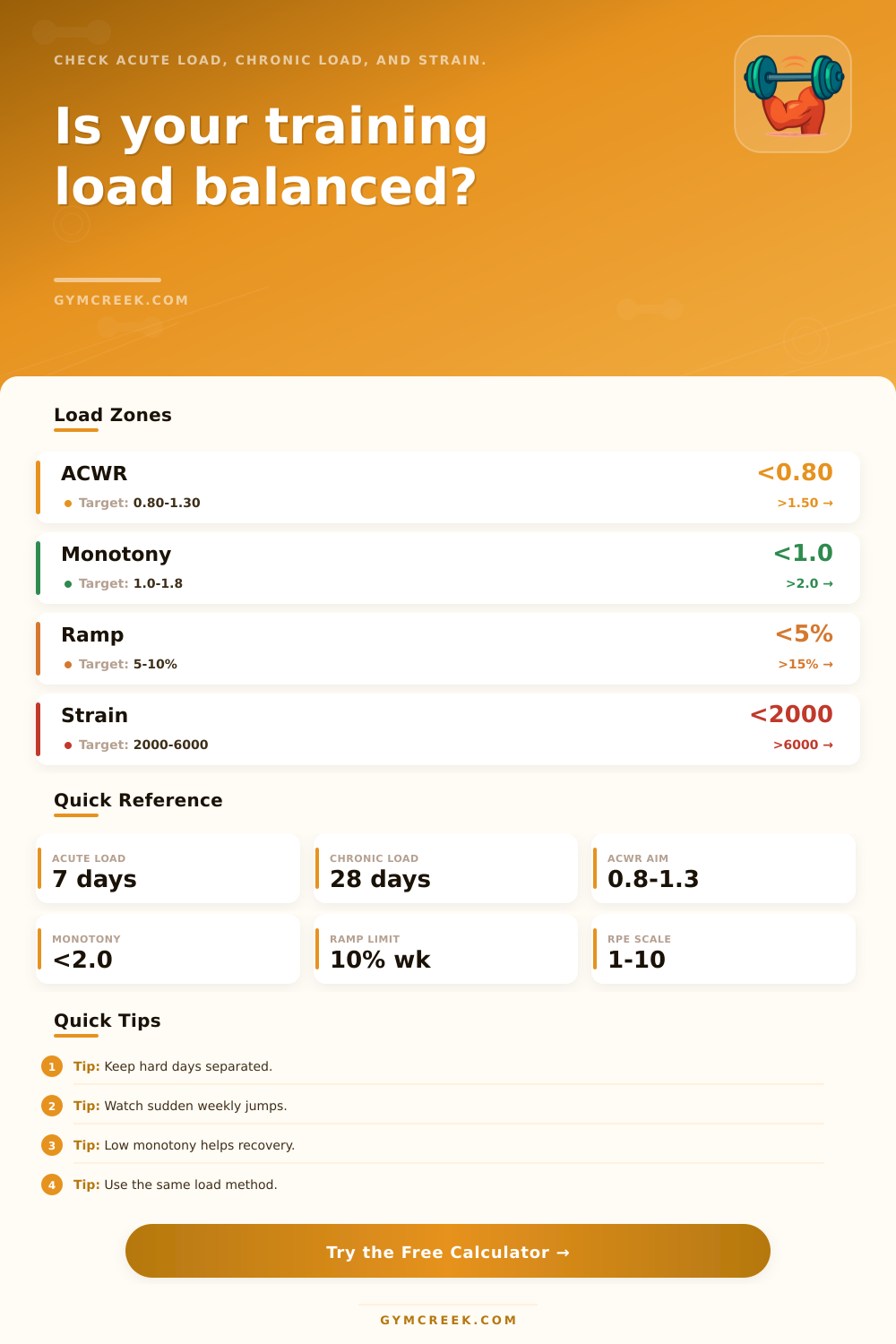
| ACWR | Below 0.80 | 0.80-1.30 | Above 1.50 |
| Monotony | Below 1.0 | 1.0-1.8 | Above 2.0 |
| Weekly ramp | Below 5% | 5-10% | Above 15% |
| Strain | Below 2000 | 2000-6000 | Above 6000 |
| Method | Formula | Best Use | Watch |
|---|---|---|---|
| sRPE | Minutes x RPE | Mixed training | Honest RPE |
| TRIMP | Time x HR load | Endurance work | HR drift |
| Strength | Tonnage x effort | Barbell blocks | Exercise stress |
| Hybrid | Same scale weekly | Team sports | Method changes |
| Scenario | Load Pattern | Signal | Adjustment |
|---|---|---|---|
| Build week | Gradual rise | ACWR 1.0-1.3 | Hold course |
| Spike week | Sharp jump | Ramp over 15% | Trim volume |
| Flat hard week | Similar daily load | Monotony over 2 | Add easy day |
| Taper | Load drops | ACWR below 0.8 | Keep intensity |
| Input | Meaning | Good Practice | Common Error |
|---|---|---|---|
| Acute load | Current 7 days | Use daily totals | Missing rest days |
| Chronic load | 28-day baseline | Update weekly | Too short sample |
| RPE | Session effort | Rate after session | Rating the peak |
| Previous week | Ramp baseline | Compare totals | Mixing methods |
💡Tips
Fatigue isn’t just an acute issue for most athletes; it’s actualy a mathematical accumulation of what you do and how hard you push. Why am I tired? Why am I dragging ass today? Instead, fatigue builds over time based off your previous training. How hard did you push it? What did you do?
To build fitness safely you need to know your training loads. You need to track them in order to understand your adaptation and stress. The calculator translate the raw data of your sessions into clear information from your own body. Chronic load is the average from the past twenty-eight days, while acute load is the work performed over the previous seven days. A good range for most athletes are 0.8 to 1.3. If you’re below that, you’re detraining. If you are above it, you are at a higher risk of injury. Too many folks tries to increase their short-term load too fast. You can’t sprint into fitness; you should of build up a chronic base first.
How to Track Your Training Load Safely
Monotony is how similar your training load is from one day to another. If all of your training days feel like they have equal intensity, then you’re experiencing high monotony which sounds productive, but might cause burn out. You need variation in order to properly recover. As you can see in the reference table, low monotony help long term consistency. Varying easy days with hard days is not laziness; it’s a strategy.
Adding load and monotony create strain. The higher your strain, the greater risk that you’re working too hard with insufficient variety. With the help of the calculator, you can identify this problem at an early stage. Ramp rate is how quickly your week’s volume increase. Doing too much too soon is a common cause of overuse injury. If your ramp rate exceeds fifteen percent then you know to slow down.
But it’s not just about the number. It depends on context. The tool asks for background in sports or other physical activities, age, and sleep duration. This affect how your body responds to load. An athlete may be able to endure more than a recreational runner. Sleep deprivation will increase the perception of a moderate load as heavy. That gives more context to the numbers. It tells you there is more to you than a collection of data point.
Volume A lot of people track volume. They log their sets, they log their miles. But not their intensity. Internal cost is what Session RPE measure. It is the cost of your effort during that workout. The load is going to be high on a short intense interval session despite less total time. The load will be low on a long easy jog despite longer total time. Other ways to measure stress include heart rate TRIMP or lifting tonnage. Pick one way to measure it and stick with it. Mixing measurement methods just add noise to your data. Stick to consistency over complexity.
It’s also about resting. It is not about blank periods in the plan, but active elements in the load profile. Training hard on a rest day elevate your acute load while increasing strain and monotony. You’re after making gains week by week, not hour by hour. Recovery planning should be every bit as much a part of the plan as workout planning. It doesn’t have to be perfect either. Any ballpark guess will be enough for this method. It’s about the pattern more than the actual number. Do you observe steep ramp rates or a lot of strain? Tweak your training before it becomes too much for you to handle.
Keep in mind that you’re looking at the bigger picture spanning weeks and months. Your training shouldn’t be chaotic but cumulative. So begin with reality. Log your real-world performance for current week. Record how difficult each day was. Review last month and see how it compares. Check your position different than the target zones. Based off what you discover, tweak a few things here or there. Add an easy day when things feel repetitive. Back off volume if the ramp rate is too great.
You want sustainable progress, not suffering. Fatigue isn’t your enemy. It’s your feedback. Listen to it. Track it. Manage it. Your body will decide what happens; the numbers are there for guidance. Trust the process. Vary your days. Build slowly. That’s how you become strong while avoiding breakdowns.