Training Frequency Calculator
Plan weekly lifting days, split structure, set distribution, and recovery pressure from your goal, training age, schedule, and current workload.
📌Presets
⚙Calculator
Training frequency plan
Enter your weekly workload and recovery profile to plan training days.
📊Fitness Metrics Comparison
📑Reference Tables
| Goal | Typical Days | Set Distribution | Best Fit |
|---|---|---|---|
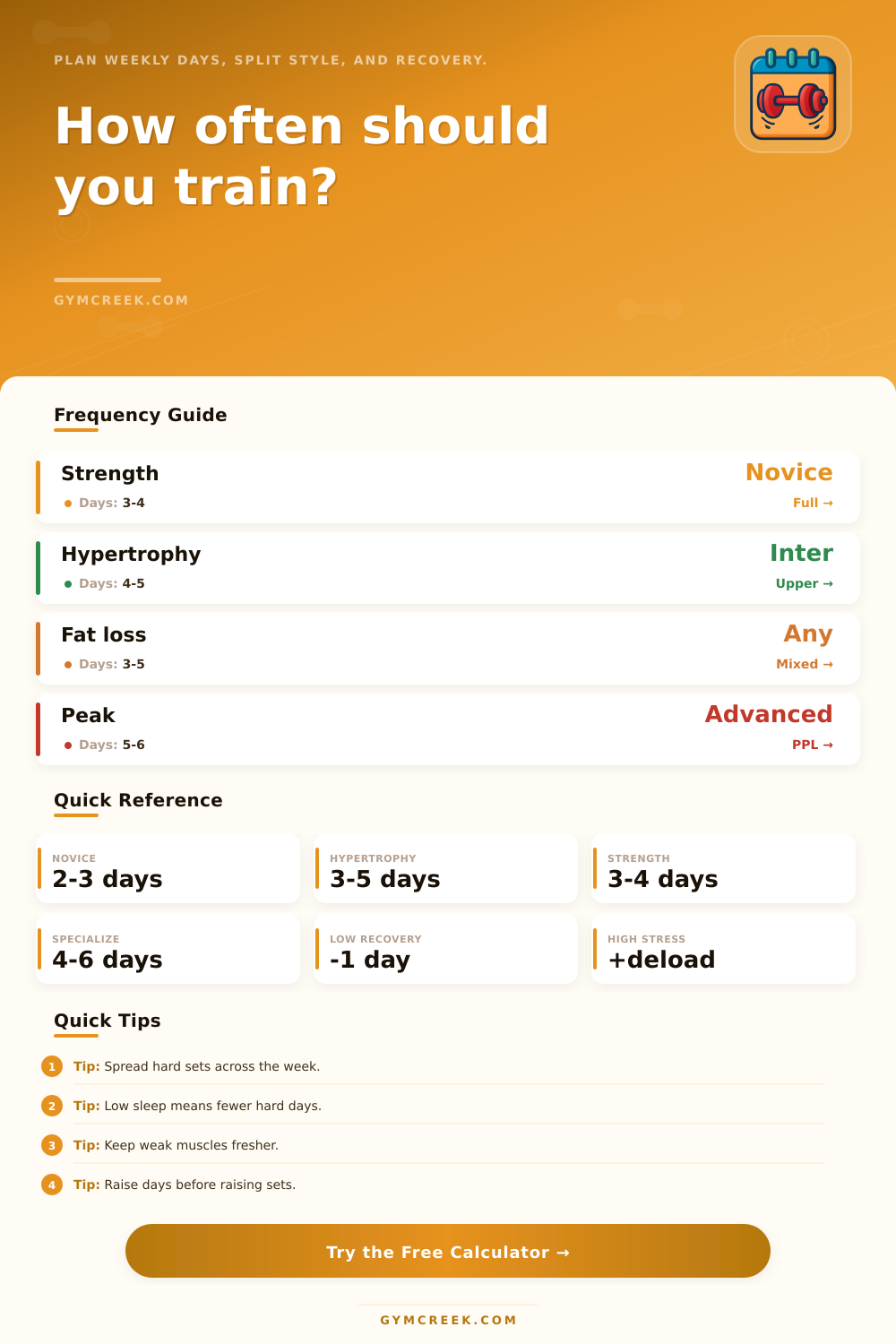
| General fitness | 2-4 | Moderate sets, full body | Consistency and skill |
| Hypertrophy | 3-5 | 10-20 sets per muscle | Upper/lower or PPL |
| Max strength | 3-4 | Frequent practice, lower reps | Full body or lift focus |
| Specialization | 4-6 | Extra priority exposures | Rotating emphasis |
| Training Age | Frequency Bias | Session Load | Watch Point |
|---|---|---|---|
| Novice | 2-3 days | Simple full-body work | Technique quality |
| Early intermediate | 3-4 days | More weekly volume | Adding too many sets |
| Intermediate | 4-5 days | Split volume across days | Joint fatigue |
| Advanced | 4-6 days | Shorter focused sessions | Recovery ceiling |
| Recovery Status | Adjustment | Meaning | Planner Action |
|---|---|---|---|
| Fresh | +0 to +1 day | High sleep, low soreness | Spread volume wider |
| Normal | No change | Mostly recovered | Use the base result |
| Mixed | -1 day or fewer sets | Some fatigue debt | Cap hard days first |
| Strained | -1 to -2 days | Low sleep or high stress | Use minimum effective work |
| Equipment | Set Density | Good Split | Frequency Note |
|---|---|---|---|
| Full gym | Highest | Upper/lower or PPL | Efficient exercise pairing |
| Barbell basics | Moderate | Full body or lift focus | Longer warm-ups matter |
| Dumbbells | Moderate | Full body or upper/lower | Higher reps add time |
| Bodyweight | Variable | Full body circuits | More exposures can help |
💡Tips
Training frequency determine how many training sessions you will perform each week. Training frequency is a critical component of training because training frequency must be balanced with recovery. You must find a training frequency that allows you to continue making progress but also find a training frequency that dont leave you excessively fatigue.
Training frequency depend on several factors, including training goal, training age, sleep quality, stress level, and available time to train. These factor are included in the training frequency calculator so that you can find your apropiate training frequency without performing the calculation yourself. Your training goals will influence your training frequency.
How Often You Should Train Each Week
For instance, if your training goal is to gain muscle, you may want to train more frequent than someone who is training to increase there strength. Individuals that is just starting to lift weight may be able to train less frequently than more experienced lifter. This is due to the fact that more experienced lifters can take in more training volume.
Factor that influence your ability to recover from training sessions will play a critical role in determining your training frequency. Factor like sleep and stress will have the most influence on your recovery capacity. If you get seven and a half hour of sleep per day and have low level of stress, you can handle more training days than someone who sleeps for five hour and experiences high level of stress.
This recovery score within the calculator will help the calculator to determine your training frequency based off your sleep and stress level. The length of each training session and your access to the necessary training equipment will impact your training frequency. For instance, if you only have a sixty-minute window to train each day, you can only perform a certain number of hard sets before your quality of training decline.
Additionally, if you train for less time than others or do not have access to the same equipment as others, you will either need to reduce the number of training sessions you perform or increase your training frequency. The equipment access and training session length feature within the calculator will account for these factor. Finally, your priority muscle group will impact your training frequency.
If you are specifically focusing on training certain muscle, you may need to train more frequent to accommodate for the muscle groups to allow for the desired number of training set for each session. Stress and sleep are two critical factor that affect your recovery from training days. High level of stress or poor sleep will reduce the number of hard training day that you are able to recover from.
High level of stress and poor sleep can stall your training or make you feel physical ache. By including a calculator that take into account your stress and sleep input, the program will prevent you from having too many training day, especially if your recovery input are poor. The calculator will also take into account the number of day per week that you are currently training so that it will not recommend that you train more frequent than you are able to sustain with your current schedule.
For example, going from three training day per week to six day per week is a major change that most individual will have difficulty maintaining. The training frequency calculator will provide four specific piece of information for individual lifter. First, the calculator will provide information regarding the number of training day that the lifter should perform each week.
Second, the calculator will provide information regarding the split style that the lifter should use with the number of training day that they will perform. Third, the calculator will provide information regarding the number of hard set that should be performed in each training session for each priority muscle group. Finally, the calculator will provide information regarding a recovery pressure score that allow the lifter to understand whether or not their training plan is within there recovery capacity.
It is often better for lifter to separate the concept of volume from session volume. Many lifter, for example, will increase the number of set that they perform in a single training session. However, this can lead to training session that are too long or not focused enough on the muscle that are being trained.
It is often better for lifter to have a more reasonable number of set per training session but to increase the number of training day that they have each week. Increasing the number of training day will improve the quality of the set that can be performed as well as the recovery of the muscle between training session. However, if the number of set per training session is too high for the lifters time, the split should be trained over more day.
A lifters schedule and other physical activity will impact there ability to train. For instance, if an individual has a demanding job or if they have children, they may only have three day per week to train. The training frequency calculator will use this input to ensure that the training frequency recommendation cannot be exceeded due to time constraint.
Furthermore, other physical activity can also impact the number of day that an individual can recover from lifting. For instance, if an individual perform other cardiovascular or sports activity, those day will also reduce the number of recovery day for lifting. Training frequency can vary from lifter to lifter depending upon a variety of factor but primarily the goal of the lifter and the amount of time that they can dedicate to training.