Deload Calculator
Dial back load and weekly hard sets from your current training max, fatigue profile, cycle timing, and recovery goal so your next hard block starts with better bar speed.
📌Preset Reload Paths
Each preset loads a realistic recovery scenario so you can compare how fatigue, soreness, cycle week, and goal change the recommended load drop, set drop, and return window.
⚙Deload Inputs
Deload recommendation
Enter your current training details to map a load and volume step-back.
📊Recovery Benchmarks
📑Reference Tables
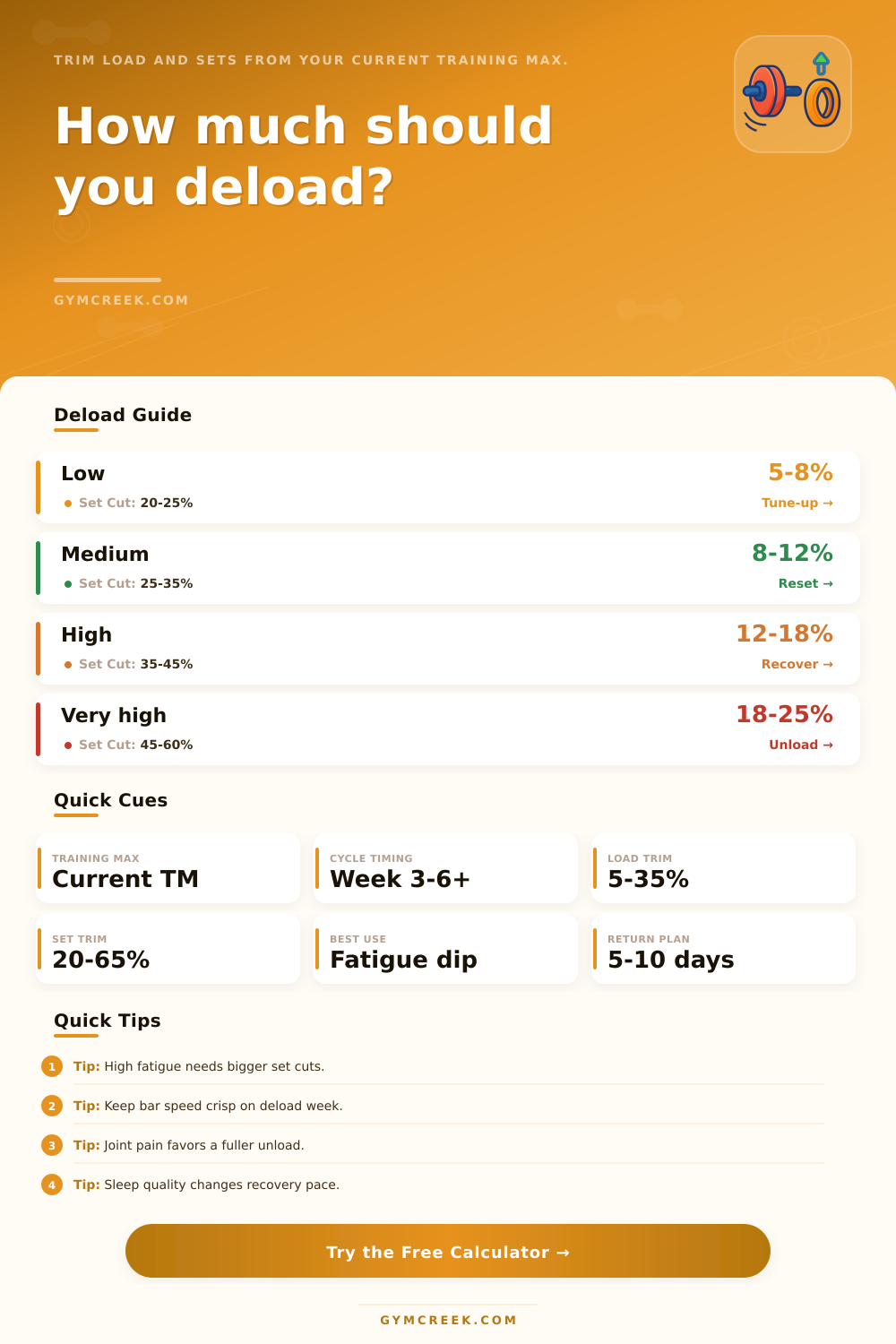
Fatigue Reduction Bands
Use these baseline cuts before adding cycle-week, soreness, and goal adjustments.
| Fatigue | Load cut | Volume cut | Best use |
|---|---|---|---|
| Low | 5-8% | 20-25% | Short tune-up |
| Moderate | 8-12% | 25-35% | Normal reset |
| High | 12-18% | 35-45% | Accumulated fatigue |
| Very high | 18-25% | 45-60% | Full unload |
Cycle Week Pressure
Longer blocks need deeper deloads because fatigue has had more time to stack.
| Week | Extra load cut | Extra set cut | Typical note |
|---|---|---|---|
| Week 2 | 0% | 0% | Mostly a refresh |
| Week 3 | 2% | 5% | Early fatigue check |
| Week 4 | 4% | 8% | Standard deload spot |
| Week 5 | 7% | 12% | Longer accumulation |
| Week 6+ | 10% | 15% | Bridge to new block |
Recovery Goal Matrix
Your goal decides whether you keep more technique exposure or chase a bigger rebound.
| Goal | Load bias | Volume bias | Rep plan |
|---|---|---|---|
| Get fresh fast | Moderate cut | Moderate cut | 2-4 reps |
| Keep technique sharp | Smaller cut | Moderate cut | 3-5 reps |
| Calm joints | Bigger cut | Bigger cut | 2-4 reps |
| Full reset | Biggest cut | Biggest cut | 2-3 reps |
Common Deload Scenarios
These examples show how recovery goals and fatigue change the week without guessing.
| Scenario | Stress signal | Likely cuts | Return cue |
|---|---|---|---|
| Meet taper | High intensity | 5-10% / 35% | Bar feels snappy |
| Sleep debt | Low recovery | 12-18% / 40% | Wake up fresher |
| Joint flare-up | Soreness high | 15-22% / 45% | Pain settles down |
| Bridge week | Long block | 12-20% / 45% | Ready for new volume |
Formula Reference
The calculator combines current top-set intensity with fatigue, timing, and recovery modifiers.
| Formula | Inputs | Purpose | Output |
|---|---|---|---|
| Mifflin-St Jeor | Sex, age, kg, cm | Baseline recovery demand | BMR |
| Activity multiplier | BMR, activity level | Daily stress context | TDEE |
| Load reduction blend | Fatigue, week, goal, sleep, soreness, style | Top-set deload % | Load cut |
| Volume reduction blend | Fatigue, week, goal, sleep, soreness, style | Set target | Volume cut |
Readiness Score Guide
Use the score to judge how aggressive your return week should be after the deload.
| Score | Band | Meaning | Next step |
|---|---|---|---|
| 85-99 | Fresh rebound | Deload is enough | Resume normal loading |
| 70-84 | Good rebound | Near-ready | Return with control |
| 55-69 | Needs discipline | Fatigue still sticky | Hold top-end work |
| 35-54 | Full reset needed | Recovery lagging | Extend the deload |
💡Coaching Notes
If bar speed is still slow after two lighter sessions, keep the top-set percentage low and protect the volume cut instead of chasing heavier singles.
When sleep and joints are both trending poorly, deloading the lift pattern plus accessories works better than trimming only the headline barbell number.
A deload are a period during which an individual reduces there training intensity to manage fatigue. Fatigue occur when an individual’s body is tired from performing training activity. Fatigue can accumulate over several week of performing weight lifting exercises.
When an individual feels fatigued, they will find it more difficult to lift heavy weight. Additionally, the individual may experience soreness in the joint or poor sleep quality as a result of the fatigue. If an individual continues to train with high intensity while experiencing fatigue, their performance with lifting weights will decline or they will experience injury.
How to Do a Deload
For these reason, it is necesary for an individual to take a deload to allow their body to recover from performing training activities. The degree of reduction in strength during a deload will depend on the level of fatigue that the individual is experiencing. For individuals with low levels of fatigue, an individual can perform a reduction of the weight by five to eight percent and a reduction in the number of sets by twenty percent.
For individuals with high levels of fatigue, though, the percentage of reduction in the weights that is lifted should be between eighteen and twenty-five percent, and the number of sets should be reduced by fifty percent or more. Small deloads can be used during the early week of a training cycle. However, larger deload periods should occur at the end of a training cycle when the fatigue is more significant.
For a deload, there are two primary metric that can be reduced. These include the weight that is lifted and the volume of sets that is performed. An individual can reduce the weight that is lifted to increase they’re bar speed.
Additionally, the volume of sets can be reduced to allow the central nervousystem to recover. For instance, an individual can perform few sets of back squat exercises to avoid adding more fatigue to their body. The degree of reduction in strength should be based off the current training max rather than the all-time max of the individual.
While an individual’s all-time max refers to the weights that they lift during their training in the past, their current training max is a more accurate indicator of their strength. External factor impact a deload. The quality of an individual’s sleep is one such factor.
During sleep, an individual’s body naturaly recover from the fatigue caused by training. If an individual gets poor sleep, they will require a more significant deload period before they can allow their body to recover. The activity level of an individual each day can also impact the body’s ability to recover.
An individual with a sedentary job will recover more quickly from training than an individual who perform physically demanding task in their job. An individual who experiences joint pain should also implement a larger deload period into their training routine. This is because the connective tissue in the joints take more time to heal than the muscle tissue.
An indicator of whether an individual is experiencing a successful deload is their bar speed. Bar speed is the speed at which an individual lift the weights during training. If the bar speed for an individual is slow, this indicate that they are still experiencing fatigue.
If the bar speed is fast, though, the individual is recovering well from the fatigue experienced during their training routine. An individual should not rush the deload period. It may take five to ten day of performing light training before they are ready to begin lifting heavy weights again.
During a deload, an individual can perform mobility or accessory exercise. However, they should ensure that the body does not experience additional fatigue during this period. By effective managing a deload period, an individual will transition fatigue into a period of recovery that will allow their body to prepare for future gains in strength.