Training Age Calculator
Estimate your adjusted training age from years trained, consistency, breaks, weekly practice, coaching, program structure, and strength or skill exposure.
📌Presets
Presets show how calendar experience can differ from adjusted training age when breaks, low frequency, or unstructured practice are included.
⚙Calculator
Adjusted training age
Enter your training history to estimate your experience stage.
📊Training Age Metrics
📑Reference Tables
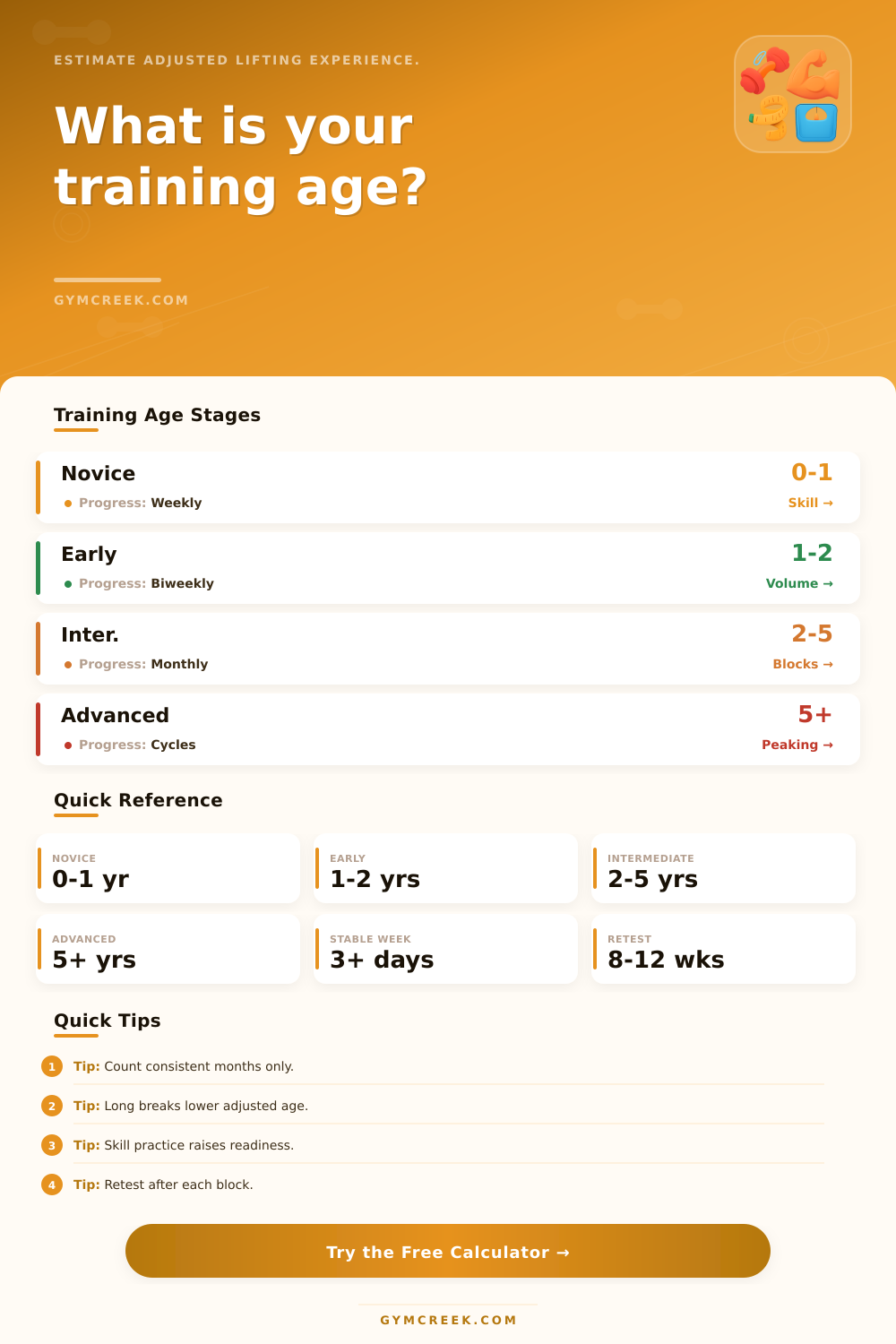
| Stage | Adjusted Age | Typical Progress | Main Need |
|---|---|---|---|
| True novice | 0-0.5 years | Session to session | Technique and routine |
| Novice | 0.5-1.5 years | Weekly | Repeatable overload |
| Early intermediate | 1.5-3 years | 2-4 week blocks | Volume control |
| Intermediate | 3-5 years | Monthly | Specific blocks |
| Advanced | 5+ years | Training cycles | Peaking and weak points |
| Factor | Low Credit | Full Credit | Why It Matters |
|---|---|---|---|
| Frequency | 1-2 days | 3-5 days | Skill and adaptation dose |
| Weeks/year | Under 32 | 44-50 | Training continuity |
| Program | Random | Periodized | Progression clarity |
| Feedback | Rare | Regular | Technique quality |
| Logging | None | Detailed | Load management |
| Goal | Best Stage | Update Pace | Common Marker |
|---|---|---|---|
| General fitness | All | 4-8 weeks | Habit consistency |
| Hypertrophy | Novice+ | 4-6 weeks | Volume tolerance |
| Strength | Novice+ | 3-6 weeks | Top set quality |
| Power or sport | Intermediate+ | 2-5 weeks | Speed or jump output |
| Endurance | All | 3-8 weeks | Pace or HR drift |
| Formula Piece | Input | Output | Use |
|---|---|---|---|
| Calendar exposure | Age - start age | Years | Upper limit |
| Net months | Total - breaks | Months | Base time |
| Consistency | Weeks and days | 0.25-1.15x | Dose credit |
| Structure | Plan and log | 0.82-1.18x | Quality credit |
| Adjusted age | All factors | Years | Stage estimate |
💡Tips
Training age isnt the same as the number of year that an individual has been a member of a gym. Instead, training age is a reflection of the adaptations that the individual’s body have accumulated as a response to a specific stimulus. Many individuals may believe that the longer that an individual trains in a gym, the stronger and more physicaly fit the individual is.
However, the number of year that an individual has trained dont necessarily indicate the training age of that individual. An individual’s training age is a reflection of the percentage of the genetic potential of that individual’s body that has been utilized. An novice individual may experience rapid gain in strength because that novice individual is responding to the stress placed upon there body, and because that novice individual can add more weight to a barbell during almost every training sessions.
What Training Age Means and How It Helps
However, gains in strength for that novice individual will eventualy cease to increase with time because that individual must change the way in which that individual continues to progress in strength. The training age calculator utilize a specific formula to determine the training age of an individual. The training age calculator takes into account the number of years that an individual has been training, as well as the quality of that training.
Factors that the calculator may include in the calculation of the training age may include the structure of the individual’s training programs, as well as whether the individual keep a training log to track their training sessions. For instance, an individual who keeps a training log can utilize the concept of progressive overload to their training program. Progressive overload allow an individual to gradually and effective increase the amount of weight that they lift if the individual knows the amount of weight that they lifted during previous training sessions.
Therefore, an individual who does not keep a training log can not implement the concept of progressive overload, and thus, has less quality training compared to an individual who keeps a training log. Consistency in training is one of the main factors that is considered in the calculation of training age. However, various factor, such as injuries, job changes, or vacations from regular training activities, may interrupt an individual’s consistency in training.
If an individual takes a long layoff from their training program, the individual may lose some of their strength gains. More importantly, however, the individual’s neurological system may cease to be effective in perform the exercises that are required of that individual. Thus, the training age calculator incorporates a break penalty for individuals who take a layoff from their training program.
An individual’s training age calculator provide an individual with a guide as to how to structure their training program. For instance, if the individual calculates to have a training age as a novice athlete, the individual should focus primarily upon skill acquisition and performing a form of repeatable overload. An novice athlete does not necesarily need to incorporate complex training techniques or methods into their training program, but does require a plan to gain strength in a linear manner.
Conversely, if an individual calculates to an intermediate or advanced training age, the individual find that the gains in strength become much slower over time. At these stages, the individual must utilize concepts such as volume control and block periodization. Block periodization require an individual to train for several week to gain strength and muscular endurance, followed by several weeks of performing the same exercises to reach the individual’s peak strength.
Many strength lifters believe to be of an advanced training age due to the number of years that they have been training in the gym. However, many strength lifters’ training quality is low, and thus, those lifters have yet to evolve their training techniques. An individual who has been training for many years yet has yet to see gains in strength still has a significant amount of potential strength gains if the individual can implement a training plan that incorporates the concepts discuss within the article.
Such a skill index will blend the years of training experience with the individual’s skill in performing training techniques. The skill index will provide an individual an understanding of the maturity of their training methods. By knowing the training age of an individual, that individual can structure their training plan according to the current state of their body.
If an individual understands their training age, they can understand that their gains in strength can stop increasing if they attempt to continue to increase the strength requirement of their training routines. By understanding their training age, an individual may recognize a plateau in their strength gains. At this point, an individual understands that their training method need to be evolved.
Thus, the goal of training is to adapt the complexity of the training plan to the current state of the individual’s body, ensuring that the individual does not devote their training efforts to guesswork as to what the body can take and how best to prepare their body for their goal.