Trail Running Pace Calculator
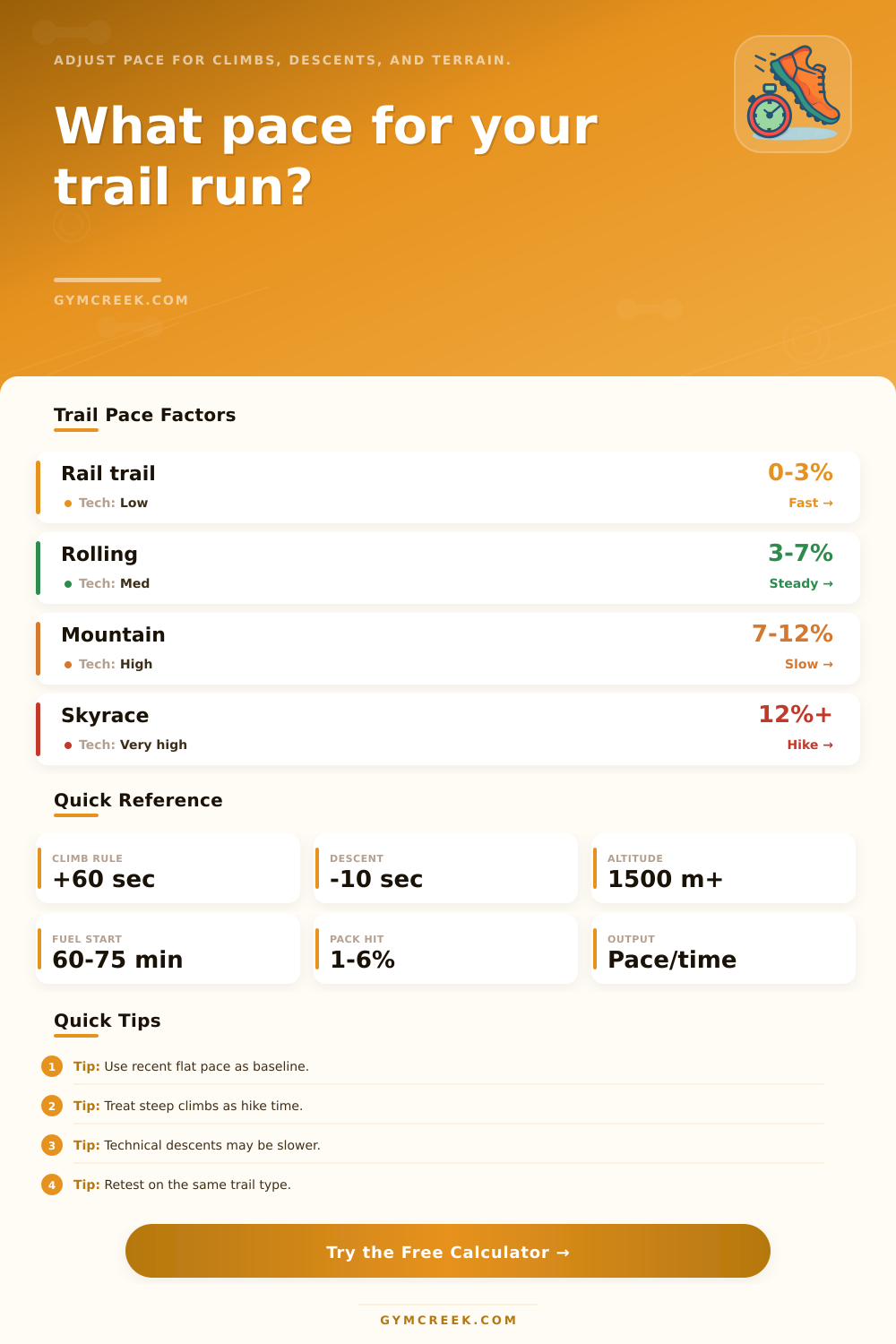
Estimate trail pace from flat fitness, distance, elevation gain and loss, technical footing, altitude, pack weight, aid-stop time, and race effort.
📌Presets
Presets load realistic trail scenarios and calculate immediately so you can compare flatter routes, rolling terrain, technical courses, mountain races, and ultra pacing.
⚙Calculator
Trail pace estimate
Enter route details to adjust flat pace for trail conditions.
📊Trail Metrics Grid
📑Reference Tables
| Terrain | Multiplier | Typical Feel | Use Case |
|---|---|---|---|
| Smooth dirt | 1.00-1.03 | Roadlike | Rail trail, fire road |
| Flowy singletrack | 1.04-1.08 | Steady | Runnable trail |
| Rooty or rocky | 1.10-1.18 | Broken rhythm | Technical forest |
| Mountain technical | 1.18-1.30 | Slow focus | Rock gardens |
| Scramble terrain | 1.30+ | Hike mix | Hands-on trail |
| Grade Cue | Climb Load | Pace Note | Strategy |
|---|---|---|---|
| 0-3% | Low | Run steady | Hold cadence |
| 3-7% | Moderate | Ease effort | Shorten stride |
| 7-12% | High | Power-hike ok | Save legs |
| 12%+ | Very high | Hike likely | Use poles if trained |
| Duration | Carbs | Fluid | Check |
|---|---|---|---|
| Under 60 min | Optional | Thirst | Warm days |
| 1-2 hours | 20-40 g/hr | 300-600 ml/hr | Practice |
| 2-4 hours | 40-70 g/hr | 400-800 ml/hr | Sodium |
| 4+ hours | 60-90 g/hr | Plan aid | Gut train |
| Formula | Inputs | Output | Limit |
|---|---|---|---|
| Flat pace base | Recent pace | Min per mile/km | Fitness varies |
| Climb penalty | Gain, grade | Added time | Terrain varies |
| MET calories | MET, kg, min | Calories | Estimate |
| Mifflin-St Jeor | Age, sex, size | BMR/TDEE | General |
💡Tips
Because trail running include many different variable that impact an ultrarunners speed, a different approach is required compared to road running. When ultrarunner run on roads, they can maintain a constant speed. However, when running on trails, the pace are fluid because of the different trail terrain.
The terrain can include hills, rocks, and uneven footing that will all impact an ultrarunners speed on the trail. An ultrarunner must take a few second to understand that there speed on the trail will be slower then their desired pace when they are on the road. Another variable that will impact an ultrarunner’s speed is the elevation gain for that race.
How Trails Change an Ultrarunner’s Pace
Because elevation gain will make an ultrarunner gain vertical feet, it will add time to their total race distance. By using a calculator, an ultrarunner can determine the total amount of time that the total race distance will add due to the gain of elevation. Using a calculator allow an ultrarunner to see how many calories they will burn due to the grade of the hills.
The grade of the hill will determine whether an ultrarunner power hikes or not. If an ultrarunner power hikes up a hill, they save their glycogen for when they will be able to run on the trail. The other impact on an ultrarunner’s speed is the descent of the trail.
A descent down a trail is not always the more faster alternative to running on even ground. If the descent is on even ground, it is possible to move quick down the trail. However, if the descent is on a technical trail full of rocks and roots, it will take longer to descend the trail.
The technicality of the trail impact on an ultrarunners speed. Technicality on a trail allow for a calculator to determine the number of time an ultrarunner will lose their running momentum on the trail. Another factor that will impact an ultrarunner’s speed is the environment they are in.
The altitude where the trail is located can greatly impact an ultrarunner’s speed. At high altitudes, the air is thinner and contain less oxygen. Because an ultrarunner’s aerobic capacity is reduced, their pace will be much slower on high mountains when compared to sea level.
The other environmental factor is the weight of the ultrarunners gear. If they have a heavy hydration pack, they will add to the total distance that they run because of the increased weight. Ultrarunners must fuel themselves because trail running burn more calories than road races.
Ultrarunners use their stabilizing muscles more when running on trails. Because their muscles are engaged more, they burn more calories. By estimating the calories that they will burn, ultrarunners can determine what type of food they will need to fuel their bodies during the trail race.
If they dont fuel their bodies proper, they will lose energy. Losing energy will make it difficult to finish a trail race. An ultrarunner uses pace estimates to have a realistic idea of their running speed.
The grade-adjusted pace show what their running speed will be on flat ground. By understanding their grade-adjusted pace, they can determine whether their goal for the trail race is too high or low. By using these estimates for pacing, an ultrarunner can plan their fueling and logistics for the race.
These estimates will turn their trail race from a guessing game to a strategic game plan. A trail race plan that an ultrarunner creates with these estimates would of allow an ultrarunner to better manage there effort during the race.