Track Laps to Miles Calculator
Convert track laps into miles, kilometers, lane-adjusted distance, finish-time pace, lap splits, and workout checkpoints for indoor or outdoor ovals.
📌Presets
Presets load real track situations, including lane correction, indoor lap lengths, yard tracks, partial offsets, and target time splits.
⚙Calculator
Track lap conversion
Enter laps, lane, track size, and target time to calculate distance and pace.
📊Track Metrics Grid
📑Reference Tables
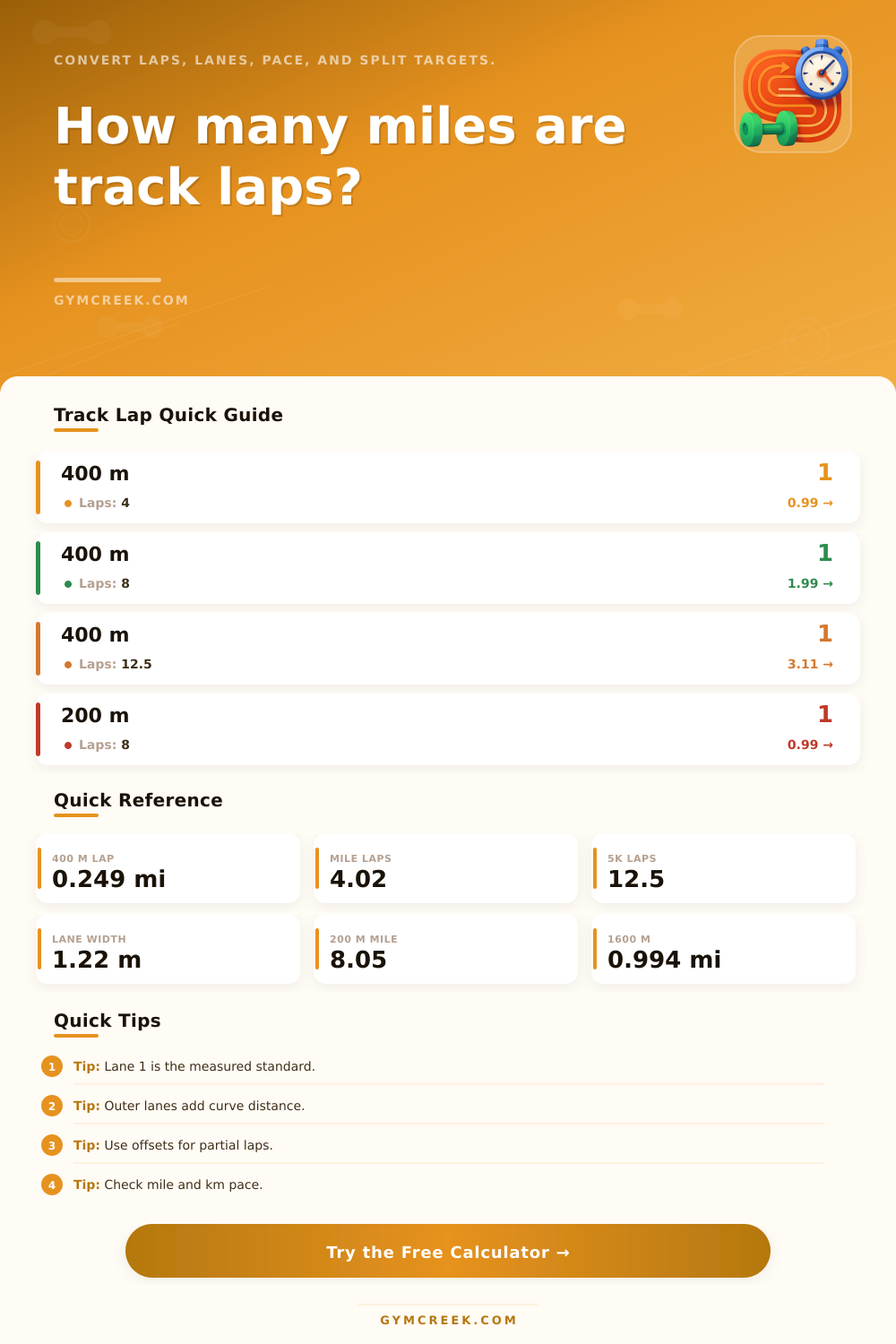
| Track Type | Lap Length | Laps per Mile | Common Use |
|---|---|---|---|
| Outdoor metric | 400 m | 4.023 | Mile, 5K, intervals |
| Indoor metric | 200 m | 8.047 | Indoor workouts |
| Yard track | 440 yd | 4.000 | Older facilities |
| Custom loop | 300 m | 5.364 | Training loops |
| Lane | 400 m Lap | 8 Laps | Gain vs Lane 1 |
|---|---|---|---|
| Lane 1 | 400.00 m | 3200 m | 0 m |
| Lane 2 | 407.67 m | 3261 m | 61 m |
| Lane 4 | 423.00 m | 3384 m | 184 m |
| Lane 8 | 453.65 m | 3629 m | 429 m |
| Distance Goal | 400 m Laps | 200 m Laps | Miles |
|---|---|---|---|
| 800 m | 2.00 | 4.00 | 0.50 |
| 1600 m | 4.00 | 8.00 | 0.99 |
| 1 mile | 4.02 | 8.05 | 1.00 |
| 5K | 12.50 | 25.00 | 3.11 |
| Pace Target | 400 m Split | 800 m Split | Mile Pace |
|---|---|---|---|
| Easy | 2:30 | 5:00 | 10:03 |
| Steady | 2:00 | 4:00 | 8:03 |
| Tempo | 1:40 | 3:20 | 6:42 |
| Fast | 1:20 | 2:40 | 5:22 |
💡Tips
On paper it seems easy; just go out and run four times around a regular old outdoor track and there you go! You’ve covered a mile. It’s what they tell you in middle school gym class, and it’s the kind of shorthand used in casual jogging clubs everywhere.
In real life it’s not quite that simple. A regular track has laps that is precisely 400 meters long, but a mile is actualy 1609 meters. So instead of getting to a mile after four laps, you’re actualy at 1600 meters, which means you fell a bit short (by about nine meters).
Why Four Laps Is Not One Mile
If you’re out for a quick jog around the block, maybe that doesn’t sound like much when you lace up your sneakers. But if you’re tracking your pace accurately or training for a race, those extra meter will really add up. Running 4.023 laps is a lot more different than running four laps, it’s knowing versus guessing.
The big mistake when doing self-paced runs is that most runners believes all lanes on a track are the same, when in fact outer lanes has a longer distance to travel to make one full lap. Let’s say that Lane 1 is taken up with a faster runner, so you’re running in Lane 4 or 5. You’ll be logging a lot more ground than that person hugging the inside rail on each lap.
On a standard oval, this would mean a five kilometer run would require twelve and a half laps. So if you don’t adjust your mental math when running in an outer lane, you’ll think you ran further then you actualy did during that workout. People get it wrong there because they listen to the lap counter but forget about lane width.
There are also other variables associated with running indoors that outdoor athletes don’t typically think about. Most indoor tracks aren’t actually a full 400 meter oval but instead are 200 meters, meaning double amount of laps for every single distance marker. Also, the turns on the smaller indoor track tend to be sharper, adding slightly different body movement stress and a bit of a different pacing strategy versus a more wide-open turn outside.
By plugging in your specific lap length into the tool, whether it is a metric yard track or some custom loop at a local university, the tool then normalizes all the data so no matter where you train, your pace per mile will stay the same. So a mile paced at 5 minutes 30 seconds inside on a banked track will transfer precisely to a flat road course come October.
When I think about running, I don’t really think about raw laps, I think about them in fractions of a mile/kilometer. For example, a tempo run might feel daunting, but breaking the distance down into mile markers provides psychological checkpoints that help maintain steady effort. Rather than trying to have a vague idea about my pace, I look at my watch after every split.
The output shows the time per mile or kilometer based off your overall goal. If I’m doing intervals, I like to know EXACTLY what distance and what kind of rest period I should take because this is where physiology adapts. When I enter a target finish time, it gives me an exact pace to aim for. If I type in a desired pace, it tells me what my final time will be based on the total distance run.
These little math exercises are where the margin of error lies with endurance sport. Picking an inside or outside lane can make you underestimate how far you actualy ran. This could of caused a runner to cover less distance while thinking they are going as fast as they should be. Running farther unintentionally may result in hitting the wall sooner then planned because you’ve run further than planned. Knowing the geometry of what you’re running on will help you dial in your effort accurately.
What was once a vague feeling of “running really hard” becomes something measurable and real. All told, training accurately isn’t really about getting down to every last meter; it’s about trusting what you feel and knowing whether that feeling matches what you’re putting out. If you’re after a personal record or just maintaining a consistent pace as you cruise through a recovery run, knowing how long each lap should be helps you avoid drifting into either direction: too slow or too fast.
Let the math take care of the geometry while you get on with the breathing. Is this close enough for a slow walk? Four laps will do nicely. Looking for some hard data? Get the conversion right. Begin with a basic loop and end up with crystal clear information.