Track Lap Split Calculator
Plan lap targets for track races, time trials, interval reps, and lane workouts with pacing strategy, lane distance adjustment, split tolerance, opening control, and kick reserve.
📌Track Presets
Presets fill realistic event, track, and pacing setups. Use lane adjustment when running repeated laps outside lane 1 without a marked stagger.
⚙Lap Split Inputs
Track split snapshot
Enter track details to calculate lap targets, pace windows, lane distance, and finish projection.
📊Track Metrics Grid
📑Lap Split Tables
| Lap | Distance | Target Split | Cumulative |
|---|---|---|---|
| --- | --- | --- | --- |
| Lane | Extra Per Lap | Lap Distance | Use Case |
|---|---|---|---|
| Lane 1 | 0 m | 400 m | Measured line |
| Strategy | First Lap | Middle Laps | Closing Cue |
|---|---|---|---|
| Even | Target | Hold | Compete late |
| Event | Lap Basis | Typical Check | Planning Note |
|---|---|---|---|
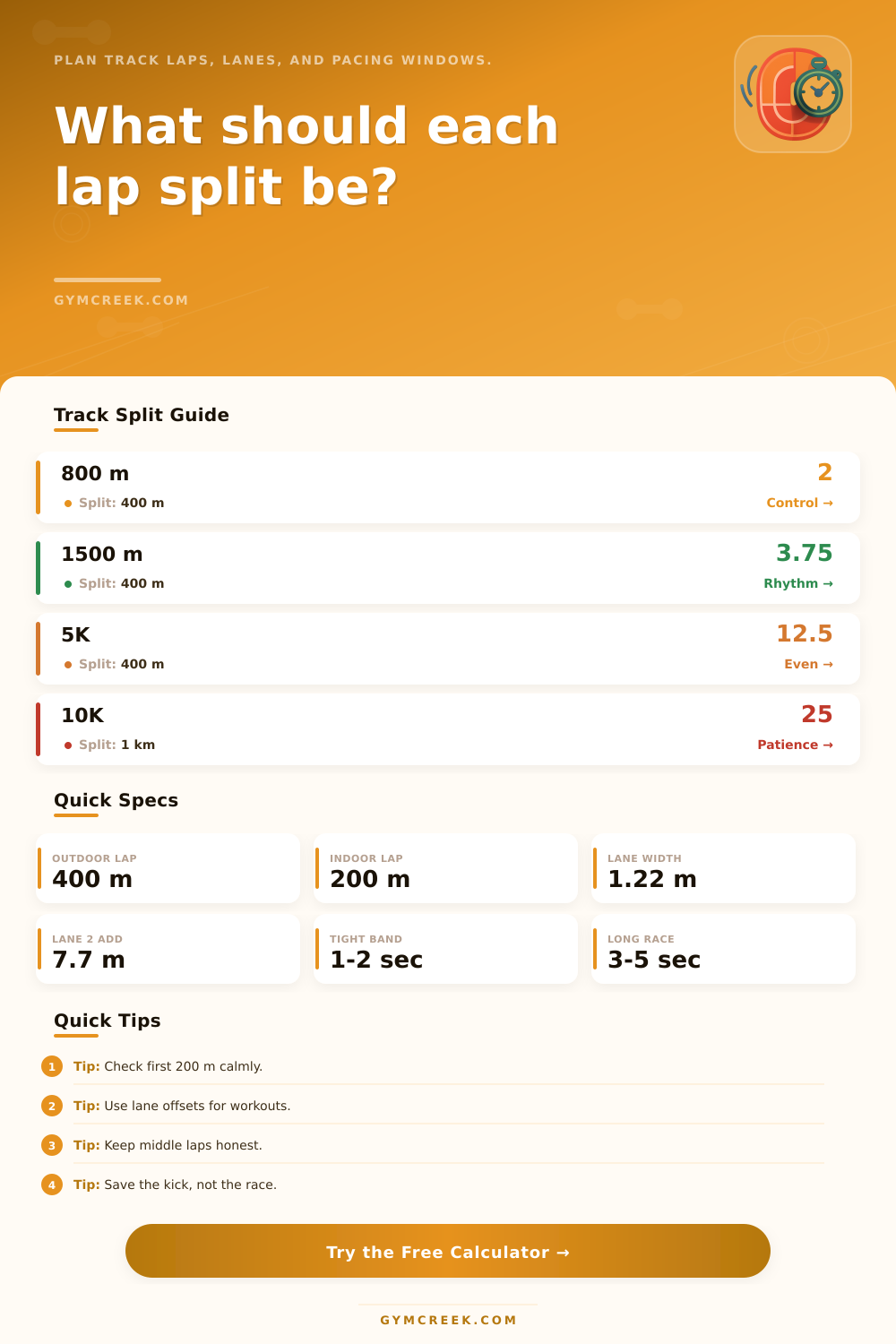
| 800 m | 2 x 400 m | 200 m marks | Opening speed must stay controlled |
| 1500 m | 3.75 laps | 300 m plus laps | First 300 m changes the math |
| Mile | 4 x 440 yd or 1609 m | 400 m style laps | Confirm track markings before racing |
| 5K / 10K | 400 m laps | 1 km blocks | Use small corrections, not surges |
| Indoor mile | 8 x 200 m | 200 m splits | Tight turns make rhythm important |
💡Lap Split Tips
Running on a track is hard, but oftentimes it’s not necessarily because the track is an oval: Instead, you tend to get farther from inside lane as you run further around the track. For example, if you’re running a 1K repeat at race pace and you’re in lane four, you’ll add several extra meter per lap compared to inside rail. That translates into more distance per mile (or kilometer), which adds up over a full mile or 5K of running. The calculator above do that math for you.
Just plug in your desired finishing time, your lane number, and whether you plan to use a steady pace, negative split, or even intervals. Then, it takes the guess work out of how far away you are from finish line.
Plan Your Race Pace
There’s more than just the lane offset. Training indoors shorten the lap (to 200 meters) and increases turns, whereas loops on road or grass extend it and change footing. Switching surfaces allow you to enter the same target time and see how many different lap expectations that tool shows you. A 3:20 kilometer can feel controlled on rubber but like survival on wet cinders, so you’d better have an idea what surface you’ll train or race on.
Surface is important; pacing strategy is equally important. Starting out at an even split seems easy enough, but adrenaline on first lap and fatigue on the last will derail those plans. Instead, go for a controlled negative split that creates a little breathing room up front and allows the middle laps to be steady instead of frantic. Once you select the strategy, the calculator automatically weights it, but do you have the race situation and fitness to start slower different than your average? Most athletes learns they get more by being patient then pushing to bank time they can’t hold up.
This is why there’s an opening control and kick reserve input. By having a little bit of positive reserve on that first lap, you avoid tendency to go out too hard on the first 200 meters and pay for it later. Conversely, the closing reserve act as protection against giving away a few seconds in a useless attempt to save yourself and instead allows you to attack the final segment, rather than survive it. There’s no magic number here, but it forces you to make a decision about where the effort should of occur, instead of hoping that the race cooperates.
One level down are condition tweaks. Each of these factors. Wind on the back stretch, heavy competition and heat. Has its own tiny time penalty which the calculator rolls up in the recommended tolerance band. That’s where the band comes in: It provides an idea for how far off a single lap is allowable without derailing the plan. On a quiet morning in lane one, you might be able to get away with a tight two second margin but out in lane six with a headwind, you might require four or five seconds of leeway. With the tool, you know what to expect rather than panic when it happens during the race.
Now that we’ve got our plan, we can check it against how seasoned runners track their races. Use the reference tables on this page to see common events and normal checkpoints to help you compare your own plan. For instance, an 800-meter runner will be monitoring the 200-meter marks; a 5K runner, those kilometer blocks. Why? Because those markers convert abstract lap times into concrete feedback you know you can act upon, even without your watch.
Split planning isn’t about perfect execution of each number, but a means to provide yourself with a plan that withstands minor errors in execution. If one lap take a couple seconds longer, do you see from your calculator that’s OK (still within the band) or that you must execute a measured course correction, as opposed to a frenzied effort? That determines if you keep the workout/race intact versus reacting your way through an exercise.
Same goes for volume of training. You set out with six 1K repeats, but extra distance from your lane choice and the weather conditions both adds up throughout the session. That’s where the tool shows you that total to help you decide if it’s still appropriate for the week, or if you should expand the band or drop one of the reps. Knowing the true cost going in is all this planning are about.