Towel Hang Calculator
Estimate total towel hang load, per-hand grip demand, endurance reserve, set fatigue, and safer added or assisted training targets from your body weight, towel setup, grip, time, sets, and RPE.
📌Presets
Each preset loads a complete towel hang scenario, including one or two towels, towel thickness, external load, hang duration, sets, rest, and grip style.
⚙Calculator
Towel hang snapshot
Enter a towel hang test to estimate training load, endurance reserve, and grip stress.
📊Towel Grip Metrics
🧮Formula Cards
system load = body weight + added load - assistanceShows the total load supported by the hands, arms, shoulders, and towel.
per-hand demand = system load / hands x setup x thickness x gripTurns the total hanging load into a towel-specific grip stress estimate.
max time = test seconds x RPE reserve x readinessEstimates how long the same load might last if the set were taken closer to failure.
target load = max load x duration x target RPE x set fatigueRounds the external load or assistance to the increment you can actually use.
📑Reference Tables
| Goal | Hang Time | Target RPE | Rest |
|---|---|---|---|
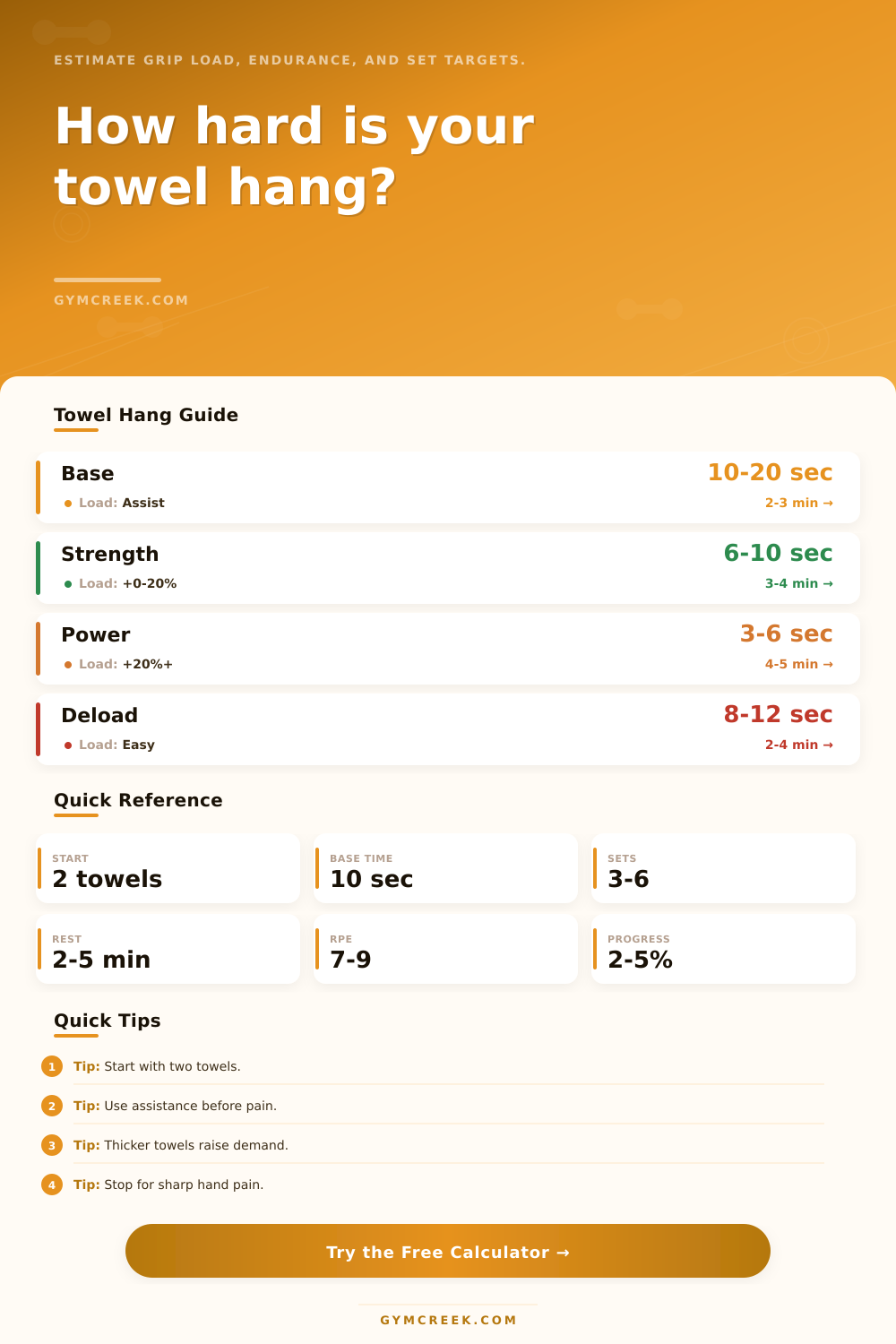
| Grip base | 10-20 sec | 6-8 | 2-3 min |
| Max strength | 6-10 sec | 8-9 | 3-5 min |
| Limit test | 3-6 sec | 9-10 | 4-5 min |
| Deload | 8-12 sec | 5-6 | 2-4 min |
| Towel Setup | Load Split | Demand | Best Use |
|---|---|---|---|
| Two towels | Even | Base | Standard |
| One shared | Crowded | Higher | Advanced |
| One assisted | Mixed | Variable | Learning |
| Uneven grip | Uneven | High | Test only |
| Thickness | Grip Demand | Typical Feel | Adjustment |
|---|---|---|---|
| 15-22 mm | Lower | Easier wrap | -8% |
| 23-34 mm | Base | Standard | 0% |
| 35-44 mm | High | Thick squeeze | +8% |
| 45 mm+ | Very high | Open hand | +18% |
| Grip Style | Demand | Risk Note | Use Case |
|---|---|---|---|
| Full wrap | Base | Stable | Most sets |
| Thumb lock | Lower | Skin check | Control |
| Fingertip | High | Finger stress | Short sets |
| No thumb | Very high | Slip risk | Advanced |
💡Tips
⚠Safety Disclaimer
Grip strength is what we are talking about. To most this mean crushing a ball with your hands until they’re white as a sheet or very large. It doesn’t.
Grip strength is about creating friction, generating leverage and knowing exact point at which a piece of soft fabric releases. The pull-up bar become a mechanical disadvantage test when you hang from towel. There’s no rim holding the fabric in position so the load spike on your fingers as the towel bunches up and your hands slip. Precision is key.
How to Use the Grip Strength Calculator
When the surface beneath your grip change continuously, you don’t want to be guessing how much weight your connective tissue can handles. Plug in your body weight, number of towels set up, and level of grip desired, and the calculator will take care of the rest. It takes into account factors others typically overlook such as towel thickness and grip type. Because, after all, gripping a thin hand towel isn’t anything different than grabbing a thick bath sheet.
To keep your hands in contact with the towel, you have to squeeze harder. And more so if it’s folded up thickly. That’s why the tool measure the number of millimeters of towel you’re squishing and adjusts per-hand demand to match. It’ll even adjust for if you’re sharing a single towel or not. If you are, it will crowd your hands and make it harder to prevent bar from rotating, which isn’t something you would normally experience with standard bar.
Two towels, bodyweight, and that’s how most people begin. Seems easy enough…until you attempt it. The first slip will be the biggest jolt to the system. Your forearms feels like they’re burning from both holding the weight up and fighting instability itself. This is where folks go astray. They think their fingers aren’t strong enough, when in fact it’s more about their inability to tolerate unstable surface.
The table at the bottom of the page break down target times according to your desired goal. For base strength, you’ll aim for ten to twenty seconds. For max strength, you’ll bring that number down to six to ten seconds while increasing weight. The length of your hang determine the stimulus. Long hangs create endurance, and short hangs builds the strength needed to last longer.
The tool bridges the gap between effort and recovery with something called RPE (Rate of Perceived Exertion). Your test RPE is used as basis to predict your reserve capacity, how much gas is still left in the tank. So if you tested at a nine (you had maybe one second left in the tank) then the calculator can give you an idea of what a seven might feel like during a complete workout. This allows you to plan your sets and avoid burning yourself out. You don’t want to train grip so hard that you can’t open a jar of pickles all day long.
Towel hangs cause fatigue differently than bars. Constantly adjusting how you hold the towel so it doesn’t slide is as mentally taxing as it is physically draining. Rest periods and set fatigue is included in the calculation. While short rests may seem efficient, they tend to make your form break down more during towel hangs. Falling off a bar is one thing; slipping is another. A missed bar grip might just result in dropping. But a missed towel grip could of resulted in slamming your back down or twisting your shoulder out of socket.
If what you input says that you’re too far ahead of where you are prepared to be, the safety flag will turn red. Make incremental progress: Don’t expect to go from bodyweight to heavy added loads overnight. Take advantage of assistance bands that can lowers the effective load until your tendons and skin becomes accustomed to it.
Your calluses is your armor, but they don’t form overnight. In fact, excessive calluses can diminish grip sensitivity. They can also make gripping more difficult. Trim ‘em.
Pay attention to your elbows. This isn’t about being macho; pain is not a badge of honor. It’s an indicator to back off. The numbers comes from the calculator. The limits come from your body.
Try two towels to establish a starting point. Then, allow the data to inform what comes next. Remember, grip training is a marathon consisting of little, painful adjustments. Respect the slip.