Touch And Go Vs Dead Stop Calculator
Compare touch-and-go reps against dead-stop reps using estimated 1RM, reset time, elastic assistance, fatigue, and goal-specific carryover.
📌Presets
Presets load realistic lifting situations where touch-and-go and dead-stop reps can produce different strength, fatigue, and tension readings.
⚙Calculator
Rep style comparison
Enter matching load and reps for touch-and-go and dead-stop sets to compare useful carryover.
📊Fitness Metrics Comparison Grid
📑Reference Tables
| Rep Style | Best Training Use | Main Bias | Watch Point |
|---|---|---|---|
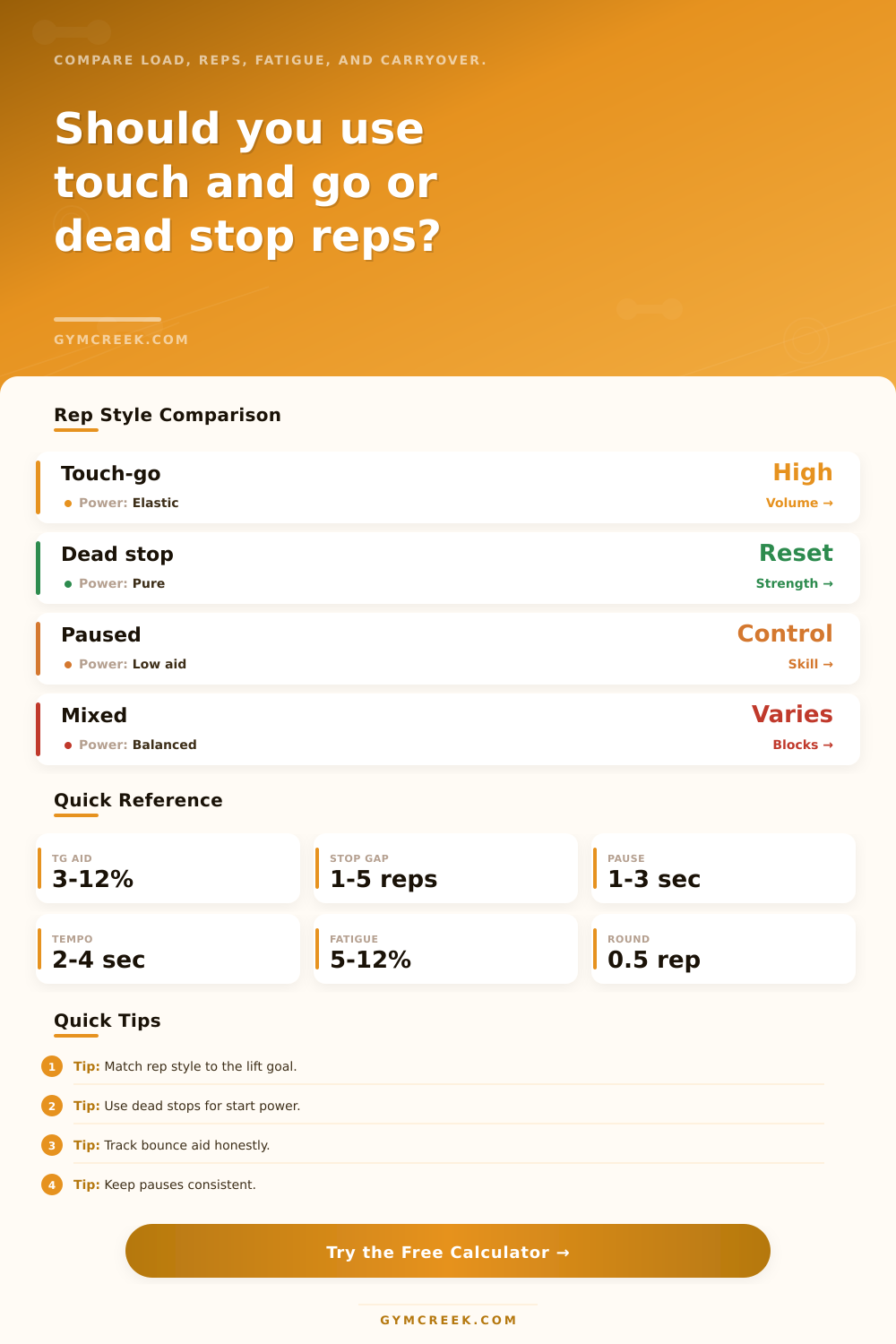
| Touch-and-go | Hypertrophy volume | Continuous tension | Excessive bounce |
| Dead stop | Start strength | Force from zero | Long sloppy rests |
| Paused touch | Technique skill | Position control | Inconsistent pauses |
| Cluster reset | Power practice | High rep quality | Too much rest |
| Mixed block | Balanced cycle | Specific contrast | Unclear goal |
| Lift Pattern | Typical Gap | Dead-Stop Value | Touch-Go Value |
|---|---|---|---|
| Bench press | 1-3 reps | Pause control | Volume tolerance |
| Deadlift | 2-5 reps | Floor power | Hinge endurance |
| Squat | 1-3 reps | Bottom confidence | Rhythm practice |
| RDL | 1-4 reps | Position reset | Tension time |
| Barbell row | 2-5 reps | Strict torso angle | Back volume |
| Goal | Prefer | Reason | Useful Check |
|---|---|---|---|
| Max strength | Dead stop | Less rebound aid | E1RM gap |
| Muscle gain | Touch-go | More tension time | Total seconds |
| Technique | Dead stop | Repeatable setup | Pause time |
| Conditioning | Touch-go | Higher density | Reps per minute |
| Peaking | Dead stop | Specific start | Carryover |
| Formula | Variables | Output | Use |
|---|---|---|---|
| Epley E1RM | Load x reps | Strength estimate | Both styles |
| Elastic adjust | TG aid x lift | Strict touch-go | Carryover |
| Tension time | Reps x tempo | Set duration | Volume |
| Density | Reps / time | Rep rate | Conditioning |
| Load ratio | Load / body wt | Relative load | Benchmark |
💡Tips
So, for instance, you can get away with doing a higher number of “touch and go” reps with a certain amount of weight then you can if you use that same weight in dead stop reps. If you can do ten bench presses while staying touching your chest, but you can only do six if you stop totally at the bottom on every rep, then the difference between those two values is what’s important… Not the fact that one is six and one is ten.
That’s where momentum comes into play versus true muscular work, and you want the calculator above to do this math for you so you don’t guess as to how many reps are actualy due to momentum vs. It is pure force. Compare your dead stop reps and touch and go reps using same weight. This will show how much stronger you are when you has to use the stretch reflex to generate speed versus when you don’t.
Touch and Go vs Dead Stop Reps
It’s not suggesting that one is better than the other. Rather, it allows you to recognize what each type of rep measures and train to match with more purpose then habit. Touch and go movements creates metabolic stress and work capacity based off their ability to retain tension on muscle while not allowing the bar to settle. This keeps your heart rate up and also helps with time under tension which promotes muscle growth goals.
That continuity, however masks the weakness of your start position. Can’t accelerate the bar off a dead stop? You probably have a gap in how you build strength, and bouncing will hide it for you. Spring-like help is taken out of the equation with dead stop reps. There is no stored tendon energy, only a zero velocity start. This means every single gram of motion must be produced by 100% muscle contraction. They’ll be shorter and more difficult, but also translate better into situations without momentum and still needing raw power.
Think about when it’s time to deadlift off the floor or squat heavly in the hole (you get nothing from the last rep). These are reflected in the various responses of lifts to each style, which can be seen in reference tables on the page. The pecs depends heavily on their stretch reflex at the bottom, so you’ll often see a greater difference between dead stop and touch and go compared with a squat. Deadlifts will often have an even greater split because getting any substantial amount of weight off the ground has to overcomes inertia and static friction in ways hinged joints don’t.
Presets allow you to see this before you train. Load a bench with volume as a scenario. See the increased rep range provided by touch and go versus strict stops. Change to a deadlift start power preset. Notice how fast reps falls off when demanding force from rest.
Match rep style to your immediate goal. Chasing tension time is great for building size. Respect dead stop data if you’re trying to lift more in competition. A lot of athletes combine both without knowing that they’re actually training two different adaptation at the same time. They’ll do a set for endurance and then another for peak power; but how will you know what’s progressing if you don’t record each set individually?
Do you want to get stronger or better at bounce? Know the difference. It’s not so much about moving weight as it is about moving weight effectively. If you want a bar to burn continuously, then that’s great for work capacity, but a full reset is the brutal honesty that shows your real strength. You could of fooled yourself by looking at the number on the plate, but how you make it move might tell a different story.