Total Gym Weight Resistance Calculator
Estimate effective resistance from body weight, incline angle, glideboard loading, pulley setting, added weight, exercise type, reps, and tempo, then compare the set to a free weight load.
📌Total Gym Presets
Presets use common incline trainer scenarios. Replace them with your own measured rail angle, pulley route, reps, and tempo for the best logbook estimate.
⚙Calculator Inputs
Total Gym resistance snapshot
Enter your incline trainer setup to estimate effective resistance, bodyweight percent, volume load, progression, and free weight comparison.
📊Metrics Grid
📑Reference Tables
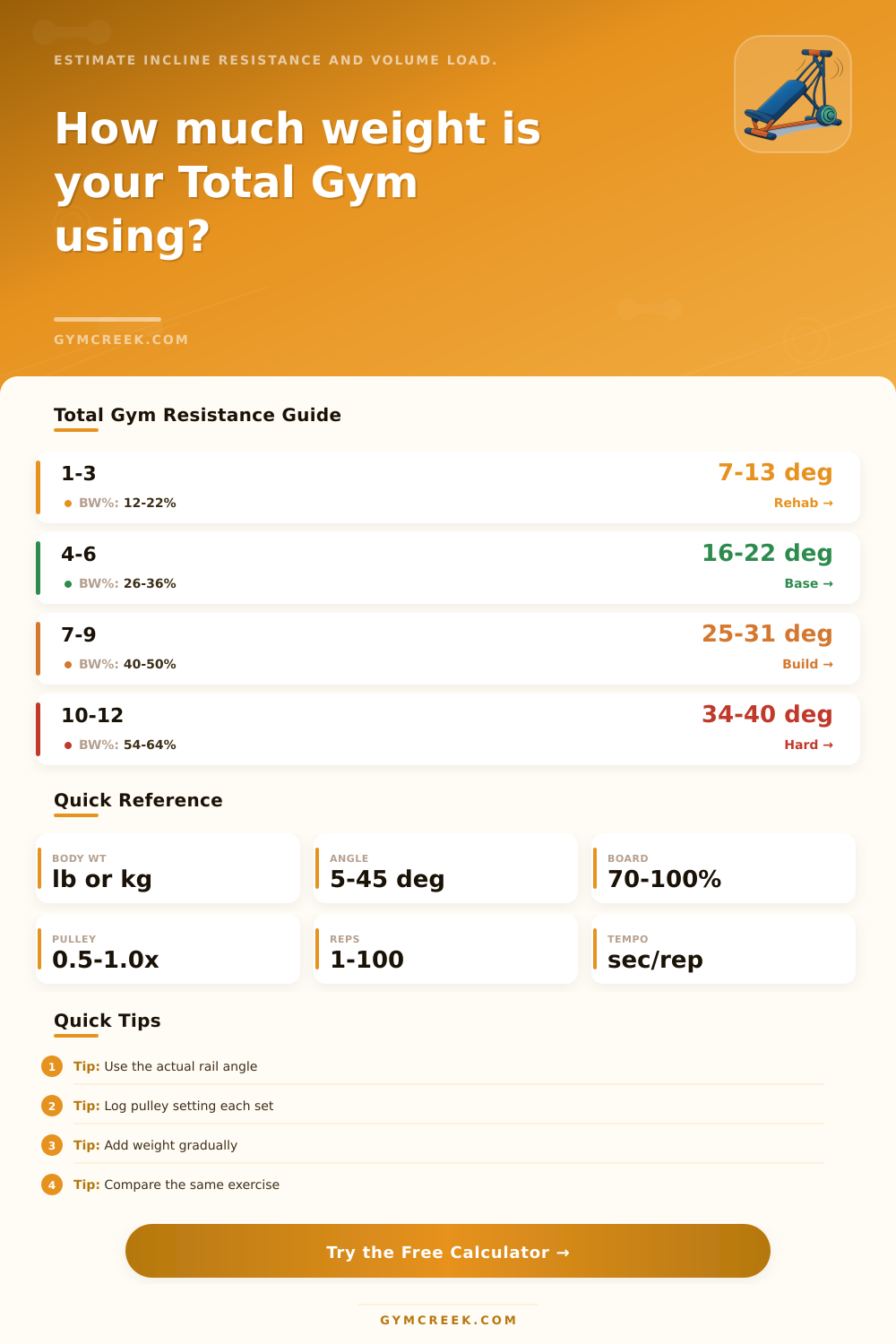
| Level band | Typical angle | Bodyweight load | Training use |
|---|---|---|---|
| Levels 1 to 3 | About 7 to 13 degrees | Roughly 12% to 22% before pulley changes | Rehab, warmup, very high reps |
| Levels 4 to 6 | About 16 to 22 degrees | Roughly 26% to 36% before pulley changes | Base strength and technique |
| Levels 7 to 9 | About 25 to 31 degrees | Roughly 40% to 50% before pulley changes | Hypertrophy and strength endurance |
| Levels 10 to 12 | About 34 to 40 degrees | Roughly 54% to 64% before pulley changes | Hard sets and lower-rep progressions |
| Setting | Multiplier | Best match | Logbook note |
|---|---|---|---|
| Dual handles | 0.50x per handle, 1.00x combined | Rows, presses, pullovers | Calculator reports total combined effort |
| Single handle | 0.50x | One-arm row, one-arm press | Compare one side at a time |
| Direct board push | 1.00x | Squat stand, leg press | No cable split is applied |
| Accessory leverage | 0.75x | Wing bar, specialty handles | Approximate unless measured |
| Effective % bodyweight | Progression label | Common reps | Adjustment cue |
|---|---|---|---|
| Under 15% | Technique or rehab | 15 to 30+ | Raise angle only if control is strong |
| 15% to 30% | Base strength | 10 to 20 | Add reps before adding angle |
| 30% to 45% | Build phase | 8 to 15 | Add one level or small plate |
| Over 45% | Heavy incline | 5 to 12 | Protect tempo and range first |
| Output | Formula idea | Variables | Meaning |
|---|---|---|---|
| Board load | Body weight x glideboard share x sine angle | Body, board %, angle | Gravity component along the rail |
| Added load | Added weight x sine angle | Added weight, angle | Extra load moving on the board |
| Effective resistance | (Board load + added load) x pulley x exercise factor | All setup inputs | Working resistance estimate |
| Volume load | Effective resistance x reps | Resistance, reps | Set workload for progression tracking |
💡Tips
Setting the correct resistances on a Total Gym is an important process and necessary in ensuring that the resistance the Total Gym provides is working in the way that is required by an individual user. If the resistance is correctly set on the exercise, the muscles will feel the necessary resistance to provide the required exercise to that muscle group. However, if the resistance is incorrectly set, the individual may either feel too little resistance in you’re exercise or may experience discomfort in their joint from the resistance that is provided to that joint.
One of the variable that affects the resistance that is provided to the user is the glideboard percentage. The glideboard percentage is the percentage of the individual’s body weight that is placed onto the rails of the glideboard. This percentage can change for an individual according to the position of their body in relation to the glideboard.
How to set the resistance on a Total Gym
A calculator allows for an individual to adjust the glideboard percentage in relation to the individual’s body weight to reflect the actual weight that is being placed onto the glideboard rails. By adjusting the glideboard percentage, individuals can understand why some individuals feel more resistance then others at the same setting on the machine. Another variable that impact the resistance that is experienced by an individual on a Total Gym is the angle of the rails of the glideboard.
The angle of the rail impacts the strength of the gravitational pull along the glideboard rails. The relationship between the angle of the rail of the glideboard and the resistance that is provided to the individual is not linear, meaning that small changes in the angle of the rail can lead to significant changes in the resistance that is provided. The calculator for the Total Gym allows for the individual to enter the actual angle of the glideboard rails rather than the percentage of the angle that is represented on the Total Gym machine.
By entering the actual angle of the glideboard, the individual ensure that the calculated resistance that is represented on the screen is accurate. The third variable that can impact the resistance that is experienced by an individual when using a Total Gym is the choice of pulley. The pulley choice allow for an individual to choose between using dual handles, single handles, or direct pushes of the glideboard.
Each of these pull system choices will impact the resistance that is felt by the individual during use of the Total Gym exercise. The calculator for the Total Gym allows for the individual to input the chosen pulley settings for the exercise to ensure that the calculated resistance is accurate. The fourth variable that can impact the resistance that is provided to the individual is the added weight on the glideboard.
The resistance of the added weight on the glideboard will experience the same angle as the glideboard itself. An object that feels light when placed on the glideboard will feel more resistance as the glideboard is tilted to an angle. Finally, the individual can also impact the resistance that the Total Gym provides by the tempo with which the exercise is performed.
Many individuals may attempt to increase the incline level on the Total Gym to increase the resistance that is provided to their muscles. However, increasing the incline level can lead to individuals losing their form or increasing their tempo on the exercise. The Total Gym calculator allows for an individual to determine the volume load and time under tension of their exercise.
These values can allow for an individual to decide whether they should of adjust their angle, tempo, or control of their range of motion on the Total Gym exercise. Finally, a comparison between the strength of resistance that is provided by the Total Gym exercise and that of free weights is presented. This comparison provides an individual with an understanding of how the Total Gym exercise can compare to free weight exercise.
While the Total Gym resistance is not provided as an exact comparison to free weights due to the change in the load that is placed onto the incline trainer, the comparison can still allow for an individual to understand the relative strength of both type of exercise. Reference tables are provided within the Total Gym exercise to assist individuals with making decisions on how to adjust to Total Gym exercise. These tables allow an individual to understand the different percentages of body weight that may be experienced on the Total Gym exercise.
Additionally, the reference tables also allow an individual to understand how to avoid a common mistake with the Total Gym exercise. Finally, the value of logging the data provided by the Total Gym exercise over time. By logging each of these variable for each exercise that is performed on the Total Gym exercise, an individual will eventually be able to understand which variables impact which muscles or exercise.
After gaining this knowledge of the Total Gym exercise, an individual will be able to use that exercise as a system that the individual can control.