Tire Flip Weight Calculator
Estimate tire weight from dimensions, compare it with your bodyweight, and calculate the first-lift force and session flip volume.
📌Presets
Presets fill realistic tire dimensions, athlete size, grip difficulty, and flip volume, then recalculate immediately.
⚙Athlete And Tire Inputs
Tire flip estimate
Enter tire dimensions and session volume to estimate the working weight.
📊Fitness Metrics Comparison
📑Reference Tables
| Tire Type | Typical Weight | Common Use | Notes |
|---|---|---|---|
| Passenger or SUV | 40-120 lb | Drills only | Often too light for flipping |
| Light truck | 90-220 lb | Beginner skill | Useful for warm-ups |
| Semi truck | 180-350 lb | Conditioning | Good group option |
| Tractor | 300-700 lb | Strongman | Most common gym tire |
| Loader or OTR | 700+ lb | Heavy prep | Advanced use only |
| Training Goal | Tire Ratio | Reps Per Set | Session Focus |
|---|---|---|---|
| Skill practice | 0.6-1.0x bodyweight | 3-6 | Clean wedge and hip drive |
| Conditioning | 1.0-1.6x bodyweight | 5-12 | Repeatable power output |
| Power development | 1.4-2.2x bodyweight | 2-6 | Explosive first lift |
| Max strength prep | 2.0x+ bodyweight | 1-3 | Low-volume heavy attempts |
| Modifier | Calculator Effect | Why It Matters | Practical Read |
|---|---|---|---|
| Poor grip | Raises force 15% | Hands sit shallow | Harder first break |
| Good wedge | Lowers force 8% | Chest and legs share load | Cleaner transition |
| Slick surface | Raises force 12% | Tire slides before rolling | Use more margin |
| Deep tread | Adds mass | More rubber volume | Usually tougher tire |
| Formula | Variables | Purpose | Output |
|---|---|---|---|
| Torus volume estimate | Diameter, width, rim | Approximate tire rubber volume | Base mass |
| Construction density | Tire type factor | Adjust for tire category | Weight estimate |
| Lever force model | Radius, grip, surface | Estimate first lift demand | Hand force |
| Session tonnage | Weight, reps, sets | Compare total workload | Total load |
💡Tips
So what’s the issue? The first problem is knowing how much the tire weigh. People think any big tire are going to weigh roughly the same thing, but it’s not always true. You might find a tire that has the same diameter as another one used on a front-end loader or semi-truck that weighs hundreds of pound less (or more).
So if you guess wrong on the load you will do the wrong exercises or choose a weight that is too light to build strength. After entering the measurements, the calculator do the rest of the math for you. Carefully measure both the section width and outside diameter since they’re what give your tire its volume.
Why Tire Weight Matters for Training
Why does volume matter? Even if two tires is the same size, one with deeper treads have more material than a slick version of that same size. That extra rubber mean more mass, which takes more acceleration from zero mph. If you don’t account for tread depth or rim size, you’ll end up with inaccurate guesses. Important when measuring improvements month after month.
In addition to knowing the static weight of the tire, you must know how hard it will be to lift the tire in the first place. It depends off the ground condition and grip. Grass or dirt adds friction which can make the first flip seem harder then later flips. Concrete offers a solid foundation for transferring power into breaking the tire free. The tool take these ground conditions into account as well as your own leverage when adjusting the estimated force.
The stronger your leverage (legs/chest), the less force on your shoulders when breaking the tire free of the ground. When the tire is moving, it’s all about managing volume and work capacity. Flipping a tire tax your central nervous system. Use the bodyweight ratio to decide how hard to push. If the tire weighs significantly more than your bodyweight then you’ll want to stick with lower reps, long rest periods and train for maximum strength. You will reach failure based off your range of motion. The failure here isn’t gradual, which is why high rest intervals is needed.
If the tire is near your bodyweight then you can do conditioning sets with higher volumes while maintaining form. The decision of what size tire to select is not an egotistical decision but rather a training decision based on desired outcome. Novice exercisers can begin with light tires in order to train proper knee extension and hip drive mechanics. More advanced performers might choose to push themselfs to maximum capacity by loading up with heavy tires.
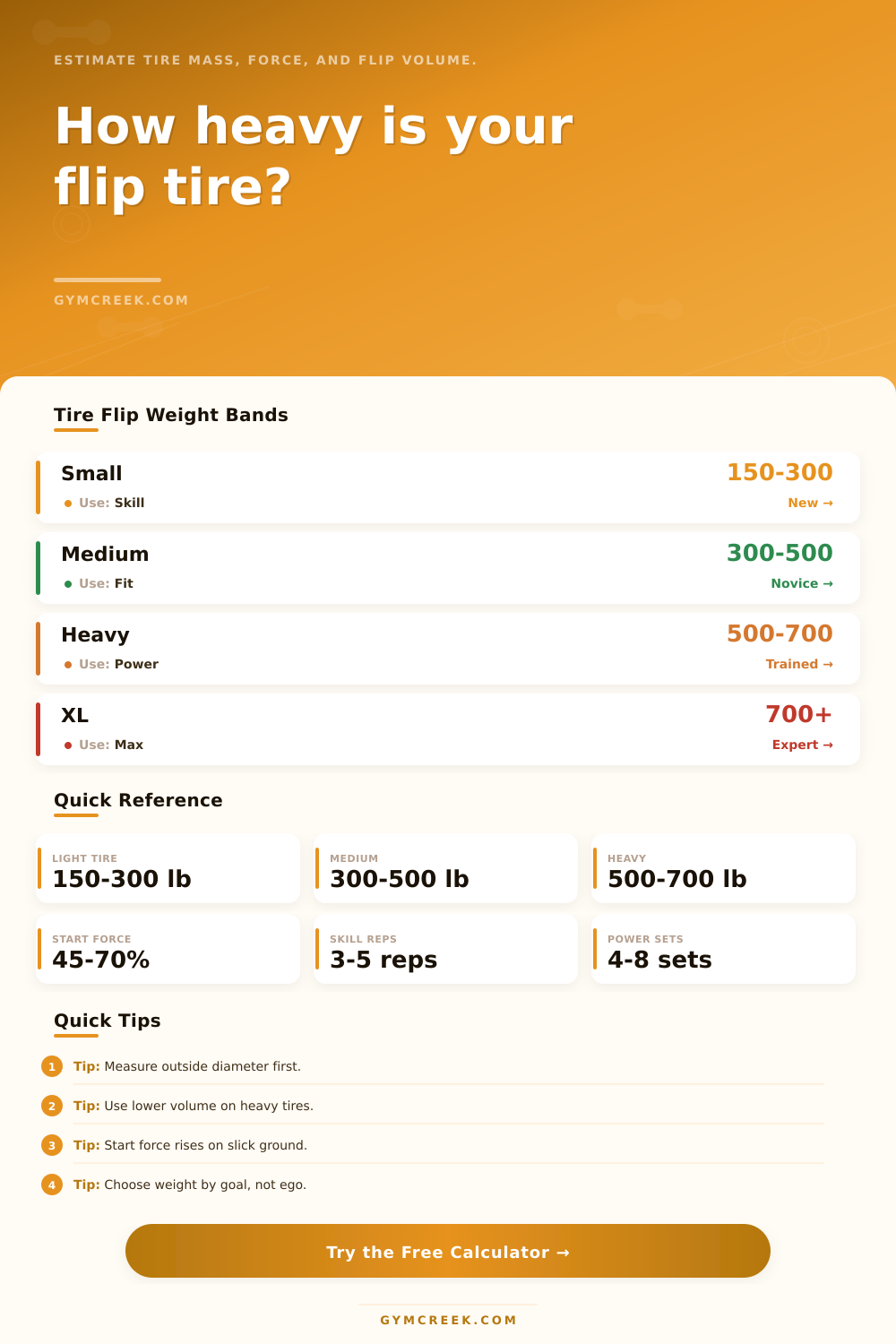
The table below list expected results for each weight band so you don’t accidently choose a load beyond your current strength. But when it’s just you, the tire, and the laws of physics, only your mass and how it interact with the ground matter. And that’s where you learn the variables, what the weight factors are; what the surface friction is, so you can influence it.
It becomes less guesswork and more training with a clear goal. Suddenly, you have something substantial to use. It becomes a precise tool for building power.