Timed Up and Go Calculator
Score a Timed Up and Go test from trial times, assistive device use, chair setup, gait notes, and dual-task load.
📌Presets
Each preset loads a realistic mobility-testing scenario and recalculates the score.
⚙Calculator
Timed Up and Go snapshot
Enter trial details to score mobility status and fall-risk flags.
📊Mobility Metrics
📑Reference Tables
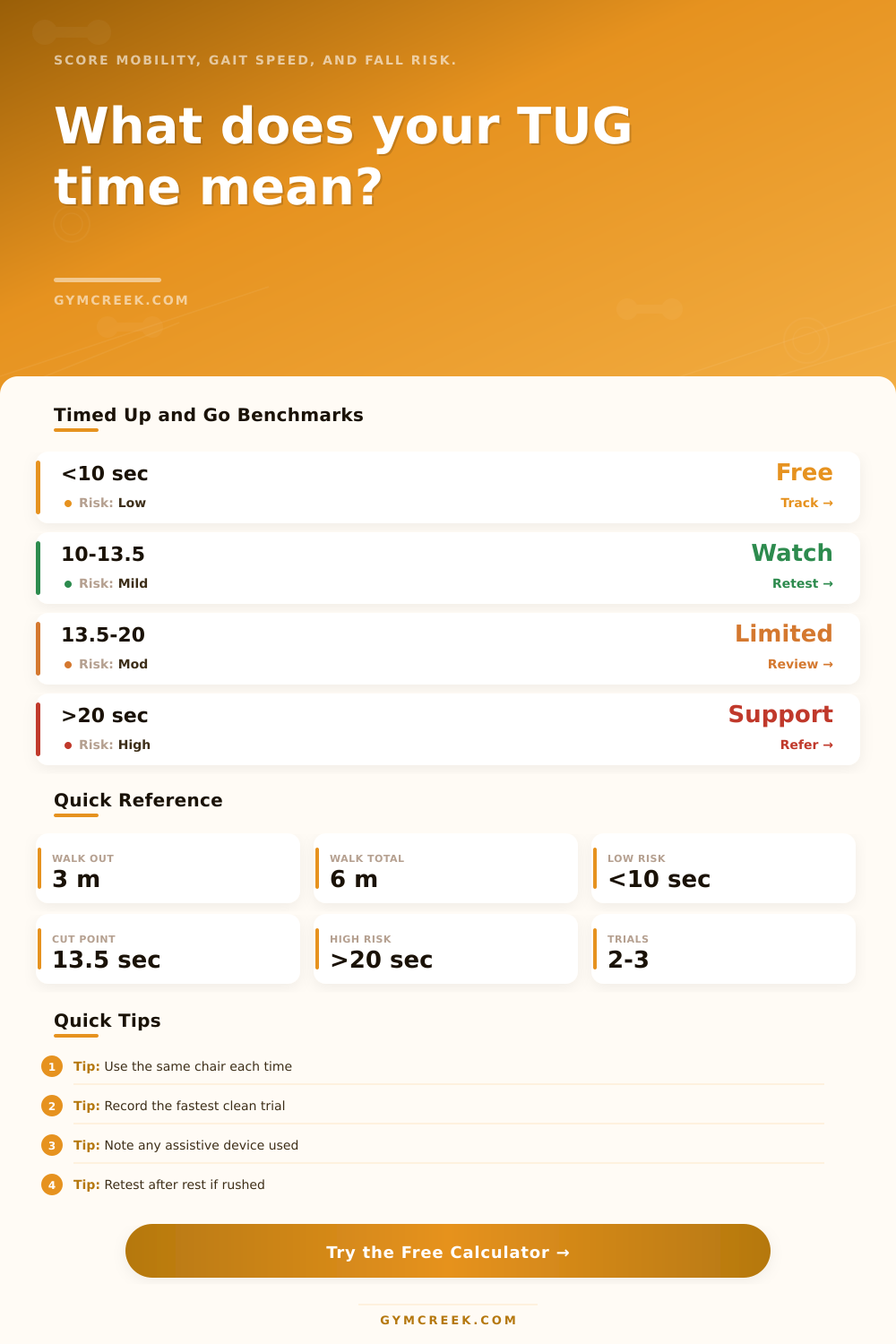
| TUG time | Interpretation | Fall flag | Follow-up |
|---|---|---|---|
| Under 10 sec | Freely mobile | Low | Track baseline |
| 10 to 13.5 sec | Borderline slowing | Mild | Repeat test |
| 13.5 to 20 sec | Limited mobility | Moderate | Review gait |
| Over 20 sec | Needs support | High | Clinical review |
| Setup item | Standard | Why it matters | Record as |
|---|---|---|---|
| Chair | Arm chair | Stand consistency | Same chair |
| Distance | 3 m out | 6 m walking total | Measured line |
| Footwear | Usual shoes | Real-world pace | Shoe type |
| Device | Usual aid | Changes risk | Cane or walker |
| Scenario | Typical time | Key cue | Watch for |
|---|---|---|---|
| Healthy adult | 7 to 10 sec | Smooth turn | Rushing |
| Active senior | 8 to 12 sec | Stable stand | Wide turn |
| Cane user | 12 to 18 sec | Aid sequence | Trip risk |
| Walker user | 18 sec plus | Turn control | Freezing |
| Logic piece | Input used | Output | Purpose |
|---|---|---|---|
| Best trial | Trial times | Main TUG | Clean pace |
| Gait speed | 6 m / time | m/s | Walking context |
| Modifier sum | Device flags | Risk score | Safety screen |
| Spread | All trials | Consistency | Retest need |
💡Tips
While this seems like a fairly straightforward test to administer, there is a lot of useful clinical information gathered from the timed up and go test. From a seated position you must rise out of a chair, walk 3 meters, turn around, walk back to the chair and sit down. It’s sort of a simulation of what we do every day, get up off a chair when someone rings the doorbell, or get out of your car to go into the grocery store.
Since the test mimics real-life behaviors, clinicians can use the timed up and go test to assess strength, balance, and fall risk. Just because the protocol is easy doesn’t mean that it lose ground as a test for functional independence.
What the Timed Up and Go Test Shows About You
To eliminate guessing in the scoring of the trial times, the calculator factors in trial times. But speed alone isn’t everything (which people think), it also breaks down analysis into gait quality, cognitive load and use of assistive devices. So carrying a cane will up the risk score since it means you don’t have independent balance. A walker does too, and so does physical assistance. It’s all an indication that they needs something to help them move safely.
Also, note that speed is one part of consistency. For example, the calculator will need several trials to establish a baseline. One really fast time might be luck, or maybe you had a surge of adrenaline. If there’s significant variance between your best and worst times, it probably means you don’t have good control over what you’re doing, Or maybe you’re tired. That tends to be a better sign of what will happen then any single metric (like an average time).
It’ll also show how your scores compares with expected averages for your age. The test shows how much dual-tasking affects your performance. Most of us don’t save our brain power for just walking, so it will take more effort to walk while holding something or even counting backwards. Instead of focusing on moving, many times you are distracted and fall down. If you’re slower with a cognitive task, the calculator accounts for it by lowering your baseline score. This is important because it identifies concerns associated with divided attention. This is what happens in life as we talk and look around or watch out for things as we move along.
The results are interpreted through reference tables which define standard cut points. Ten seconds or less is typically considered safe and unimpeded mobility. A time of thirteen to twenty seconds suggest limited mobility that should be reviewed. Over twenty seconds indicates the need for clinical intervention. But without seeing how someone moves, there’s no context in the number alone. A score of twelve might seem fine, yet if they hesitates or rely heavily on their hands while turning, it shows their mechanics are fragile. It distinguishes raw speed from quality of execution, giving a clearer picture.
The test results can vary depending on how it’s set-up. How tall are your chairs? Do you have good standing-up leg strength? What kind of shoes do you wear? How do they affect your balance and grip on the floor? Is surface underfoot stable? These parameters is included in the calculation so that changes over time can be compared accurately. For example, you cannot compare a test taken wearing socks on a slick floor versus taking it again while wearing sturdy shoes on carpeting. Measuring functional independence means understanding those variables.
It also means racing against the clock. Then there’s the monitoring process, which includes testing again. For example, how do you know if mobility has improved? Has it fluctuated because of seasonal changes or a post-surgery recovery time or medication? It recommends retesting to measure progress, with the target score suggested by initial results. People in that “moderate risk” category will get a second test once they’ve tried an aid or exercise to see if it works. It transforms a diagnosis from something abstract to measurable data.
Start with a clock and a chair; finish with a sense of where you stand between independence and safety. And isn’t that worth taking that three-meter stroll? You should of tried it.