Time Under Tension Calculator
Estimate tempo code, seconds under tension per rep, total session tension, density, weekly workload, and load-time exposure from your sets, reps, pace, load, and rest.
📌Presets
Presets load realistic tempos and workloads so you can compare strength, hypertrophy, endurance, power, bodyweight, and controlled-rehab scenarios.
⚙Calculator
Time under tension estimate
Enter tempo and workload details to calculate tension time.
📊Tension Metrics
📑Reference Tables
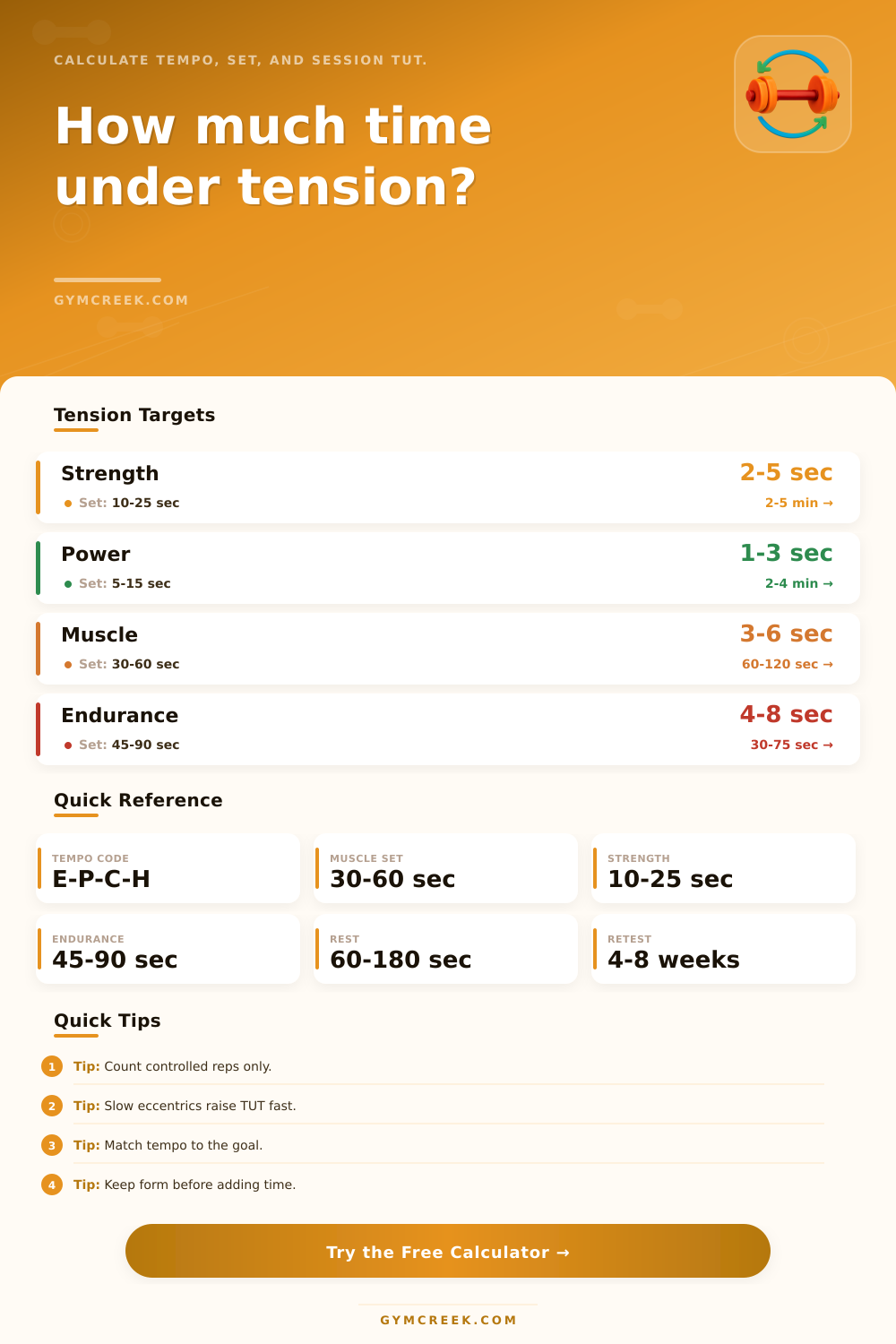
| Goal | Rep Tempo | Set TUT | Common Use |
|---|---|---|---|
| Max strength | 1-0-1-0 to 3-1-X-0 | 10-25 sec | Heavy skill and force |
| Power | Controlled down, fast up | 5-15 sec | Speed and intent |
| Hypertrophy | 2-0-2-0 to 4-1-2-1 | 30-60 sec | Mechanical tension |
| Endurance | 2-1-2-1 or slower | 45-90 sec | Local fatigue tolerance |
| Technique | 3-2-2-1 | 40-80 sec | Position control |
| Tempo Piece | Meaning | Training Effect | Watch For |
|---|---|---|---|
| Eccentric | Lowering phase | Control and tissue load | Too slow for power |
| Bottom pause | Stretch position | Position strength | Losing tension |
| Concentric | Lifting phase | Intent and force | Grinding every rep |
| Top hold | Squeeze or lockout | Peak contraction | Joint resting |
| Extra hold | Set isometric | Static tolerance | Form drift |
| Exercise Type | Typical Count | Body Load | Tempo Note |
|---|---|---|---|
| Squat or lunge | 6-15 reps | Moderate to high | Control depth |
| Push | 6-20 reps | Load or bodyweight | Pause if needed |
| Pull | 5-15 reps | Often bodyweight | Hold top cleanly |
| Isolation | 10-25 reps | Lower load | Squeeze target |
| Power lift | 1-5 reps | Explosive | Do not chase long TUT |
| Formula | Inputs | Output | Use |
|---|---|---|---|
| Rep TUT | Tempo parts | Seconds/rep | Tempo check |
| Set TUT | Rep TUT x reps | Seconds/set | Goal match |
| Density | TUT and rest | Percent | Fatigue context |
| Weekly TUT | Session x days | Minutes/week | Volume trend |
| Load-time | Effective load x TUT | Load-sec | Exposure trend |
💡Tips
Time under tension refer to the length of time a muscle is under load during a set of weightlifting exercises. While many weightlifters focuses on the amount of weight they use for their lifts, the length of time that the muscles is under tension also plays a role in creating the specific adaptations within that muscle. If an individual performs a lift very quick, they rely upon momentum and the elastic recoil of the muscles to help them lift the object of their effort.
These two element are beneficial for moving heavy objects, but they are not the best for increasing the size of a muscle. If an individual slows the performance of their repetitions, their muscles must perform more work over a longer period of time, which increase the time under tension for that exercise. One way to track the time under tension for an exercise is to use a tempo code.
What Time Under Tension Means
A tempo code consist of four numbers that describe each phase of a repetition. The first number is for an eccentric phase of the lift. This is the phase in which an individual lower the load.
The second number is how long an individual pause at the bottom of the lift to remove any momentum from their movement. The third number is the concentric phase, or how fast an individual lift the load. Finally, the last number is for the squeeze at the top of the lift.
By utilizing a tempo code, an individual can control the time under tension for that lift. The use of time under tension will differ for various training objectives. For raw strength training, individuals should not utilize long sets because long sets will fatigue the central nervous system before the muscles becomes fatigued.
For strength training in general, an individual will utilize shorter burst of tension but will take longer rests between sets to allow the CNS to recover. For muscle growth, however, an individual should aim for time under tension between thirty and sixty seconds. Performing sets that are too short will not provide enough time to trigger muscle growth, while performing sets with too much time under tension will fatigue the individuals muscles before they can complete the exercise.
Density ties into the concept of time under tension. Density is the ratio of the time under tension to the total time of an individuals work block. The work block include both the performance of the sets and the rests between those sets.
If an individual decrease the rest periods for their sets, their density increase. High densities create more metabolic stress on the muscles. High densities are beneficial for those looking to increase muscular endurance or increase the size of their muscles, but it become a problem for strength athletes.
Reference tables can help an individual to understand whether their densities and their time under tension relates to their goals. Another concept to consider for time under tension is bodyweight. Bodyweight alone create a significant amount of load for the muscles without the use of any weight.
For exercises like pushups or pullups, an individual is moving a percentage of their body mass, which create the tension in those muscles. By accounting for the bodyweight that an individual can move as a percentage, an individual can more correctaly understand the load that their muscles are performing. By considering bodyweight as part of the calculation of time under tension, bodyweight circuit can be considered a form of strength training.
Form is another aspect to consider with the use of time under tension. As an individual increase the time under tension for each repetition of a lift, they should never sacrifice their range of motion. Increasing the time under tension may lead some lifter to use partial repetitions for each exercise.
However, using partial repetitions is less efficient for those desiring to increase the size of their muscles. An individual must find a way to perform their lifts with high quality movement as they are increasing the length of each repetition for each set. Finally, time under tension can be used as a guide to an individuals training, but it is also important for that individual to listen to their body.
The amount of time that an individual can handle under tension may depend upon the recovery period of that individual. A beginner may struggle with performing sets that take forty-two second each, but an advanced lifter may require more time under tension. By tracking the stimulus that an individual performs each week, their body will eventually send signals to that individual as to what they need in their training.
If an individual decides to stop performing repetitions alone and start to count how many second an individual spends under tension for each set, their weightlifting effort can be both more deliberate and precise.