Tibialis Raise Calculator
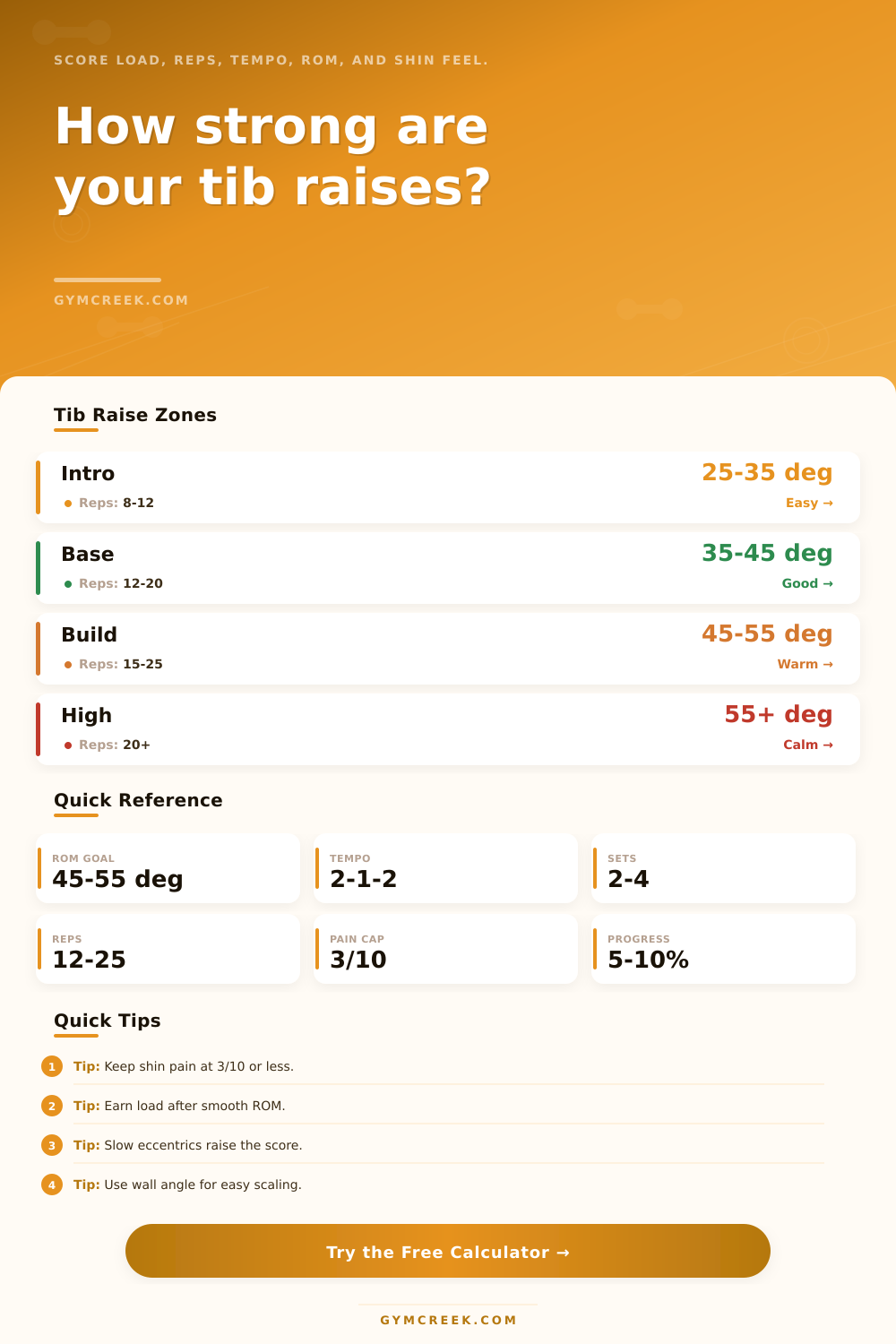
Score tib-bar, bodyweight, and wall-angle tibialis raises from load, reps, tempo, dorsiflexion range, shin tolerance, bodyweight, and unilateral setup.
📌Presets
Each preset updates the exercise mode, angle or load, ROM, tempo, reps, bodyweight, unilateral setting, and shin tolerance before calculating.
⚙Calculator
Tibialis raise snapshot
Enter your set details to score the session.
📊Metrics Grid
📑Reference Tables
| Style | Main Input | Best Range | Use |
|---|---|---|---|
| Tib-bar | External load | 8-20% BW | Strength |
| Wall raise | Lean angle | 25-55° | Scaling |
| Bodyweight | Reps + ROM | 15-35 reps | Base work |
| Band | Band tension | Light-medium | Control |
| ROM Band | Degrees | Score | Training Note |
|---|---|---|---|
| Limited | 10-29° | Low | Use smooth reps |
| Developing | 30-39° | Fair | Build range |
| Useful | 40-54° | Good | Progress load |
| Large | 55-70° | High | Keep control |
| Tolerance | Shin Feel | Action | Next Step |
|---|---|---|---|
| 0-2 | Calm | Continue | Add 5-10% |
| 3 | Noticeable | Hold steady | Repeat load |
| 4-5 | Irritated | Reduce | Cut volume |
| 6+ | High | Stop set | Seek advice |
| Goal | Priority | Good Target | Progress Rule |
|---|---|---|---|
| Rehab | Tolerance | 2/10 feel | Slow reps |
| Base | Volume | 45° ROM | More reps |
| Running | Durability | 20+ reps | Add sets |
| Strength | Load ratio | 15% BW | Add load |
💡Tips
Your shins are like spare parts: run ‘em down and buy another one. Ouch! Ice it; go home. Maybe it will go away.
But more often than not, this isn’t about running to much. Your shin pain stem from failing to teach your anterior tibialis muscle how to handle workload. Time to get strong in a methodical way.
How to Make Your Shins Stronger
This is where the thick muscle on the outside of your shin comes in: The tibialis anterior. It pulls your big toe upward and toward center of your body. So when you place your foot down, it hold your ankle steady.
When that muscle fail, your ankle caves a bit each time you walk, and shock waves ripple back up your leg. Most people don’t make that link. They assume their shins hurt because there’s something wrong with a bone.
In many case, it’s an issue with a muscle. To develop this muscle, there are a few methods. Each one change how the exercise works.
Enter your set-up into the calculator and it’ll do the rest of the work. No more guesswork when wondering whether a bodyweight wall lean is harder then a loaded tib-bar raise.
The program adjust the load to your bodyweight. It also consider the angle of resistance to compare exercises.
If you’re leaning into the wall, you have an advantage. As your feet get further from the wall, effective load gets heavier. More of your bodyweight is supported by muscle and the angle increases percentage. That’s where the input for wall angle comes in. Each ten degrees will feel like five additional pounds on the bar.
If you’re using a weight plate and a tib-bar, you’re dealing with direct external load. It resist throughout the movement.
Most lifters neglect tempo as a variable. Rushing lead to form breakdown. The calculator give a lot of weight to eccentric time.
An eccentric performed slowly will result in more micro-tears of the muscle fibers during the lowering phase and less in the lifting phase. Micro-tears cause the muscle to rebuild itself stronger.
If you rush through your reps you’re mainly building endurance. When trying to build tissue tolerance, control is king… not speed.
The last part is range of motion. Maybe you lift your foot up twenty times. If you can only move through fifteen degrees of motion, you’ve missed half of the work.
When the muscle contract at its weakest point. Which happens when you’re in full dorsiflexion, that’s when it need to be strengthened. That’s what the table on the page makes very clear.
Even with a high rep count, limited range of motion is scored lower. Quantity never beats quality.
This is where how much your shins can take comes into play as a safety valve. “I want you to feel the muscle working.” “I don’t want you to feel the bone hurting.” Zero to three is okay on a pain scale. It’s the difference between muscle fatigue and tendon irritation.
Above four, you’re probably pushing too hard. That goes into the tool which adjust its recommendations accordingly. No amount of strength are worth a stress fracture.
Whatever works in your world today… do it. If all you’ve got is a wall, lean into it and work slowly. If you’ve got a tib-bar, start easy and go for full range of motion.
Whatever you do, create a solid shin. It should be a shin that can handle the stress you put on it.
Hiking, walking, sprinting… none of this should of hurt you.
Because, like I said, your shins are spare parts. Treat ‘em as such and you won’t get much use out of ’em.
Put some load on them so they becomes more stable for you.