Thoracic Mobility Angle Calculator
Estimate upper-back rotation, extension capacity, left-right balance, and training readiness from simple mobility measurements.
📌Presets
Presets fill realistic mobility profiles and recalculate the angle score immediately.
⚙Calculator
Thoracic mobility snapshot
Enter both rotation angles and calculate your mobility score.
📊Fitness Metrics Comparison
📑Reference Tables
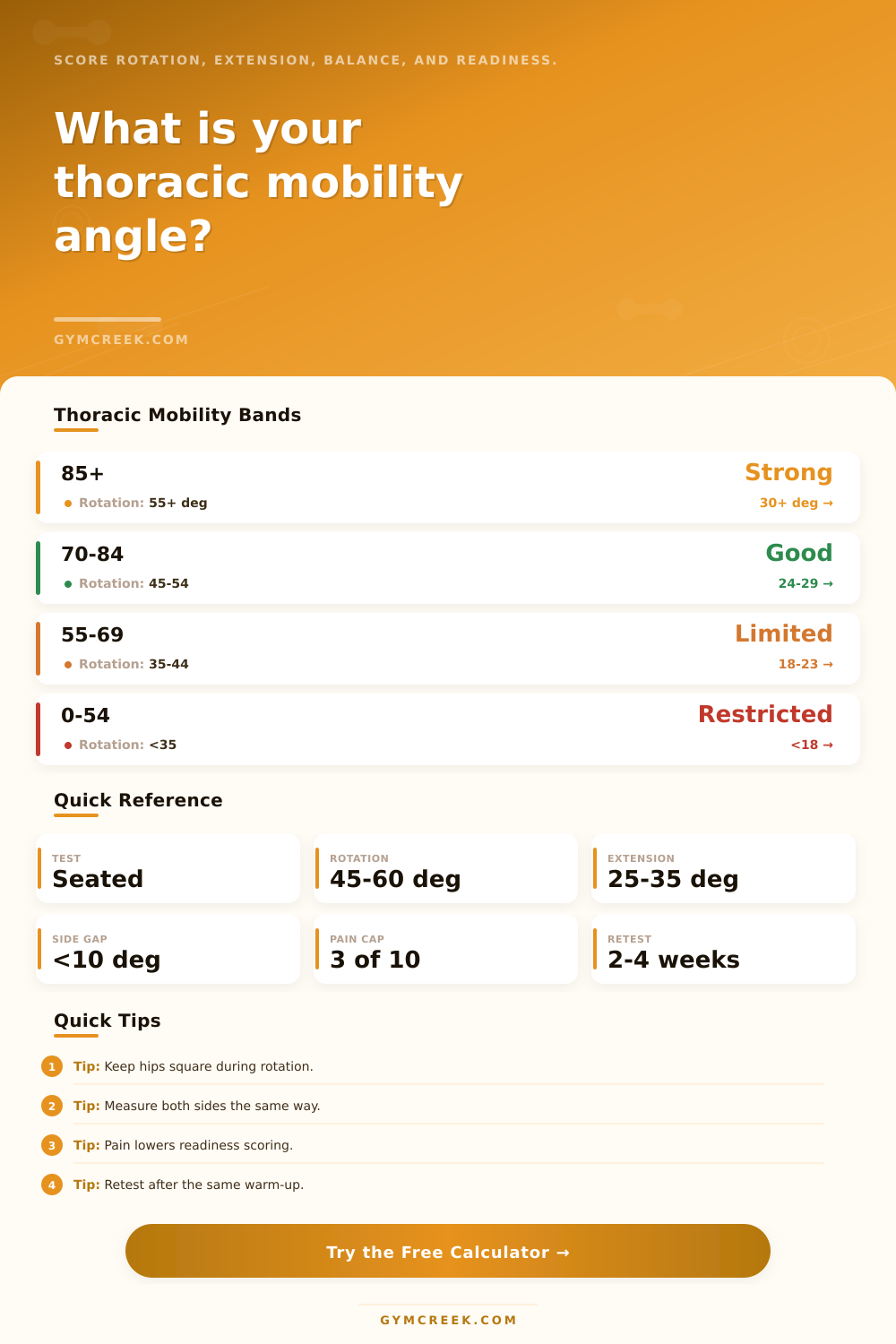
| Band | Rotation Avg | Extension | Training Meaning |
|---|---|---|---|
| Strong | 55+ deg | 30+ deg | Broad movement options |
| Good | 45-54 deg | 24-29 deg | Most lifts supported |
| Limited | 35-44 deg | 18-23 deg | Technique may compensate |
| Restricted | Under 35 deg | Under 18 deg | Use conservative loading |
| Side Gap | Symmetry Score | Likely Impact | Retest Focus |
|---|---|---|---|
| 0-5 deg | Excellent | Balanced turning | Keep baseline |
| 6-10 deg | Acceptable | Minor bias | Same setup |
| 11-15 deg | Watch | Sport-side pattern | Check technique |
| 16+ deg | Flag | Compensation likely | Reduce strain |
| Goal | Key Angle | Useful Range | Why It Matters |
|---|---|---|---|
| Overhead lift | Extension | 28-35 deg | Stacked lockout |
| Squat bench | Extension | 22-30 deg | Bracing shape |
| Golf throw | Rotation | 50-65 deg | Turn capacity |
| Posture reset | Flex plus ext | 58-80 deg | Segment control |
| Formula | Variables | Output | Use |
|---|---|---|---|
| Mean rotation | L, R | Avg angle | Rotation base |
| Asymmetry | |L - R| | Side gap | Balance check |
| Extension index | Ext, target | 0-100 | Upper-back reach |
| Readiness blend | Angles, pain | 0-100 | Training context |
💡Tips
Your upper back is tight when you sit down and squat heavy. This creates a mechanical wall that keeps you from stacking your spine proper, so your shoulders roll forward to compensate. Thoracic mobility isn’t just general soreness; it’s a range of motion problem.
And unlike guessing if you’re restricted or tight, you don’t have to with the calculator. It does the math for you after you enter your extension limits and rotation angles. Knowing the difference will change how you train because it explain exactly what mechanics need attention.
Why Your Upper Back Matters for Heavy Lifting
When you’re lifting really heavy thing, your lower back should be stable and your upper back should can swivel freely. When that separation gets disrupted, it’s injury time. Sometimes people think they just need to do more core work but often times it’s just that their vertebrae is glued to their ribs because of sitting in a chair all day every day. It’s hard for your body to get out of that rounded position when it stand up to lift something, as it has learned to hold its body that way.
The key is knowing what it is we’re measuring here (not so much how far you can twist the entire length of your torso), does the twist happen through the spine? Or are you using only your hips? How do we measure? It takes some discipline here; rotating with a square pelvis ensure that the motion happens where it should, in the thoracic region. Letting the hips go will result in a better number on paper but not a true representation of what’s there, hence importance of keeping things consistent.
The bands laid out on the reference table is there for a reason. If your score lands in the strong band, you’ve got options in terms of mobility for just about every sport/lift. If you find yourself in the restricted zone, it doesn’t show anything other than an opportunity to shift the focus of training prior to getting under the bar.
Another silent killer is asymmetry; i.e., many of us have one side that’s just fine and the other has stiff joints and we have perfect mobility, so there’s an imbalanced force being applied through the spine with each push/pull. You may not notice it during a light set but it starts showing up as fatigue sets in. By comparing how much you rotate left vs. Right, the tool can help identify the gap since a small gap is normal (humans aren’t symmetrical machines). But if it’s a big gap, you’re likely favoring one side. This will cause long-term issues. Most people miss this because they focus too much on chasing a higher total number without paying attention to the balance between their two sides.
So while rotation is important, so too is extension (being able to arch your upper back on an overhead press without collapsing your midsection into lockout). The calculator takes your shoulder comfort into account here, just as it does with all mobility measures. Pain reduces your readiness score if you can’t maintain mobility comfortabley. You can grind out a better angle through tissue irritation, but you won’t be able to do it under load. It’ll collapse the second you increase weight.
That said, you should of repeat these tests every week or two to really get a sense of what’s going on. Don’t go off one good session of stretching. You want to use the same landmarks and warm up every time to eliminate “noise” in your results. It isn’t temporary flexibility you’re looking for, but structural change; using the presets lets you compare yourself to realistic types (e.g., powerlifter or desk worker) to get some context around your numbers.
Thoracic mobility issues aren’t typically solved with one magical stretch, but rather by learning to control and consistantely make the right movement patterns, so that your nervous system understand it’s OK to move without fear. When you do nail it, though, don’t forget: You’re not only trying to open up the back; you want to add that new freedom of movement to all your actual training movements. Begin by slowly building the range through some light extensions and rotations on low load.