Thermic Effect of Food Calculator
Estimate daily digestion calories from protein, carbs, fat, fiber, alcohol, body size, activity, meal pattern, and diet phase.
◎Presets
Presets load realistic body stats, macro targets, meal patterns, and diet phases. Every number stays editable after loading.
⚙Calculator
Thermic effect snapshot
Enter your macros to estimate digestion energy and net intake.
▦Fitness Metrics Grid
▣Reference Tables
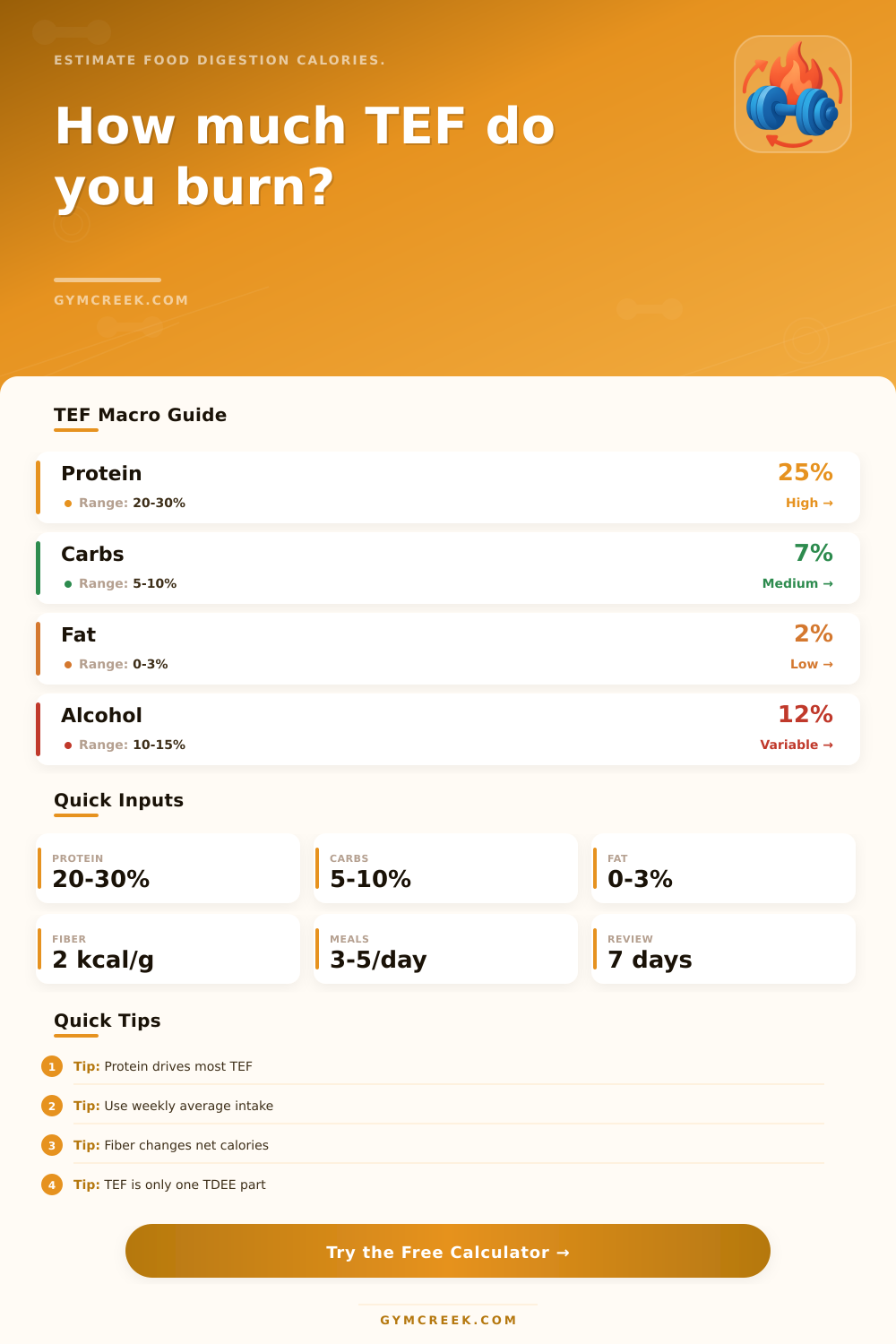
| Macro | Common TEF range | Calculator middle | Why it matters |
|---|---|---|---|
| Protein | 20% to 30% | 25% | Highest digestion and processing cost |
| Carbohydrate | 5% to 10% | 7.5% | Moderate cost, varies by source |
| Fat | 0% to 3% | 2% | Lowest digestion cost |
| Alcohol | 10% to 15% | 12% | Variable and not a performance target |
| Pattern | Likely TEF | Input clue | Planning note |
|---|---|---|---|
| High protein cut | Higher | Protein 30%+ calories | TEF helps but deficit still matters |
| High carb refeed | Moderate | Carbs 50%+ calories | Scale may rise from glycogen water |
| Low carb high fat | Lower | Fat 40%+ calories | Net intake may be close to gross |
| Whole-food mixed | Middle | Fiber 12+ g per 1000 kcal | Usually a stable default estimate |
| Output | Formula | Inputs | Purpose |
|---|---|---|---|
| BMR | Mifflin-St Jeor | Age, sex, size | Resting energy estimate |
| Lean BMR | Katch-McArdle | Lean body mass | Alternate if body fat is known |
| Gross calories | 4/4/9/7 kcal | Macros and alcohol | Food energy before TEF |
| Net calories | Gross minus TEF | Macro TEF rates | Energy after digestion cost |
| Scenario | Protein | TEF signal | Best interpretation |
|---|---|---|---|
| Balanced maintenance | 0.7 to 1.0 g/lb | Average | Use TEF as a TDEE component |
| Cutting phase | 0.8 to 1.2 g/lb | Higher | Supports satiety and lean mass |
| Lean gain | 0.7 to 1.0 g/lb | Average | Surplus size matters more |
| Endurance block | Moderate | Carb led | Fuel training, then review trend |
◇Tips
Moving your body burns calories. And you dutifully log your gym session. And you count your steps. But here’s something you probably don’t pay much attention to: Every time you take a bite of a meal, there’s a silent furnace lighting up in your belly. That’s a part of your metabolism called the thermic effect of food. It refers to the amount of energy your body uses to digest, absorb and process everything you eat. Most of us believe it’s negligible. It is small enough to not obsess over, but not small enough to not notice. The key are to understand where it’s noise and when it isn’t.
This is the heavyweight champ of metabolic cost. Amino acids require far more work by your body to break down than either glucose or fatty acid. It doesn’t have to do as much with them. The calculator uses a middle-range estimate of 25% for protein. This is why high-protein diet tend to result in better fat loss results. If you consume one-hundred calories of pure protein, your body may burn a quarter of that, twenty-five, simply trying to process it. This is why they makes you feel fuller compared to other foods. You get a discount on the energy you retain.
How Your Body Burns Food
These ranges are laid out nicely in the reference tables within the tool. You’ll be able to see how large an area for error exists here. It is not a precise science but the direction of the trend is very clear. Fat is almost free to process. Because we’re hard-wired to store fat, your body doesn’t want to waste any energy digesting it. Carbs fall somewhere in the middle: moderately expensive to process. So even if two meals contains exactly the same amount of calories, the one full of carbs will be harder for your body to handle and will cause your metabolism to slow down more different than a meal made mostly of fats. For someone interested in losing weight, this means that the source of your calories matters far more then the calories themselves.
Simple calorie-tracking apps don’t account for this at all; they treats every single calorie as the exact same thing, regardless of where it comes from when it passes your lips. Many calculators don’t consider the other piece of the equation: Fiber. Even though it contains fewer net calories, it still takes energy to process. To show you what your body will actualy have to burn, the calculator factors in the added cost of fiber as its own variable. Whole foods contain more fiber by nature, which means your body must use some additional energy to break down their plant-like structure.
Slide the refined stuff right on past. Sure, you’re getting those calories… but you aren’t paying the metabolic tax. This is why, even with similar calorie counts on paper, it is harder to lose weight when eating processed foods (and easier to over-consume). A brief note about alcohol, which resides in a sort of limbo between fuel and food. On one hand, alcohol has a greater thermic effect than carbs or fat, but that doesn’t mean you’d use it as fuel. Most folks drink regularly, so it’s included in the calculator more out of completeness than anything else. While some number of calories are used up in the process, the hormonal effects tend to outweigh whatever slight metabolic uptick may occur. Think of it instead as supplemental energy that gets in the way of your objectives.
These aren’t daily targets, but weekly averages. Just because you splurge on one large steak dinner doesn’t mean you magically became a fat burning machine the next day. Your bodys metabolism is slow to adapt to consistent dietary patterns. That’s why the calculator has those presets which load real world examples, such as a lean bulk phase or balanced cut. How do those macro ratio shifts impacts the total picture? You don’t have to do the algebra yourself. It takes out the guesswork when estimating your net intake.
The bottom line: The thermic effect is an ally but a minor one. It’s not going to make up for lack of a calorie deficit (or surplus). But if you focus on eating whole foods, especially those high in protein, it can tilt things in your favor. Because no one feels their body turning calories into heat while digesting them, most of us significantly underestimate this effect. There’s nothing tangible to feel, the calories aren’t literally dissapears from your stomach. But they’re still gone. Think about your food as something you’re buying that requires dollars to be processed by your body instead of some free form of energy that magically appears. That mindset shift will alter every single meal you plan.