Tempo Training Calculator
Build a tempo prescription from eccentric, pause, concentric, and top-pause seconds, then estimate time under tension, loaded exposure, density, and rest quality.
📌Tempo Presets
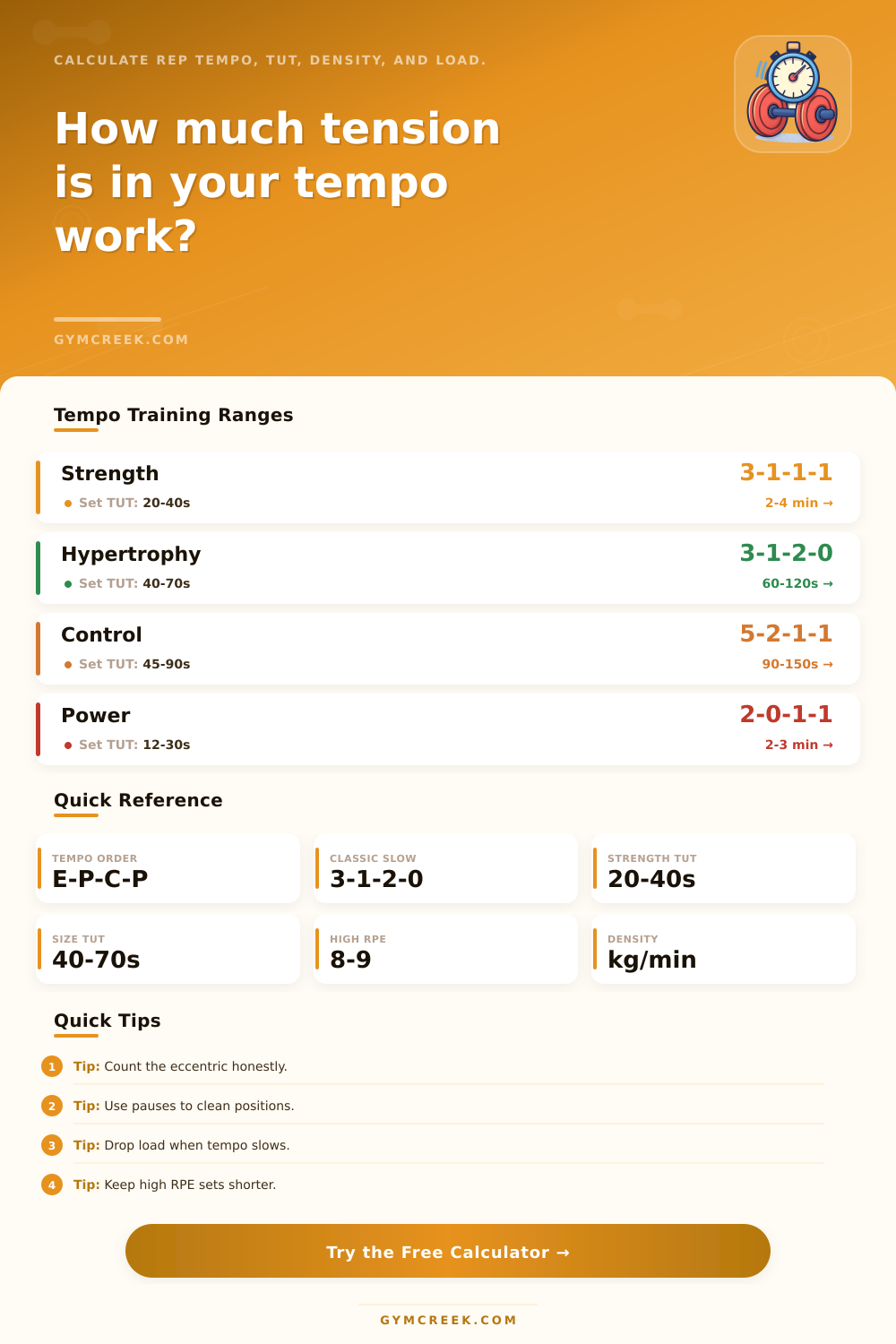
Tempo format is eccentric - bottom pause - concentric - top pause. A 3-1-2-0 tempo means three seconds down, one second held, two seconds up, and no top pause.
⚙Calculator
Tempo training snapshot
Enter tempo, reps, sets, load, effort, and rest to calculate tension exposure.
📊Training Metrics
📑Reference Tables
| Goal | Common Tempo | Set TUT Target | Use Case |
|---|---|---|---|
| Strength control | 3-1-1-1 | 20-40 sec | Bracing, position, heavy work |
| Hypertrophy tension | 3-1-2-0 | 40-70 sec | Muscle gain blocks |
| Technique quality | 5-2-1-1 | 45-90 sec | Pattern correction |
| Metabolic density | 2-0-2-0 | 50-90 sec | Pump sets, lighter loads |
| Power maintenance | 2-0-1-1 | 12-30 sec | Fast concentric intent |
| Tempo Part | Meaning | Typical Range | Training Effect |
|---|---|---|---|
| Eccentric | Lowering or yielding | 2-5 sec | Control and tissue loading |
| Bottom pause | Held stretched position | 0-3 sec | Removes bounce and tests position |
| Concentric | Lifting or overcoming | 1-3 sec | Drive, intent, and rep quality |
| Top pause | Lockout or squeeze | 0-2 sec | Stability and full-range finish |
| Exercise Pattern | Useful Tempo | Watch For | Adjustment |
|---|---|---|---|
| Squat or leg press | 3-1-2-0 | Knees and depth drift | Shorten reps if bracing fades |
| Deadlift or hinge | 4-1-1-1 | Back position under fatigue | Use fewer reps at high RPE |
| Pressing lift | 3-1-1-1 | Bar path and shoulder control | Keep pauses crisp |
| Pulling lift | 2-1-2-1 | Rushing the squeeze | Hold top position honestly |
| Single-leg lift | 3-2-2-0 | Balance replacing tension | Lower load before shortening tempo |
| RPE | Tempo Suitability | Set TUT Bias | Rest Note |
|---|---|---|---|
| 6-7 | Best for technique tempos | Longer sets tolerated | Rest until crisp |
| 7.5-8 | Best for hypertrophy work | Moderate-high tension | Use repeatable rest |
| 8.5-9 | Best for short slow sets | Avoid very long grinders | Rest longer if bar speed drops |
| 9.5-10 | Rare for tempo work | Keep exposure brief | Use sparingly |
💡Tips
This brings us to tempo training, which involve control and intention. By controlling length of time you spend in each part of lift, you’re changing load on your body. The difference between a controlled rep and a fast one are the quality of tension. And you get to witness whether or not you can repeat that tension set after set.
Each part of tempo rep does a different thing with the four numbers. As they lengthen and load your muscles, thats the eccentric portion. You has to be able to own position by pausing at bottom to remove momentum. The concentric phase is where you express force; then there’s a pause at top to reinforce your stability at lockout. Even if you keep weight the same on bar, changing those numbers change the demand on body.
Why Tempo Training Works
This is where our calculator comes in. This give you an idea of whether your plan matches your goal. If your plan consists of 20-second per-set tension in a hypertrophy block, then the answer is no. The calculator ask for your inputs: sets, reps, rest and load, as well as the phases of your training (tempo). Then it convert these decisions to measurable amounts: how many minutes per workout; what’s your total work time; and what’s your density, i.e., how much weight are you moving per minute?
They also highlight some of more subtle trade-offs that can be overlooked on paper: Longer tempos create more tension time, which means you can’t lift as much weight. A shorter rest period raises the density, which can make it difficult to stay within limits of an honest tempo on subsequent set. When we see effort climb beyond eight and a half, its flagged by the calculator because the ideal tension window get smaller. It’s a warning because long tempos and high effort dont clean up well in practice.
Tempo is a variable, not a fixed prescription for many lifter. They select a tempo from something they read or saw someone else doing. So even if reps don’t feel right, they do it anyway. This leads them to having a tempo on their first rep, which has no bearing than the fourth. I like using tempo as a constraint that forces you into a better position. Then you adjust your rest or your load so you can keep repeating the constraint.
The role of rest between sets are more important than most realize. Too little rest cause the tempo to break down. Too much rest, and session loses desired density. This ratio of work time to rest time reveal whether your recovery is supporting your work or just padding out your session. Any time the ratio goes off-track to one side or other, then session no longer matches what’s listed on program sheet.
By tracking those variables, it take the guess work out of a decision that was previously based off feel. Now you know whether the tension window you desired were created by the setup you chose. You can know if rest period matches amount of effort you put in. You can know if the overall density correspond to the block in which you’re working. With that understanding you can adjust one variable at a time without having to guess which part of workout should of been changed.
While the calculator will never take the place of your judgement of how a set felt, it provides you a consistent way to compare one workout to the next. And over time, that comparison is more important than any individual number.