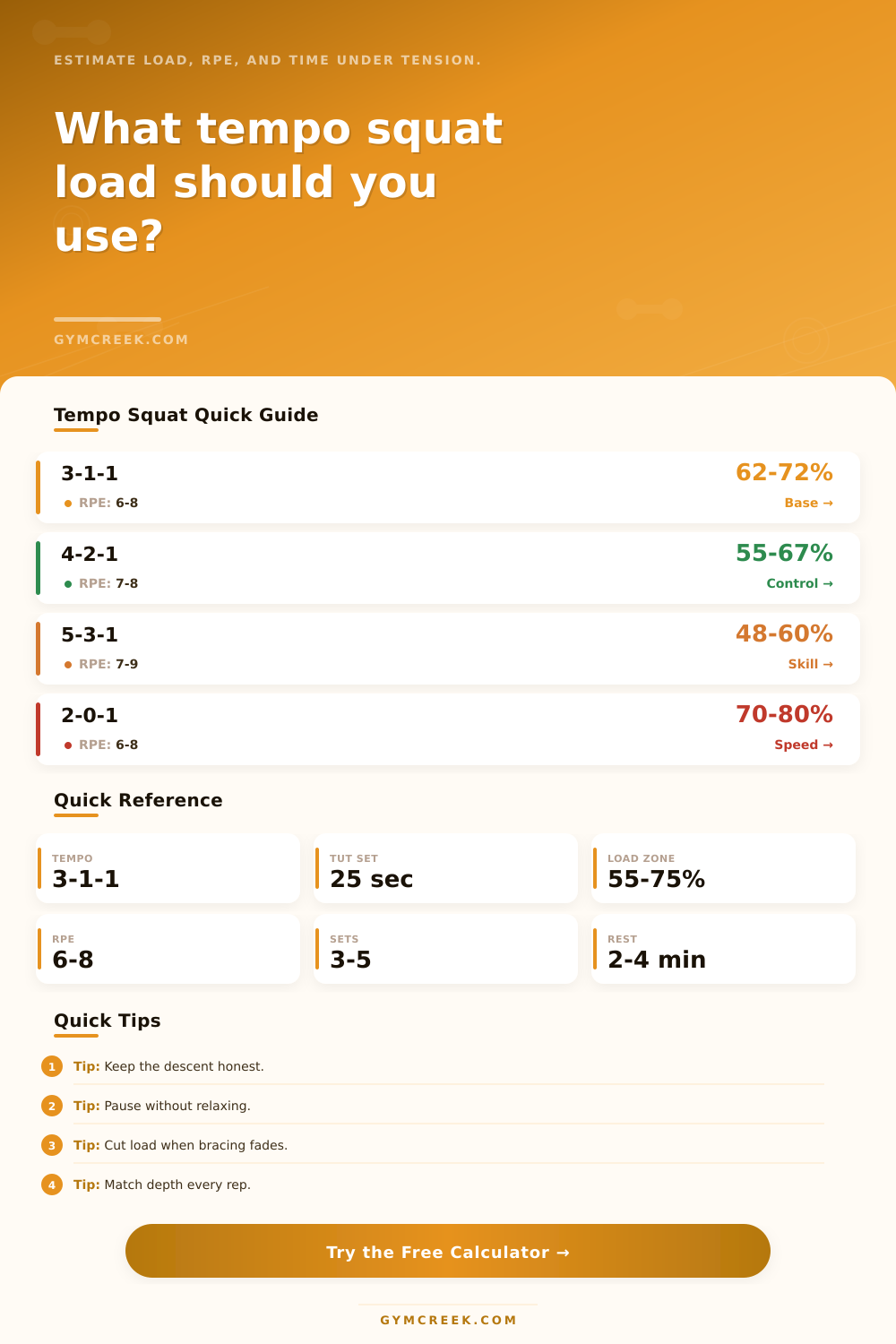
Tempo Squat Load Calculator
Dial in squat load from 1RM percentage, tempo speed, pause length, stance, depth, sets, reps, and target RPE.
📌Tempo Squat Presets
Presets load realistic strength, hypertrophy, technique, deload, and skill scenarios, then calculate the load automatically.
⚙Calculator Inputs
Tempo squat snapshot
Enter your squat max and tempo to estimate the working load.
📊Tempo Metrics Grid
📑Reference Tables
| Tempo | Rep TUT | Load Drop | Best Use |
|---|---|---|---|
| 2-0-1-1 | 4 sec | 0-5% | Speed control |
| 3-1-1-1 | 6 sec | 5-12% | Base strength |
| 4-2-1-1 | 8 sec | 12-20% | Hypertrophy |
| 5-3-1-1 | 10 sec | 18-28% | Position skill |
| RPE | Reps Left | Adjustment | Use |
|---|---|---|---|
| 6 | 4 reps | -6% | Technique day |
| 7 | 3 reps | -3% | Volume day |
| 8 | 2 reps | 0% | Hard work |
| 9 | 1 rep | +3% | Top set |
| Depth | Penalty | Control Cue | When Useful |
|---|---|---|---|
| Above parallel | 0% | Same height | Overload |
| Parallel | 2% | Hip crease | General work |
| Below parallel | 5% | Stay braced | Strength skill |
| ATG | 8% | Own bottom | Mobility skill |
| Stance | Effect | Watch | Load Note |
|---|---|---|---|
| Narrow | More knee | Heel contact | May reduce |
| Moderate | Balanced | Even pressure | Baseline |
| Wide | More hip | Knee line | Slight reduce |
| Very wide | High demand | Adductors | Reduce more |
💡Tempo Squat Tips
Tempo should never be thought off as a suggestion. It’s a fixed rule.
Many times, it ask you to lower the bar for three seconds. Guess what? Most people don’t count; they just guess at speed. Then they pick a weight based off thinking, “oh yeah, this feels like it’ll go slow enough.” However, that speed will affect how much weight you can use for your reps. Slow it down too much and you won’t get the same amount of load. It’s law of physiology and physics.
Why Slow Movements Mean Less Weight
The calculator up top allow you to precisely calculate how much less weight you need to take off the bar so you’re able to avoid failing on first rep and still avoid breezing through the set with zero tension.
Time under tension is basic idea. You know how it feels like you’re lifting less weight when rushing through a squat? You are relying on momentum to get yourself back up. Bounce off the bottom with a quick dip and your legs will make any weight feel easier then it really is. Control your descent, though, and you take away that elastic energy. All of the work fall on your muscles. Suddenly, the stress isn’t on your tendons anymore; it’s on your muscle fiber. And that changes the load too. A four-second descent plus a two-second pause means you are holding tension for six seconds before you even start pushing up. That’s a long time to keep your glutes and quads engaged.
The tool takes into account those seconds and adjusts the suggested percent of your one-rep max to match. It understands that a slower tempo need a lighter load to ensure correct form.
Get real about how many you count. Often when I see someone rush their way down in four seconds it’s actualy closer to two. Lie to yourself and guess at the rate and you’ll get a recommendation of too much. You’ll do reps with a compromised brace or poor depth and grind them out.
On the page there are also some reference tables that outlines the standard penalty for each speed. They demonstrate that you can increase amount of time you take for the eccentric phase (the lowering) by as little as two seconds and lose strength noticeabley. And this is where folks mess up. They make an effort to add time without adjusting for weight and end up doing sloppy workouts which train bad habits instead of building strength.
Lastly, both depth and stance come into play with the final number. Even at the same tempo, squatting deeper will put you through a greater range of motion, meaning a greater time under tension. A deeper squat means more work for your ankles and hips than a shallow one that goes just above the knees. If you choose a deeper target, the calculator accounts for this shift in mechanics by changing intensity to match. Likewise, a wider stance alters the leverages and move the load onto other muscles. It may be easier on your knees but harder on your adductors. These body movement shifts is factored into the load estimate so you can be confident when training.
Another advantage is time management. Knowing exactly how much time under tension you had throughout the entire session lets you see just how much your muscles was really working. You could lift for an hour, but if you rest five minutes between every set, your muscles were only under tension for a fraction of that time. Your session total provides you with a realistic look at the volume you handled. From there, you can use this in your training plan; having a clear idea on how much time under tension you want to hit each week will ensure you’re progressing. It also converts vague feelings of “this was a hard workout” into measurable data.
If you’re not sure where to start, the page has several solid preset workouts to try. Load up a pause strength workout or one of the more popular hypertrophy control routines. These are not random numbers. Rather, they stem from sound training principles that allows for enough stress to induce change while allowing time for recovery. Tweak them to match your day. Feeling fresh? Go ahead and bump up the RPE. Your knees is stiff today and need something more of a light deload flow. Whatever it is, the flexibility’s there. You simply should of trust the math.
But the devil in the details makes perfection seem attainable. Consistency is what we’re after here. Get close with the tool and go from there. Adjust by feel. Did you break form on that final rep? Too heavy. Did you finish feeling energetic? Add a little more next time around. The calculator provides the starting point. Your body is the decider. Stay honest with yourself on the way down. Keep bracing. Let the numbers help lead you back to the right side of things. It is little, but it matters.