Tempo Run Pace Calculator
Estimate your threshold pace, adjust it for the day, and turn a tempo goal into workout distance and session time.
📌Presets
Presets load realistic recent races and workout formats so the pace math has useful context.
⚙Calculator
Tempo pace snapshot
Enter a recent race or known threshold pace to calculate.
📊Metrics Comparison Grid
🏁Workout Benchmarks
📑Reference Tables
| Pace source | Tempo estimate | Best use | Caution |
|---|---|---|---|
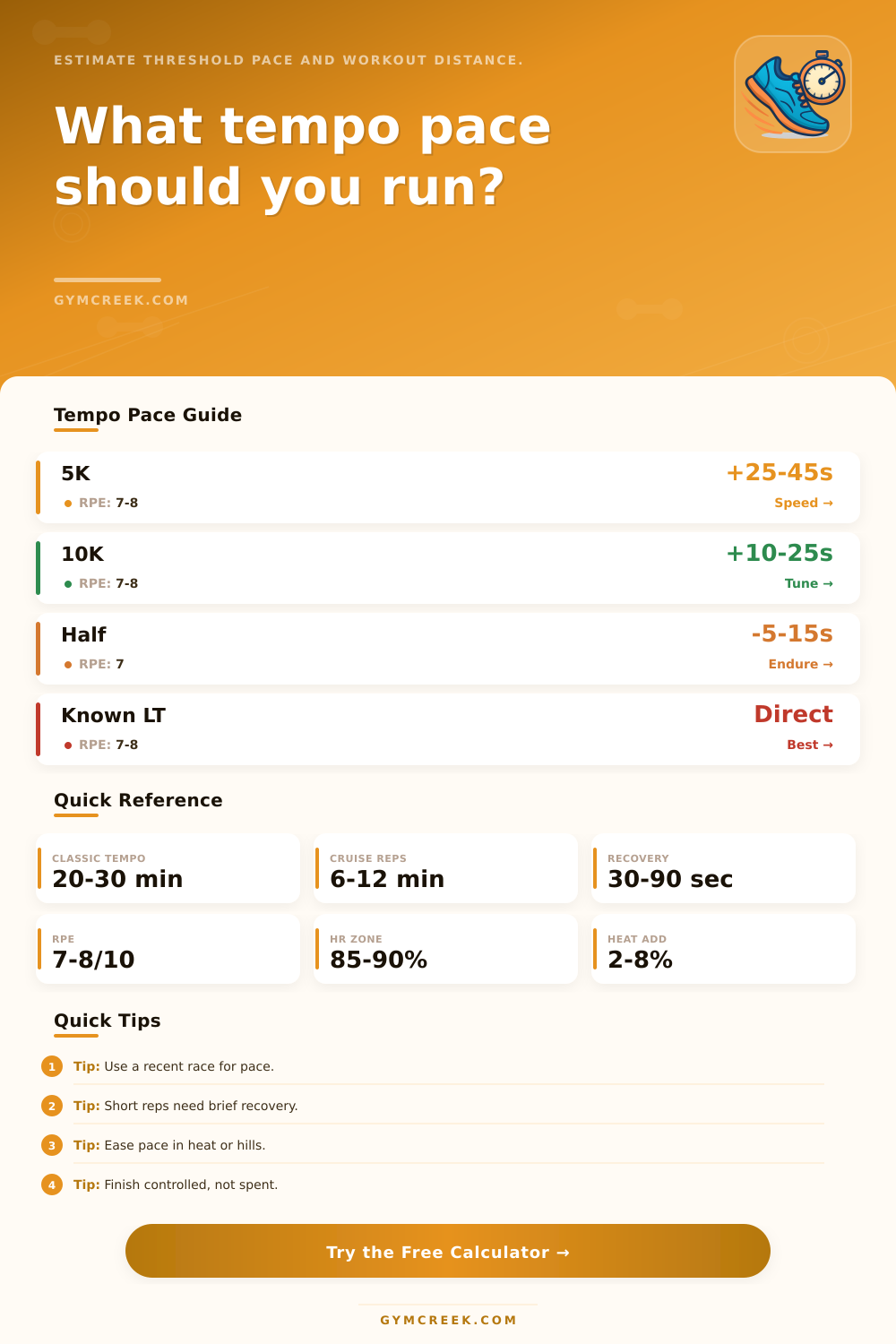
| 5K race | 25-45 sec slower | Newer runners | Can run hot |
| 10K race | 10-25 sec slower | Threshold tune | Needs fresh race |
| Half marathon | 5-15 sec faster | Endurance runners | Fatigue matters |
| Known LT pace | Direct input | Experienced runners | Retest often |
| Workout | Tempo time | Recovery | Feel |
|---|---|---|---|
| Steady tempo | 20-30 min | None | Controlled |
| Cruise intervals | 3-6 x 6-10 | 30-90 sec | Repeatable |
| Progression | 25-45 min | None | Builds late |
| Marathon tempo | 30-60 min | Optional | Strong steady |
| Condition | Pace allowance | Adjustment | Reason |
|---|---|---|---|
| Warm | 2% | Slow slightly | Cooling cost |
| Hot | 4% | Slow more | Higher strain |
| Hot and humid | 6% | Effort first | Heat load |
| Rolling hills | 1-5% | Use effort | Grade cost |
| Metric | Tempo zone | Below tempo | Above tempo |
|---|---|---|---|
| RPE | 7-8/10 | Conversational | Strained |
| Talk test | Short phrases | Full sentences | Single words |
| Heart rate | 85-90% max | 75-84% | 90%+ |
| Finish feel | One more rep | Too easy | Empty tank |
💡Tips
How fast should you run your next hard workout? You’ve got a six-week-old race time and aren’t sure how to translate that into an appropriate effort today. That’s where a good calculator comes in.
Without knowing how much of a leap to make, you might end up going too hard on day one and then burn out by day four. With a little help, you’ll know just how hard to run and be able to focus on the task at hand: actualy running.
Why You Need a Running Pace Calculator
Your recent race, likely a half marathon or 5K… Are converted into a threshold pace that represents your current fitness level. Why does this matter? Race effort doesn’t equal training effort. Fresh off a new 5K PR, you won’t likely be able to keep up that pace for twenty minutes so the math has to take that drop-off into consideration.
“Most runners assume they need to run their tempo at exactly the same speed as in their most recent race. That’s where many folks go astray. Your threshold pace is the point where you clear lactic acid, but it are still slightly slower then what you can sustain for a short burst. So the calculator does this by adding a bit of buffer (depending on your source race distance). For example, if you’re entering a 5K time, it will add more seconds/mile since that is very anaerobically powered. On the flip side, if you enter a half marathon time, it may even recommend a few seconds/mile faster as that distance is already an endurance challenge. It lays this out pretty clearly on the page with a reference table.”
Secondly: Where are you training? For a given pace, your heart rate go up with heat and humidity. There’s no point in ignoring that, it can lead to disaster. On a cool day, if you hold your cool-weather pace, in about five minutes it will have spiked your heart rate into red zone territory.
The calculator has a slider for this, so we adds a percentage slowdown factor to keep things honest physiologically. Sure, you may think you’re going too slow but your body is actualy putting out the same effort as it would on a cool morning in October. When the weather gets hot, effort trumps numbers.
You’ll approach the pace differently depending on the workout’s format, too. Four six-minute reps with a half minute of jogging in between feel much different than a single twenty-minute tempo that never stops. Choose your favorite flavor, whether it’s a classic steady run or some cruise intervals. Because those short recoveries break up the monotony and keep the muscles fresh for the next burst, cruise intervals can be an easier target.
If conditions are tough, adjusted pace gives you a realistic goal. The output will also tell you what total distance you’re covering at the faster pace so you know what to plan for. There is nothing worse than starting a rep and realizing you’ve run back home after three minutes.
This leads to another pitfall: Running at whatever seems “easy” instead of something that pushes you. You want to get up to an RPE of seven or eight (you can say a few words at a time but not whole sentences). If you can carry on a conversation while running, you are doing easy miles. Running where you’re gasping for breath? This is interval territory. The calculator shows those metrics as well (alongside the pace)… That’s a many-sided check of your run intensity.
And it includes warmup/cool down time, meaning you’ll see a realistic length of run session. That’s helpful when planning runs so you don’t worry about not running enough for a good threshold day.
In short, pace runs should push your boundaries while avoiding pushing them so far they take several days of recovery time. Ideally, you’ll finish wanting to do just a bit more rather than feeling empty. By anchoring the recommendation in your past performances, the calculator takes the fear out of selecting the incorrect number. Establish a foundation and tweak it on-the-fly depending on how your legs feel that day.
Yes, running is both a science and an art, but when you’ve got a decent science behind you, you can really put all that effort toward the effort. Trust the math at the beginning and trust yourself at the end.