Tempo Run Heart Rate Calculator
Calculate tempo run heart-rate targets from age, resting heart rate, max heart-rate method, lactate threshold HR, heart-rate reserve, selected tempo percent, cardiac drift, conditions, and workout duration.
📌Tempo Run Presets
Each preset loads a complete runner profile with a different HR anchor, lactate-threshold estimate, drift pattern, conditions, and tempo duration.
⚙Runner And Tempo Inputs
Tempo heart-rate target
Enter your runner profile and tempo settings to calculate a controlled heart-rate range.
📊Tempo Metrics
📑Reference Tables
| Anchor | Typical tempo range | Best use | Watch-out |
|---|---|---|---|
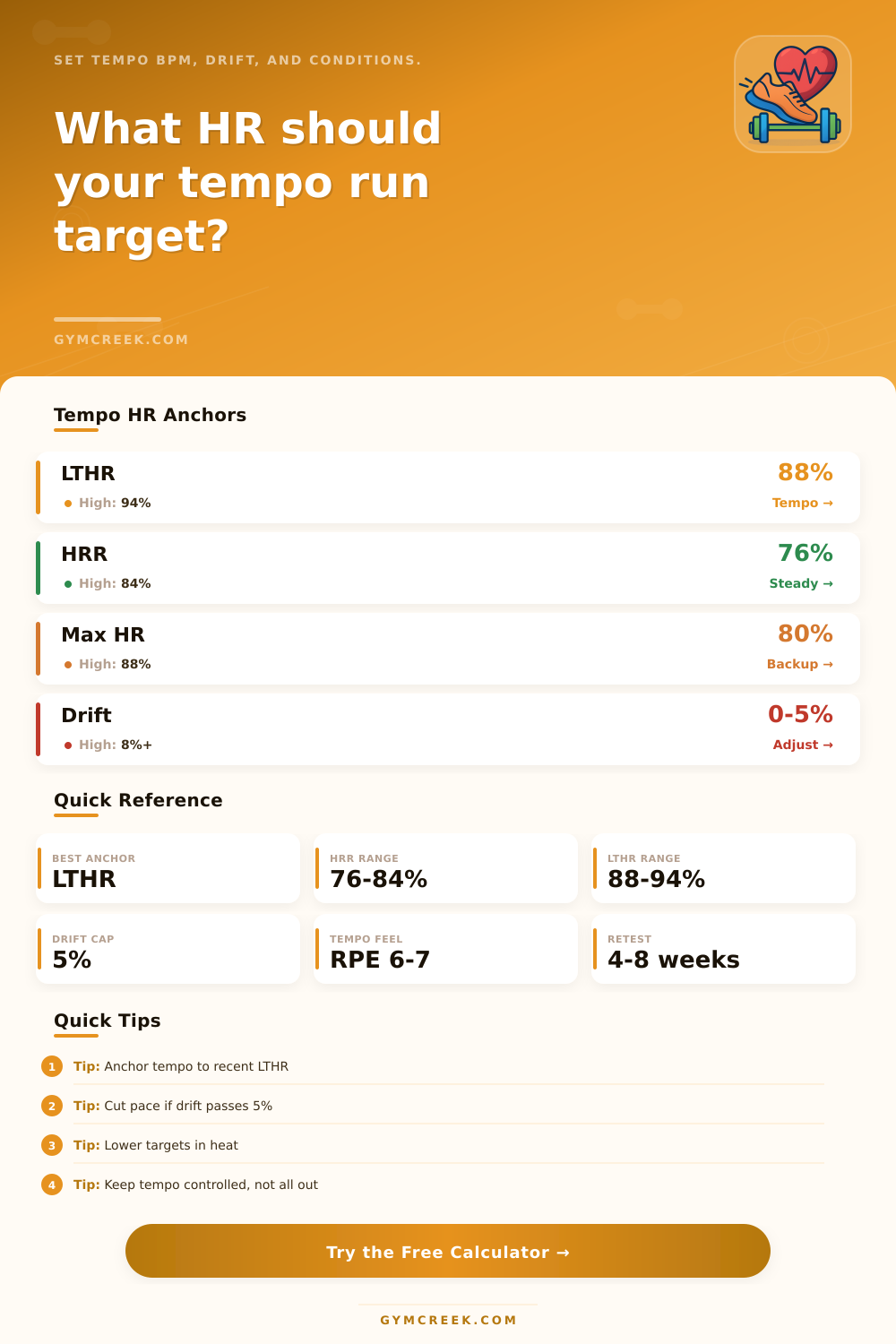
| Lactate threshold HR | 88 to 94% of LTHR | Experienced runners with a threshold test | Retest when fitness changes |
| Heart-rate reserve | 76 to 84% of HRR plus resting HR | Runners with reliable resting HR | Morning stress shifts the zone |
| Max heart rate | 80 to 88% of max HR | Backup when no LTHR exists | Formula max can be very individual |
| Hybrid check | Blend of LTHR and HRR | Comparing two anchors | Use the lower cap in heat |
| Drift | Meaning | Next-session action | Common cause |
|---|---|---|---|
| 0 to 3% | Stable tempo response | Keep the target range | Good pacing and fueling |
| 3 to 5% | Normal late rise | Hold the upper cap | Longer duration or mild heat |
| 5 to 8% | Tempo may be too hot | Start lower or shorten block | Heat, fatigue, or over-pacing |
| 8% plus | Effort likely crossed threshold | Use a recovery or easier tempo day | Dehydration, hills, stress |
| Workout type | Tempo minutes | HR target style | Effort cue |
|---|---|---|---|
| Intro tempo | 10 to 18 minutes | Lower half of tempo zone | RPE 5 to 6, short phrases |
| Continuous tempo | 20 to 35 minutes | Middle of tempo zone | RPE 6 to 7, controlled pressure |
| Cruise intervals | 24 to 45 minutes total | Low to mid tempo with recoveries | Repeatable, never sprinting |
| Long-run tempo | 20 to 50 minutes inside long run | Lower cap, drift controlled | Strong but sustainable |
| Condition | Adjustment | Why it matters | Practical cue |
|---|---|---|---|
| Heat and humidity | Lower cap by 1 to 10 bpm | Cardiovascular strain rises at same pace | Let pace slow before HR spikes |
| Rolling or trail surface | Lower cap by 1 to 5 bpm | Uneven effort causes HR surges | Run by effort uphill |
| Altitude | Lower cap by 3 to 7 bpm | Oxygen stress raises effort | Use a shorter tempo block |
| Fatigue or poor sleep | Lower cap by 2 to 6 bpm | Drift can start earlier | Stop if HR keeps climbing |
💡Tips
Tempo runs are a form of running that exists somewhere between jogging and racing. Many runners, though, perform tempo runs incorrectly due to the lack of a definition of the effort level require for a tempo run. A tempo run starts with a person feeling particularly strong, causing that individual to push harder then they should.
As a result, a person can expect their breathing to be heavy to the point of not being able to speak in full sentences, as well as having their heart rate rise above the targeted level for a tempo run. These incorrect effort cause a feeling of heaviness in the legs the following morning. The problem with tempo runs is not the lack of effort a runner puts into a tempo run, but the lack of clarity on the effort level needed to perform tempo runs correctly.
Find Your Tempo Run Heart Rate
One solution to this problem is the implementation of heart rate into defining the tempo run. By using the heart rate monitor to keep track of tempo runs, an individual can ensure that they remain within target heart rate zone for tempo runs. However, heart rates is not a constant figure.
Heart rates can alter based on the weather, the duration of a run, and other factor. For example, a target heart rate that is correct for an individual in cool weather may be impossible to reach when outside in the sun or after a sleepless night. Thus, a tempo run heart rate calculator must include more than age and a formula for maximum heart rate.
Several inputs are required to create the correct calculation for a tempo run heart rate calculator. One of the most important of these inputs is the resting heart rate of the individual. Another important input is the lactate threshold heart rate.
Lactate threshold heart rates are important because they define the upper limit to the heart rate that an individual can sustain without making the effort too intense for the body. Another necessary input is the heart rate reserve. Heart rate reserve is an indicator of the difference between an individual’s resting and maximum heart rate.
Each of these variable creates a target range for tempo runs. These target ranges are important for enabling runners to maintain control over there tempo runs. Environmental conditions can change the requirement for tempo runs.
For example, warmer climates and humidity increase the workload of the heart at a given pace. Terrain that rolls up and down trails can increase an individual’s heart rate due to the effort required to maintain that terrain. Additionally, both wind and altitude can impact an individual’s tempo runs.
An increase in either wind or altitude can increase the workload on the heart due to the additional energy required to move forward at a given pace. For these reasons, the calculator that determines heart rates for tempo runs must include an adjustment to the upper limit of the target heart rate zone. This adjustment ensures that runners do not push their hearts to rates that may seem good at the time of setting the tempo run, but that may become impossible to maintain with the current environmental condition.
Another factor that impacts a tempo run is the phenomenon known as cardiac drift. Cardiac drift is the decrease in an individual’s resting heart rate while they are still performing their tempo runs. Small amount of cardiac drift are normal while performing tempo runs.
However, if an individual’s heart drifts more than five beats per minute from their initial resting heart rate, then the tempo run was likely too challenging for that individual. Using a calculator for tempo runs allows an individual to estimate the risk of cardiac drift by using the length of the tempo run, the heat of the climate in which they are to run, and their level of fatigue prior to beginning the tempo run. The individual can compare the risk of cardiac drift with the actual heart rate numbers achieve by the individual during their tempo run.
By comparing these two figures, an individual can decide whether or not they need to adjust the target heart rate for their next tempo run. The output of a tempo run heart rate calculator is not a single number, but a range of heart rates. This range includes adjustments for the conditions in which the tempo run is to take place.
In addition to the adjustments for various conditions, the tempo rate calculator also outputs the broader training zones for that individual. These training zones will enable the individual to understand how their tempo run compares to their easy running zones and threshold working zones. Tables are also displayed within the tempo run heart rate calculator.
These tables provide an explanation for the different percentages of drift for tempo runs. Additionally, the tables will provide information on the length of time that an individual should spend performing each tempo run block. Individuals can make mistakes when using tempo run heart rate calculators.
One mistake is to treat the upper number of the calculated heart rate range as a rigid ceiling for that tempo run. If the individual adheres to this ceiling, the tempo run may be too cautious of the heart rate of that individual. Another mistake is to ignore the adjustment for the conditions of the tempo run on days when they feel particularly good.
If an individual chooses to ignore the adjustments, they may feel excessively fatigued after the tempo run. The individual can avoid these two mistakes by treating the upper limit of the calculated heart rate range as a soft limit that should of only be pushed if the individual feels particularly good during their training cycle. One of the main values of utilizing heart rate measurements to calculate the target heart rate for tempo runs is the ability to ensure repeatability in the performance of those tempo runs.
By establishing a target heart rate for tempo runs, an individual will know that they have the ability to make small adjustments during the run to their heart rate. By knowing this, the individual will be able to maintain control of their tempo runs and ensure that they have the capability of perform tempo runs with the same level of effort. Additionally, by establishing a target heart rate, individuals will be able to develop tempo runs that have the same effect and purpose, and that the individual maintains those calculated heart rates throughout their training cycle.