Total Daily Energy Expenditure TDEE Calculator
Estimate maintenance calories from BMR, activity, steps, exercise, thermic effect, and goal adjustments, then compare practical targets for cutting, maintaining, or gaining.
📌TDEE Presets
Presets load realistic TDEE scenarios. You can change any input after loading one.
⚙Calculator Inputs
TDEE snapshot
Enter your stats to estimate maintenance calories, BMR, goal calories, and macro targets.
📊Fitness Metrics Grid
📑Reference Tables
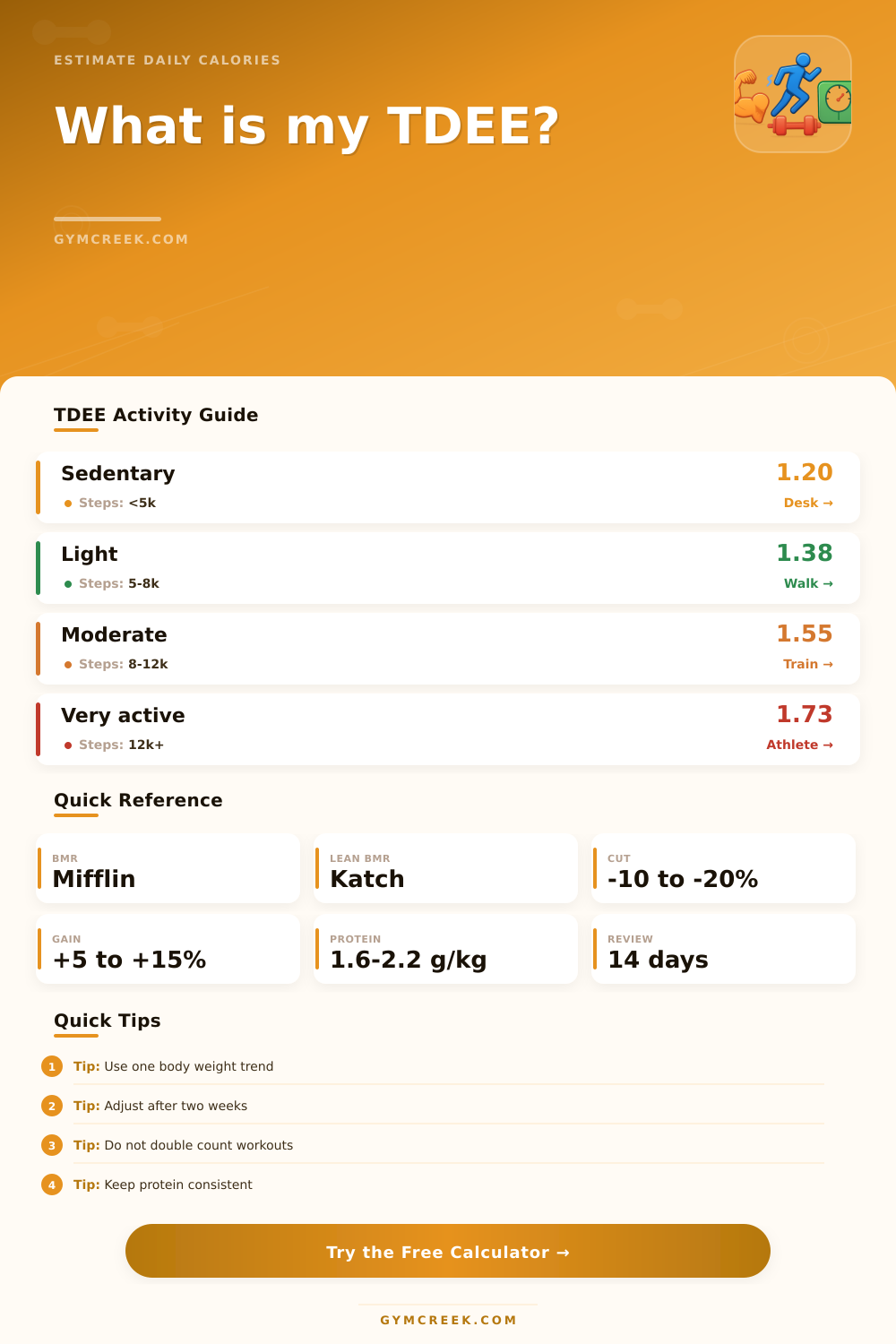
| Level | Multiplier | Typical steps | Best fit |
|---|---|---|---|
| Sedentary | 1.20 | Less than 5,000 | Desk work, little purposeful movement |
| Lightly active | 1.375 | 5,000-8,000 | Some walking or light training |
| Moderately active | 1.55 | 8,000-12,000 | Regular training and daily movement |
| Very active | 1.725 | 12,000-16,000 | Physical job or frequent hard sessions |
| Extra active | 1.90 | 16,000 plus | High-volume athlete or labor-heavy week |
| Goal | Adjustment | Use case | Watch point |
|---|---|---|---|
| Aggressive fat loss | -20% | Short, supervised cut | Recovery and hunger |
| Fat loss | -15% | Common cutting phase | Training performance |
| Slow cut | -10% | Lean or performance-focused cut | Scale changes slowly |
| Maintain | 0% | Weight stability or recomp | Weekly trend |
| Lean gain | +5% | Slow muscle gain | Waist trend |
| Muscle gain | +10% | More growth bias | Fat gain rate |
| Formula | What it estimates | Inputs | When to use |
|---|---|---|---|
| Mifflin-St Jeor | BMR | Weight, height, age, sex | Default adult estimate |
| Katch-McArdle | Lean-mass BMR | Lean body mass | When body fat estimate is credible |
| Revised Harris-Benedict | BMR comparison | Weight, height, age, sex | Helpful cross-check |
| Activity multiplier | Daily expenditure | BMR and activity level | Maintenance calorie estimate |
| TEF adjustment | Food digestion cost | Diet calories and TEF % | Context, not precision |
| Macro | Conservative | Common target | Higher target |
|---|---|---|---|
| Protein | 1.2 g/kg | 1.6-2.2 g/kg | 2.4 g/kg |
| Fat | 0.5 g/kg | 0.7-1.0 g/kg | 1.2 g/kg |
| Carbohydrate | Remainder | Training-driven | High-volume sport |
| Fiber context | Track normally | Keep consistent | Avoid sudden swings |
💡Tips
Your TDEE is not a fixed number, it’s a changing estimate, and therefore something you should think of as such. It adjust according to your method of tracking food, your metabolism, and how active you are during the day. A mathematical equation calculate that figure, and the calculator will do the heavy lifting for you. However, it helps to understand what goes into it since that’s where people gets confused.
Your starting point is your basal metabolic rate: the amount of energy expended by your body at rest, during sleep, maintaining vital bodily functions. That’s affected by both your body weight and dimensions, like height and sex and age, but it’s also very dependent on amount of lean mass carried around. If you have a good estimate of your body fat, the tool use the Katch-McArdle formula. This formula look specifically at metabolically active tissue. That gives you a clearer picture different than traditional equations, since that’s what you’re trying to lose if your goal is to shed fat without dropping muscle.
How to Use Your TDEE Number
The single largest mistake newbies make when using BMR calculators is their selection of activity multipliers. They vastly underestimate their level of physical activity and default to a moderately active label even though they sits at a desk all day. To see if your reported activity level matches reality, use the link on this page to go to reference table that connects step counts to activity levels. So if you average five thousand steps per day and pick a very active multiplier, it’s going to skew the results so high that you’ll end up disappointed.
A better approach is to accurately assess your starting point and leave work to the calculator. Track workout calories as separate from this base figure (if you choose) and then apply those as an additional number, but don’t double-count. Using a high activity multiplier and logging intense exercise will inflate your numbers far beyond what is needed to support gains or cuts.
Strategy starts with goal adjustment after getting a maintenance number. For most people, a 10% deficit works well. It is not so restrictive that it stalls your metabolism and slows down weight loss. However, it is not so loose that you won’t see consistent progress while still feeling satisfied with your meals. Going crazy-aggressively negative may seem like a good idea at first glance, but the reality is that compliance fall apart within a few weeks when you’re constantly craving food. Conversely, if your goal is to gain muscle, a mild surplus helps aid recovery without piling on unnecessary amounts of bodyfat that you’ll need to burn off eventually anyway.
These targets for macronutrients provides guidelines for reaching those calorie goals while still supplying enough of each nutrient. Maintaining a relatively fixed protein level of ~1.6-2.2g/kg help to keep lean tissue during both surplus and deficit conditions, making tracking bodyweight fluctuations significantly easier.
Consistent tracking is always better than perfect accuracy. It doesn’t matter if you weigh out each gram of food to get results. It does matter if you are consistently trending above or below your target over two weeks. When you’ve been tracking diligently for a couple of weeks and the scale isn’t budging, chances are good that your actual TDEE is either higher or lower then what was initially estimated. A small change based off an observation of the trend is infinitely better than a drastic shift based solely on a one-time weigh-in. Remember, your body adjusts to new inputs; so be patient. This is part of the process.
The tool provides a science-based starting place, but your own experiences with it will hone that number into something accurate and personal. Trust the trend, not the daily noise. But that’s only getting you to the starting line. You have to pay attention to what your body tells you along the way (adjust accordingly), while keeping your eye on the long game. Any particular Tuesday, the scale can lie. But if you provide it with enough information, it won’t lie very often about which direction you’re headed. Let your performance and energy levels be your guide; make tweaks upward or downward accordingly.
Begin with some realistic expectations and honest inputs, and everything else should of fall into place from there.