Tap Dancing Calorie Calculator
Estimate tap dancing calories from shuffle and flap cadence, combo duration, across-floor travel, class versus performance setting, rest ratio, shoes, surface, and adjusted MET logic.
📌Presets
Each preset loads a realistic tap session and recalculates from cadence, travel, combo density, rest, shoe and floor factor, and format-specific MET adjustments.
⚙Calculator
Tap dancing calorie snapshot
Enter tap cadence, combo density, rest, travel, and surface settings to estimate session calories.
📊Fitness Metrics
🧮Formula Cards
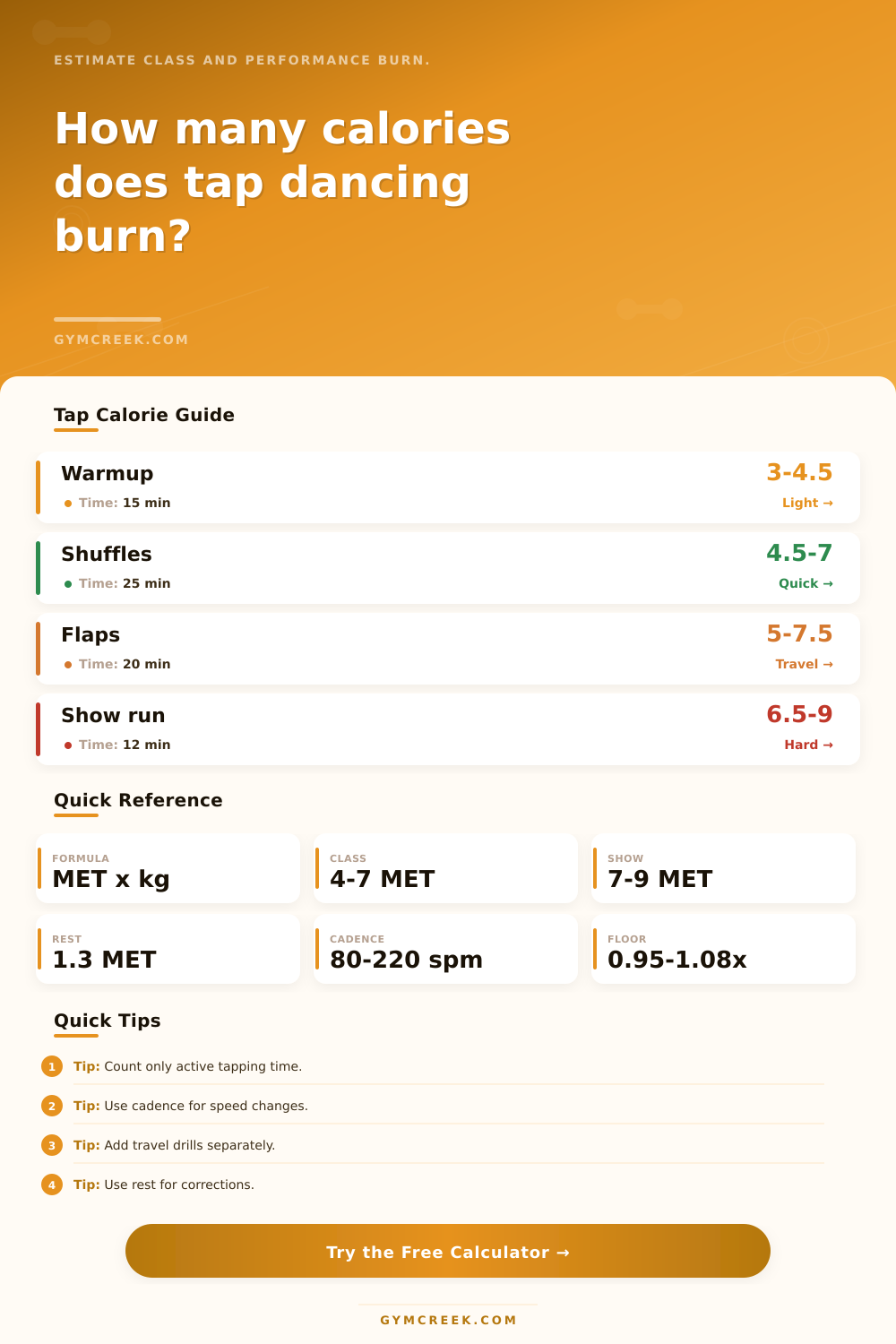
Calories per minute = MET x 3.5 x body weight in kg / 200. Tap blocks use separate adjusted MET values for shuffles, flaps, across-floor work, combo runs, and rest.
Shuffle and flap sounds per minute change intensity. Faster rhythms raise the modifier, while slower marking or soft-shoe practice lowers the effective MET.
Combo duration, run count, repetitions, and across-floor minutes estimate how much of the session is repeated full-body work instead of stationary drilling.
Mifflin-St Jeor estimates BMR from age, body size, and gender. Activity level then estimates TDEE so the tap session can be compared with the full day.
📑Reference Tables
| Tap Block | Lower MET | Typical MET | Hard MET |
|---|---|---|---|
| Warm-up walks | 3.0 | 3.8 | 4.6 |
| Shuffle and riff drills | 4.2 | 5.4 | 6.8 |
| Flaps and time steps | 4.8 | 6.1 | 7.4 |
| Across-floor passes | 5.8 | 7.0 | 8.4 |
| Show or audition run | 6.5 | 7.8 | 9.2 |
| Cadence Zone | Sounds/Min | Modifier | Use Case |
|---|---|---|---|
| Marking | 40 to 80 | 0.88x | Learning |
| Moderate | 81 to 140 | 1.00x | Class pace |
| Fast | 141 to 200 | 1.10x | Clean runs |
| Very fast | 201 plus | 1.18x | Show work |
| Surface Setting | Factor | Best Use | Load Note |
|---|---|---|---|
| Sprung wood | 0.95x | Class | Lower impact |
| Tap on wood | 1.00x | Studio | Baseline |
| Heavy shoes | 1.03x | Drills | More leg work |
| Hard floor | 1.05x | Rehearsal | Less spring |
| Stage overlay | 1.08x | Show run | Higher demand |
| Formula | Variables | Output | When Used |
|---|---|---|---|
| MET kcal | MET, kg, min | Calories | Main burn |
| Cadence | spm | Modifier | Speed load |
| Density | Runs, reps | Factor | Combos |
| TDEE share | kcal, TDEE | Percent | Daily view |
💡Tips
An hour of tap dance practice leaves me with a different kind of tired than I get from sprinting a mile. It’s a heavy, localized pain in my calves and shins, not the out-of-breath kind of tired where you can’t move another step. It’s the achy kind of tired: the soreness from thousands upon thousands of precise little impact on a wooden floor. You might as well of just run a marathon.
But it was only an hour on the clock. And calorie counts aren’t realy designed to make sense of this disconnect. That’s where the calculator step in. By converting repetition and rhythm into numbers (metabolic equivalents), it helps translate all this invisible effort into something we can grasp.
How Tap Dancing Burns Calories
Tap is underrated. Most folks think that if they’re not moving, they aren’t exercising. But your muscle are firing constantly to absorb impact and generate sound. That’s why the tool differentiates between traveling flaps and shuffle drills.
Shuffles is precision work. It’s an isometric contraction of the ankle and rapid movements that keep your heart rate up. Flaps and time steps is all about directional travel. It fires up larger muscle group and cranks up the intensity.
Your cadence is the amount you input into the app that tells the algorithm how hard your body need to work to maintain the beat. A full-out performance run will burn more calories than a slow marking pace. The math show how much effort you put in, not just how much time passes.
Rest is another factor that disrupts estimation. During an average dance class, you’ll spend a good bit of time drinking water, listening to notes and waiting for your turn. All this down time adds time but not calories. When calculating, don’t add in your quiet time as active dancing time or your overall caloric count will be inflated. Enter the rest ratio into the calculator. That’s the amount of time spent marking lightly or otherwise standing still. (Note: This tweak is essential because it gives you the true output for effort used, not just for the length of time.)
Check out the reference tables on the page and see how various activities compare with one another. A gentle stretch falls on the lower end of the spectrum; a show run, on the upper edge. Use these categories to read your data, so you’re not expecting a sprint when what you got was a gentle stretch.
Your shoes is different than mine. The surface is different too. The dance floor is sprung which will absorb some of that energy. Your legs don’t have to work as hard to give back what was taken out. If you’re dancing on a stage with a marley overlay or a really hard floor then this shifts things. There’s a factor for this in the calculator. It take into account that slight change in demand. Small detail, but it does add up if you’re doing a long session. You don’t have to go around measuring the elasticity of wood yourself. Just choose the right setting and the estimate will match your own experience.
Average intensity: Burned during the session. Active Calories: A breakdown of your burn alongside average intensity. This is a helpful snapshot. It is a snapshot that provides context. How does tap fit into your overall calorie expenditure? For those who track their fitness this can help inform how to structure their week.
Knowing that one hour of rhythm tap burns roughly as much as a moderate jog helps put things in perspective. It’s also a sign of how efficient this art form is. Not only do you learn music and coordination but it’s a great cardiovascular workout. That’s the secret payoff. The calories are just the extra benefit of understanding the beat.
The calculator is also a translation device: it changes the abstract labor of dancing into something you can measure. No, you don’t need to be a scientist to get the skinny on your body. All you need are the correct inputs. Plug in your stats (age, weight, details about the class) and let the machine do its thing.
Don’t expect these numbers to be perfect; they’re approximations at best. But they’ll provide enough information to help make an informed decision. Whether you’re training to stay fit or you’re preparing for an audition, knowing what your body’s actualy up to will help you train smarter.
Next time you experience that post-class ache, you’ll know exactly what you’re feeling. And it wasn’t just the music. It was the work.