Tai Chi Calorie Calculator
Estimate calories burned from tai chi form style, stance depth, flow duration, repetitions, balance drills, rest and breathing pace, and adjusted MET logic.
📌Presets
Each preset loads a realistic tai chi session and recalculates burn from moving form, stance holds, balance drills, breathing rest, repeats, and depth.
⚙Calculator
Tai chi calorie snapshot
Enter style, stance depth, flow time, repeats, balance drills, and rest pace to estimate calories.
📊Practice Metrics
🧮Formula Cards
Calories per minute = MET x 3.5 x body weight in kg / 200. The calculator applies this separately to form flow, stance drills, balance drills, and rest.
Flow, stance, balance, and rest percentages are converted into minutes. If the percentages do not equal 100, the calculator normalizes the practice blocks.
Low stances, repeated forms, and longer balance holds raise the adjusted MET, while high stances and learning pace keep the estimate conservative.
Mifflin-St Jeor estimates BMR from age, size, and gender, then activity level estimates TDEE so the session can be compared with daily energy use.
📑Reference Tables
| Tai Chi Block | Gentle MET | Typical MET | Hard MET |
|---|---|---|---|
| Breathing and qigong | 1.8 | 2.3 | 2.9 |
| Yang short form | 2.5 | 3.0 | 3.6 |
| Yang long form | 2.7 | 3.3 | 4.0 |
| Chen mixed tempo | 3.0 | 3.8 | 4.8 |
| Weapon form | 3.2 | 3.9 | 4.6 |
| Stance Depth | Modifier | Best Use | Load Note |
|---|---|---|---|
| High stance | 0.92x | Beginners | Easy knees |
| Medium stance | 1.00x | Class flow | Balanced |
| Low stance | 1.12x | Strength | More demand |
| Very low | 1.20x | Testing | Hard legs |
| Rest Pace | Rest MET | Use Case | Estimate Note |
|---|---|---|---|
| Meditative | 1.15 | Slow breath | Lowest |
| Easy breaks | 1.25 | Class pauses | Normal |
| Active recovery | 1.45 | Standing | Moderate |
| Walk-back reset | 1.70 | Group drills | Higher |
| Formula | Variables | Output | When Used |
|---|---|---|---|
| MET kcal | MET, kg, min | Calories | Main burn |
| Split norm | Block % | Minutes | Practice mix |
| Repeat load | Forms, drills | Factor | Density |
| TDEE share | kcal, TDEE | Percent | Daily view |
💡Tips
Most people don’t think that lightly moving burns many calories. Imagine yourself doing tai chi: It looks like a slow-motion dance; you just gently move through the poses, barely sweating. That is half correct.
Yes, those moves are both controlled and fluid, but the internal effort is rigorous. There’s an isometric engagement of your muscles for balance. Every change in weight require core stabilization. While the calorie expenditure is very real, it’s also hidden beneath the tranquil appearance. There’s no heavy lifting or visible impact, so most people underestimate the amount of energy expended in these standing posture.
Why Tai Chi Burns More Calories Than You Think
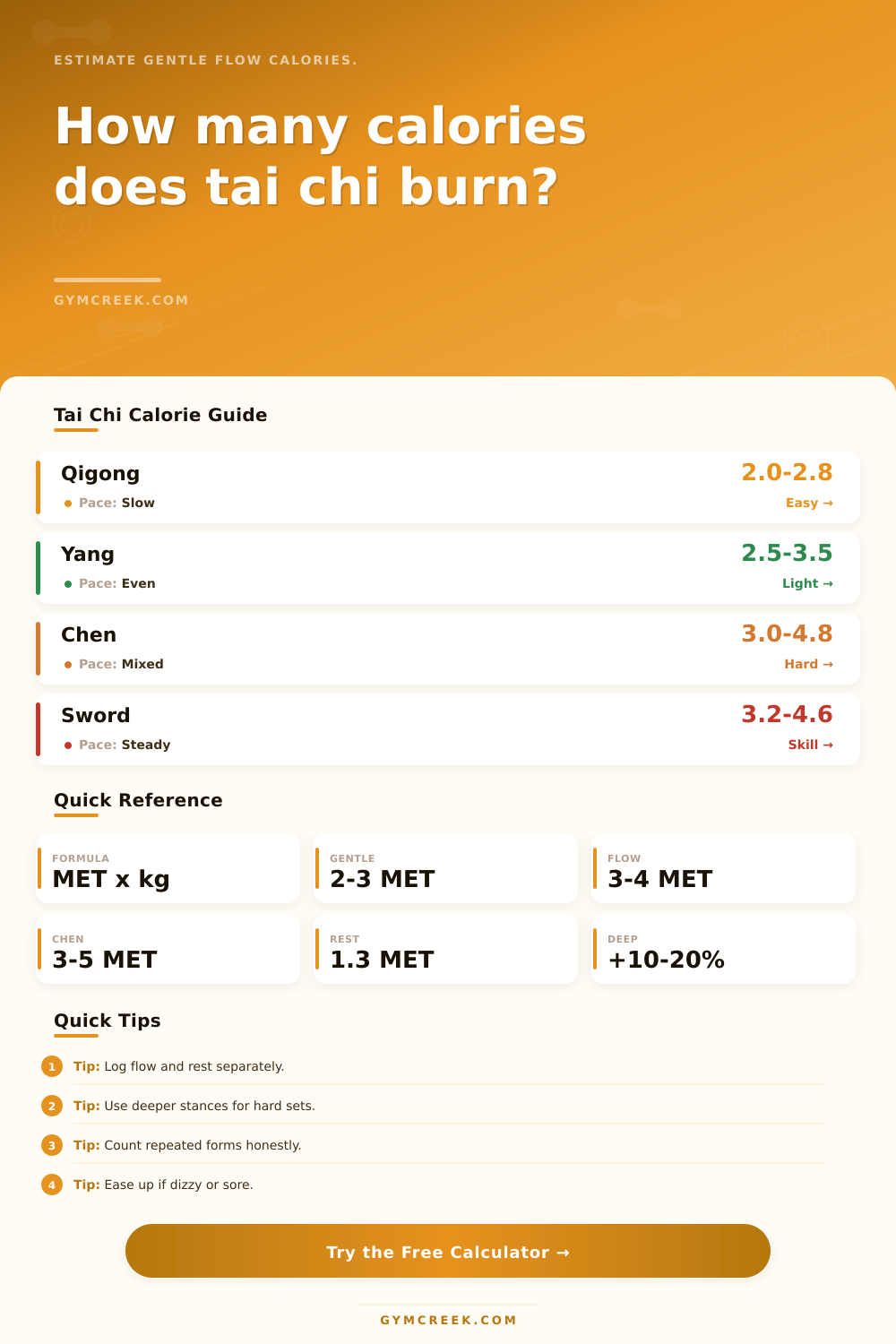
It will also adjust based on what type of tai chi or qigong practice you engage in; there’s a huge difference metabolically between practicing a deeper stance form (like Chen style) versus a higher stance one (like qigong). Beginner mobility and recovery are common reasons people turn to qigong. It’s light. Metabolic equivalent stays low. Then with Chen style we introduce the mix of deep knee bends plus bursts of explosive power. That’s when the intensity increases significanty. The tool adjusts to match these differences so you don’t have to guess which category your practice fits into.
Perhaps the most misunderstood variable in that equation is stance depth. That’s because you can do the same form on three different levels. A high stance is low effort with soft knees. It is accessible. A low stance makes the whole thing a leg strength challenge. The deeper you go the more muscle fibers your body recruits to hold you up. It is not simply a question of fitness but one of structural integrity.
The calculator has a modifier for level of your stance. Drop yourself down into a low stance and it will estimate a higher burn as a result. Makes sense. You’re holding a heavy load against gravity so it takes energy. The deeper the load, the higher the cost.
Volume means repetition is important. While some people do forms one time, maybe two, then consider their practice done. This is great for learning. It is not so much for conditioning. Repeat a form four times and the body starts feeling the build-up in terms of muscles and heart rates. Enter the number of repetitions and the tool adjusts the entire burn based on that repetition. So be honest! Don’t hesitate with your entry here.
Did you practice for an hour but only go through the motions twice? The burn will reflect your less-intense session. You drilled the same five moves for twenty minutes? Yeah, the burn goes up.
Then there’s a bit more with balance drills. Slowly moving weight onto one foot while standing on that leg doesn’t seem like it’d be difficult. But it is. You’re using tiny movements all the time, your stabilizer muscles firing to prevent you from falling over. That little motion burns through glucose. Here’s where the table on the page makes it clear. There’s a metabolic profile for single-leg transitions, for example. A slow shift in weight between legs has its own profile. And they aren’t as simple as walking steps. You’ve got to do them precisely.
The calculator sets those apart from the rest of flow time, which allows you to distinguish just how much of your burn is due to dynamic movement versus static control. That includes rest, too. Yes, I said rest. You may be surprised by this, but how fast do you recover? Do you want a meditation session to have a high metabolic rate? Of course not. Do you want it high while you’re actively recovering (e.g., walking between sets)? Sure. This tool will even out those chunks for you. Resting for ten percent of your session? That counts. But with a lower multiplier. Why? So you don’t overestimate your burn and the result remains realistic.
And it’s rounded out with the other part of the equation: context on a daily basis. Your basal metabolic rate (the amount of calories you burn at rest) is estimated. Then how much of that total does this workout represent? You’re not burning calories in a vacuum. You’re incorporating movement into your life. Tai chi is sustainable because you can do it every day. This makes it something you can make a habit of. Sure, maybe not as many calories burned than sprinting, but over time it all adds up. You reduce your stress levels. You keep your joints healthy. The calorie number isn’t everything. The long-term impact of the exercise is where the true advantage comes in.
Begin with the appropriate preset based off skill level. If you dive into deeper stances, change the stance depth. Enter a realistic repeat count. Trust the digits. Don’t expect maximum burn at any cost. The goal is to understand the tradeoff between intensity and sustainability.
Tai chi requires precision. Tai chi encourages patience. Tai chi builds resilience. Whatever energy you invest in practice stores up inside your body as stamina for the long run. Maintain the breath rhythm. Maintain the stance depth (if possible). Results will come.