Tabata Calories Burned Calculator
Estimate gross calories, net interval calories, work density, recovery burn, EPOC, and weekly Tabata volume from body weight, interval structure, exercise mode, and effort.
📌Tabata Presets
Presets load realistic interval structures, exercise MET values, between-protocol rests, and intensity levels, then calculate immediately.
⚙Interval Inputs
Tabata session snapshot
Enter your interval structure, exercise mode, and body weight to estimate session burn.
📊Tabata Metrics Grid
📑Reference Tables
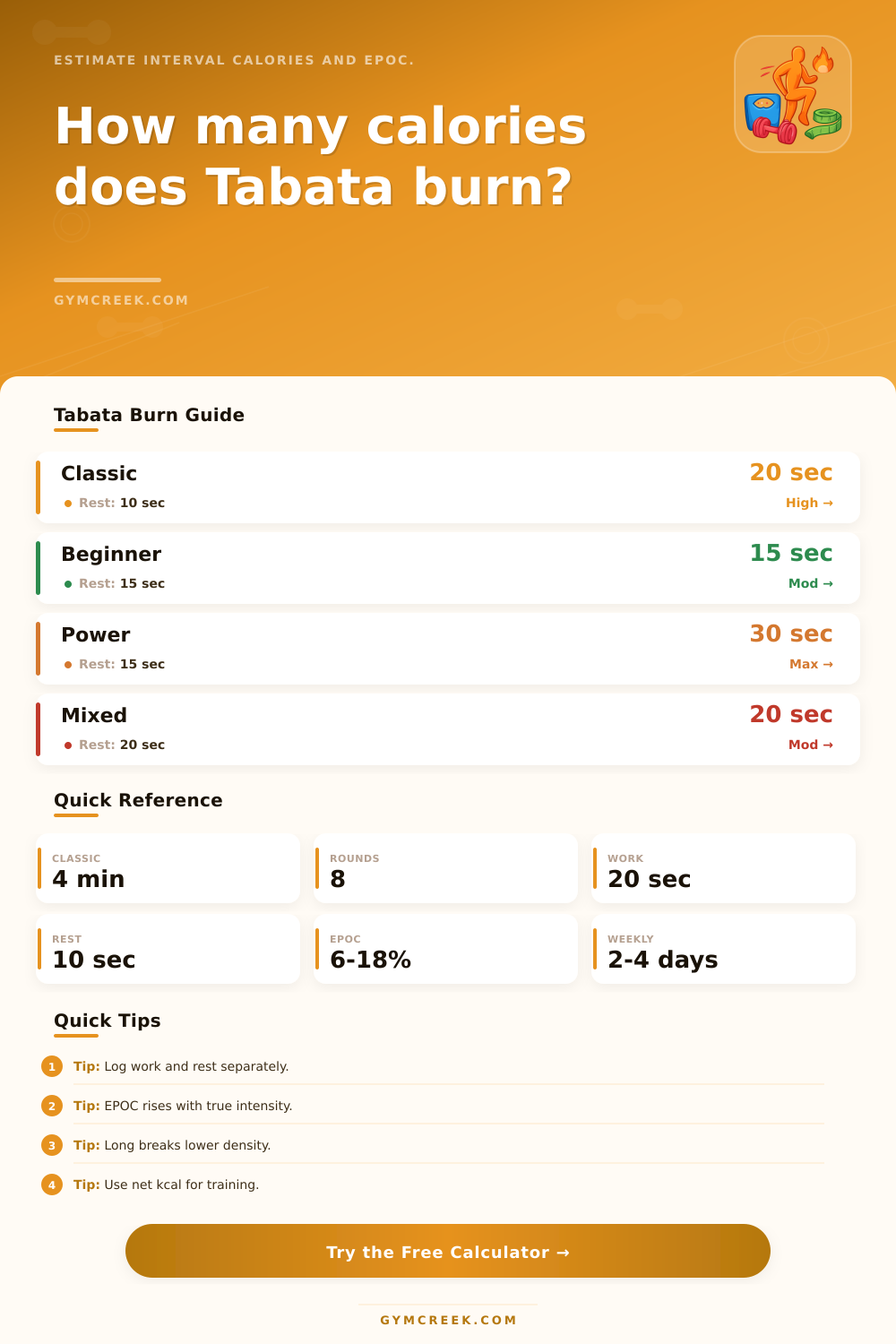
| Format | Work | Rest | Use |
|---|---|---|---|
| Classic Tabata | 20 sec | 10 sec | High density |
| Beginner HIIT | 15 sec | 15 sec | Skill practice |
| Power intervals | 30 sec | 15 sec | Conditioning |
| Low impact | 20 sec | 20 sec | Joint friendly |
| Class circuit | 20 sec | 10 sec | Multiple blocks |
| Exercise Mode | Base MET | Energy Demand | Best Fit |
|---|---|---|---|
| Stationary bike sprint | 12.0 | Very high | Classic testing |
| Rower sprint | 11.5 | Very high | Total body |
| Run or air runner | 13.0 | Maximal | Advanced users |
| Bodyweight circuit | 9.5 | High | Home sessions |
| Kettlebell complex | 10.5 | High | Strength endurance |
| Battle ropes | 10.0 | High | Upper-body bias |
| Step or low impact | 7.2 | Moderate | Lower impact |
| Mixed gym circuit | 9.0 | Moderate-high | Group class |
| Formula | Variables | Use | Output |
|---|---|---|---|
| Work kcal | MET x kg x hr | Hard intervals | Calories |
| Recovery kcal | Rest MET x kg x hr | Short rests | Calories |
| Net kcal | (MET - 1) x kg x hr | Above rest | Calories |
| EPOC | Base kcal x rate | Afterburn | Calories |
| Density | Work / rounds | Pacing | Percent |
| Density Band | Work Share | Common Feel | EPOC Range |
|---|---|---|---|
| Easy intervals | 35-45% | Controlled | 4-8% |
| Classic density | 60-70% | Very hard | 8-14% |
| Power density | 65-75% | Near max | 10-16% |
| Stacked blocks | 55-70% | Fatiguing | 12-18% |
| Recovery format | 40-55% | Manageable | 5-10% |
💡Tips
Tabata’s method is straightforward, but it take some serious doing. Eight intervals of twenty seconds on, ten seconds off equals four minutes, enough time to boil some water or fit between two commercials.
But few realize what happens inside our bodies while we’re doing those workouts (and afterward), and many treat those four minutes as a magic bullet for fat loss. They don’t know how much of this is true; most of them use a crappy heart-rate monitor on a smartwatch that doesn’t register when your heart rate change quickly. So no, you don’t know.
Understanding How Tabata Works
The formula above handles the heavy lifting by separating gross session calories from net interval burn. That allows you to get more clarity on what your body can handle. It factors in warmup, the work, the rest period, and even the after-burn effect called EPOC.
There’s one other crucial number here that many forget: work density. While total workout time matters, density describes the amount of time spent working (hard) compared to the amount of time spent not working (resting). For traditional Tabata, you work for 20 seconds out of every 30-second cycle, which means you’re working for sixty-six percent of the time. But when your muscles gets tired and you start extending your rest time to preserve proper form, your density goes down. You’ll recover more. Your body won’t need to process as much. You may even feel like you’ve done something worthwhile at the end since you made it through the clock. But the bodily challenge will be very different than expected.
The calculator on this page allow you to play with these factors and see precisely what happens when you drop your rest from ten-seconds to twenty-seconds, how it affects your load score and calorie burn. It shows how two equally long workouts can have different effects on your performance goals.
Finally, the nature of your recovery also plays a role. Active recovery (such as walking around) maintains your heart rate at a higher level and helps keep blood moving to flush out lactate. Passive recovery mean standing there allowing your heart rate to decrease before resuming another round. How you recover directly impacts how much burn you feel during your session. It also affects how long you can maintain maximum intensity through successive protocols.
You could stack two rounds of Tabata back-to-back without resting more than a minute between sessions; while the perceived effort feels double that of one single round, this isn’t simply a mental game. Increased metabolic stress drive up the EPOC estimate. The afterburn effect exists, but it correlates directly to actual work you’ve done and not necessarily the label assigned to the workout name.
The other wrinkle: Different exercises require different energy systems. Because of this, different types of workouts demand different exercise modes. For example, just because you’re pushing 160 bpm on the bike doesn’t mean you’re working the same muscles as when you swing a kettlebell. You can check out the base MET values for each activity (and get an idea of how your heart rate corresponds to those values) on the tool’s reference table, which shows why your rowing sprint burns twice as many calories per minute as a low-impact step class. Does that make either exercise “better”? Not necessarily. They are just different.
If you’re strictly looking to condition your heart, perhaps the rower or bike are best. If you’re seeking a combination of strength endurance with a metabolic kick, then the kettlebell complex will give you more carryover into everyday functional movement. Knowing this avoids the temptation of going through the motions and burning calories at the cost of exercise quality.
For example: A lot of folks wrongly believe the more rounds, the better. If they should of done eight rounds max for their true maximal efforts, they go for fourteen. In truth, there’s a huge gap between an RPE 8 and an RPE 10 in both hormone response and neural drive. Beyond that, once your form starts breaking down, you’re not actualy training speed or power anymore, you’re simply grinding out reps with subpar mechanics. Most people fail to grasp that point. To them, suffering equals effective.
The calculator helps you put that into perspective because it allows you to see how each additional protocol boost your overall load and likely burn per week. It prompts you to consider recovery days as well as sustainability instead of simply cranking up the volume until you break yourself down.
To conclude, Tabata is not torture. It’s an incredibly efficient training device that deserves our respect because it does pack a punch. You should never coast through those twenty seconds of hard work. You also cannot get away with skipping proper recovery time between sessions or nutrition needed to adequately prepare your body for this type of strenuous activity. If done right, with precision and with adjustments made according to where you’re at physically (modifying the rest periods and exercises accordingly), those four minutes are a mighty spark for change.
Your body will feel the complete picture and while the numbers give us some insight into that experience, let the stats help inform, rather than substitute, your intuition. Ultimately, the most effective workout is the one you’ll do regularly and come back from feeling fresh, able to breathe deep and meet the next round with open eyes.