Tabata Calculator
Plan a Tabata or interval session from work time, rest time, rounds, sets, exercise intensity, body profile, heart-rate target, and recovery spacing.
📌Tabata Presets
Presets are examples only. Change the work, rest, rounds, set breaks, and MET intensity to match the exact movements you will perform.
⚙Calculator Inputs
Tabata session plan
Enter your interval format to calculate timing, density, calories, and heart-rate targets.
📊Tabata Metrics
📑Reference Tables
| Format | Work | Rest | Best Use |
|---|---|---|---|
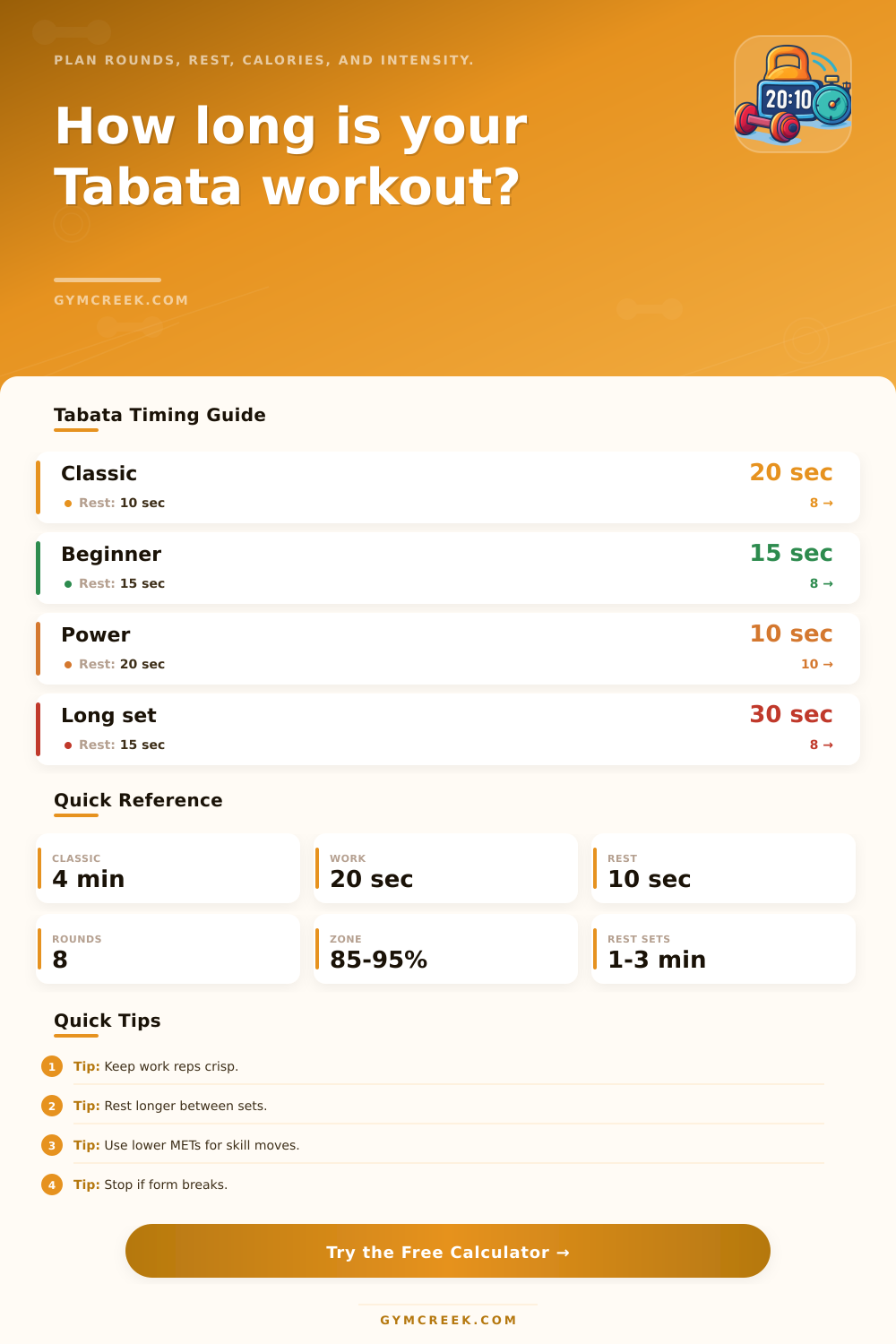
| Classic | 20 sec | 10 sec | Short maximal effort |
| Beginner | 15 sec | 15 sec | Return to training |
| Power | 10 sec | 20 sec | Explosive quality |
| Extended | 30 sec | 15 sec | Conditioning tolerance |
| Low impact | 20 sec | 20 sec | Joint-friendly cardio |
| Exercise | MET Range | Load | Notes |
|---|---|---|---|
| Bike sprint | 10-16 | High | Easy to pace and measure |
| Run sprint | 11-18 | High | Needs warm tissues |
| Row erg | 9-15 | High | Full-body conditioning |
| Bodyweight | 7-12 | Medium | Form limits intensity |
| Low impact | 4-8 | Low | Useful for rebuilding |
| Work Share | Label | Demand | Recovery |
|---|---|---|---|
| Under 40% | Power | Lower fatigue | Shorter sets |
| 40-55% | Balanced | Moderate | Manageable |
| 55-70% | Dense | High | Longer rests |
| 70%+ | Severe | Very high | Use sparingly |
| Classic | 66.7% | High | Short duration |
| Formula | Variables | Output | Use |
|---|---|---|---|
| Calorie burn | MET, kg, min | kcal | Session estimate |
| Mifflin-St Jeor | kg, cm, age | BMR | Daily context |
| Tanaka HRmax | Age | bpm | Target zone |
| Density | Work, total | % | Interval stress |
| Work:rest | Seconds | Ratio | Format comparison |
💡Calculation Tips
The Tabata method is a type of interval training that was created with the intention of making sure that individuals pushes themself to the limits of their aerobic and anaerobic systems. The method requires individuals to perform intervals with such short periods of time in which to push themselfs to exhaustion that they cannot exhaust themselfs too quick during that session. If an individual uses too little effort during the Tabata method, they will not benefit from the increased intensity of the workout; if, however, an individual uses to much effort during the method, they may find themselfs collapsing from exhaustion before they have completed the session.
Researchers developed the method following a study of Olympic speed skaters, whose goal was to increase the strength of their anaerobic and aerobic systems at the same time. As each individual has a different level of strength, endurance, and fitness, though, individuals of all levels can benefit from the Tabata method by scaling there effort to fit their individual needs. The ratio of intervals of work and rest is vital to the method.
How Tabata Works
Twenty seconds of work and ten seconds of rest allow individuals to create such high density of the method; the ten seconds of rest isnt enough time for an individual’s heart rate to drop to a lower value. This drop in heart rate is what creates the concept of an oxygen debt, which force the body to adapt to the stresses that it is experiencing. An individual can use a simple calculator to calculate the time that an individual must work and rest; tracking this variable allows an individual to form a plan for they Tabata training.
A plan that is based off measured data rather than a feeling is more likely to be successful then a plan that is based upon estimations of exertion. An individual’s choice of exercise is crucial to the success of their implementation of the Tabata method. Exercises like sprinting on a bike create different demands upon the body different than exercises like air squats.
Some exercises may place more demand upon the cardiovascular system and other more demand upon the muscular system. MET values can be used to assess the amount of energy that an exercise require. It may be more effective for an individual to use a low-impact exercise to implement the Tabata method, but only if that exercise creates enough of a demand upon the body for the individual heart rate to increase.
Thus, an individual must make sure that their exercise of choice can meet the demands of the method. An individual must focus upon their physical effort while performing the method rather than their focus upon the timer. If an individual begins to break down due to focusing upon the timer, they are no longer performing the Tabata method correct.
In fact, they are performing dangerous repetitions of the exercise instead. The concept of percentage of completion can be used to create a realistic plan for the individual. For example, if an individual knows that their strength and endurance breaks down by the sixth round of the exercise, they should of adjust the percentage of the plan that they create for the method to reflect this knowledge.
Thus, planning for an individual’s ability is better than planning for an effort that cannot be sustained. Individuals should aim to reach specific heart rate targets during their sessions with the Tabata method. For instance, methods like the Tanaka and Fox formula allow individuals to calculate their maximum heart rate.
During a Tabata session, an individual should aim to reach between eighty-five and ninety-five percent of their maximum heart rate. If an individual reaches only seventy percent of their maximum heart rate during performance of the exercise, they are essentially performing steady-state exercise rather than high-intensity interval exercise. High-intensity interval exercise is required for the body to experience the metabolic afterburn.
A proper warm-up is required before performing the method. An individual should not go from a resting state to performing maximal sprints without first warming up their body, as this may result in injuries like a pulled hamstring. An individual can use a tool for incorporating this warm-up into the individuals schedule.
Additionally, an individual needs to allow time for their pH levels to even out in the body after performing the sessions of Tabata method; without allowing the body to replenish its pH, an individual may experience exhaustion after performing the exercise.